8 The Language of Coherence
9 The Language of Coherence
2.1 Opening: The Conversation That Changed Everything
They had been arguing for an hour.
Marcus and Eliana sat on opposite ends of their kitchen table, recycling the same grievances, each convinced the other wasn’t listening. The words had become weapons—precise, defensive, aimed to wound or deflect. They were both right about the facts. They were both completely missing each other.
Then something shifted.
Eliana stopped mid-sentence. She wasn’t sure why. Instead of delivering her next point, she exhaled. She looked at Marcus—really looked at him—and noticed the tension around his eyes, the slight tremor in his hands. She noticed he was scared. And in noticing his fear, she felt her own.
“I don’t want to keep doing this,” she said. Not an accusation. Just truth.
Marcus felt something release in his chest. The argument suddenly seemed less important than this: two people who loved each other, both afraid, both exhausted by the distance between them.
“Me neither,” he said.
What happened next wasn’t dramatic. They didn’t solve the problem. They didn’t even finish discussing the issue. Instead, they sat in silence together. Something had passed between them that wasn’t words. They both felt it—a warmth, a softening, a sense of being seen that no argument could have produced.
When they did speak again, the quality was different. Not because they’d learned a technique, but because something in the space between them had changed.
This chapter is about that space.
2.2 The Missing Dimension
Vertical and Horizontal
Chapter 7 introduced the vertical dimension of consciousness: the 3D/4D/5D model describing your relationship with yourself across dimensions. Mind, Field, and Soul. The architecture of the individual.
But humans don’t exist in isolation. We are relational beings. Consciousness doesn’t just go up and down—it goes across, between, through. Every moment of your life involves exchange with other consciousness nodes: conversations, glances, presences, silences. The space between us is as real as the space within us.
The vertical dimension answers: “Who am I in relation to higher dimensions?”
The horizontal dimension answers: “How do I authentically communicate with other beings?”
This chapter introduces the horizontal framework: the 333 Triad, or the Language/Love Interface. This is how consciousness moves between entities. This is the missing piece that makes individual coherence meaningful in a relational world.
Why Language?
We often think of language as merely instrumental—a tool for transmitting information from one brain to another. Words are symbols, we assume, and communication is a matter of encoding and decoding.
But consider what actually happens when communication works:
When two people are in genuine conversation, their brainwave patterns begin to synchronize1. Their heart rate variability patterns entrain. Their breathing rhythms align. Something is coupling that isn’t captured by the words alone.
Research on infant development shows that language acquisition happens in relationship, not through exposure. Children learn to speak through being spoken to by caregivers who are emotionally attuned, not through hearing recordings. The relational field is not optional for language—it’s constitutive of it.
Across cultures, the words for breath, spirit, and speech interweave. In Greek, pneuma means both breath and spirit; logos means word, reason, and the divine ordering principle. In Hebrew, ruach is breath, wind, and spirit. In Sanskrit, vak (speech) is a goddess, and prana (breath) carries the life force. These languages encoded a truth: speaking is a spiritual act.
Language isn’t just how we transmit information. Language is how consciousness touches consciousness. And when that touch is coherent, we call it love.
Why Love?
“Love” has become a slippery word—overused, sentimentalized, stripped of precision. We need to reclaim it.
In this framework, love is not primarily an emotion. Love is the coherence that makes authentic communication possible. Love is the state in which boundaries become transparent, not dissolved—where two remain two but can genuinely touch.
Think of the difference:
Communication without love is what happens in most of our interactions: information transfer across defended borders. I encode, you decode, neither of us changes. The words may be technically accurate, but nothing real has been exchanged.
Communication with love is what happened between Marcus and Eliana when they stopped arguing. Boundaries softened. Something passed between them that couldn’t be captured in content. Both were changed by the exchange.
HeartMath research shows that when people are in states of appreciation and care, their heart rhythm patterns become coherent, and this coherent field extends several feet from the body2. Others in proximity respond to this field physiologically. Love isn’t just a feeling—it’s a measurable electromagnetic phenomenon.
Love is the carrier wave of authentic communication. Without it, we’re just making sounds at each other.
2.3 The 333 Triad - Expression, Reception, Resonance
The Complete Communication Cycle
All authentic communication involves three phases, three movements, three aspects that together form a complete cycle:
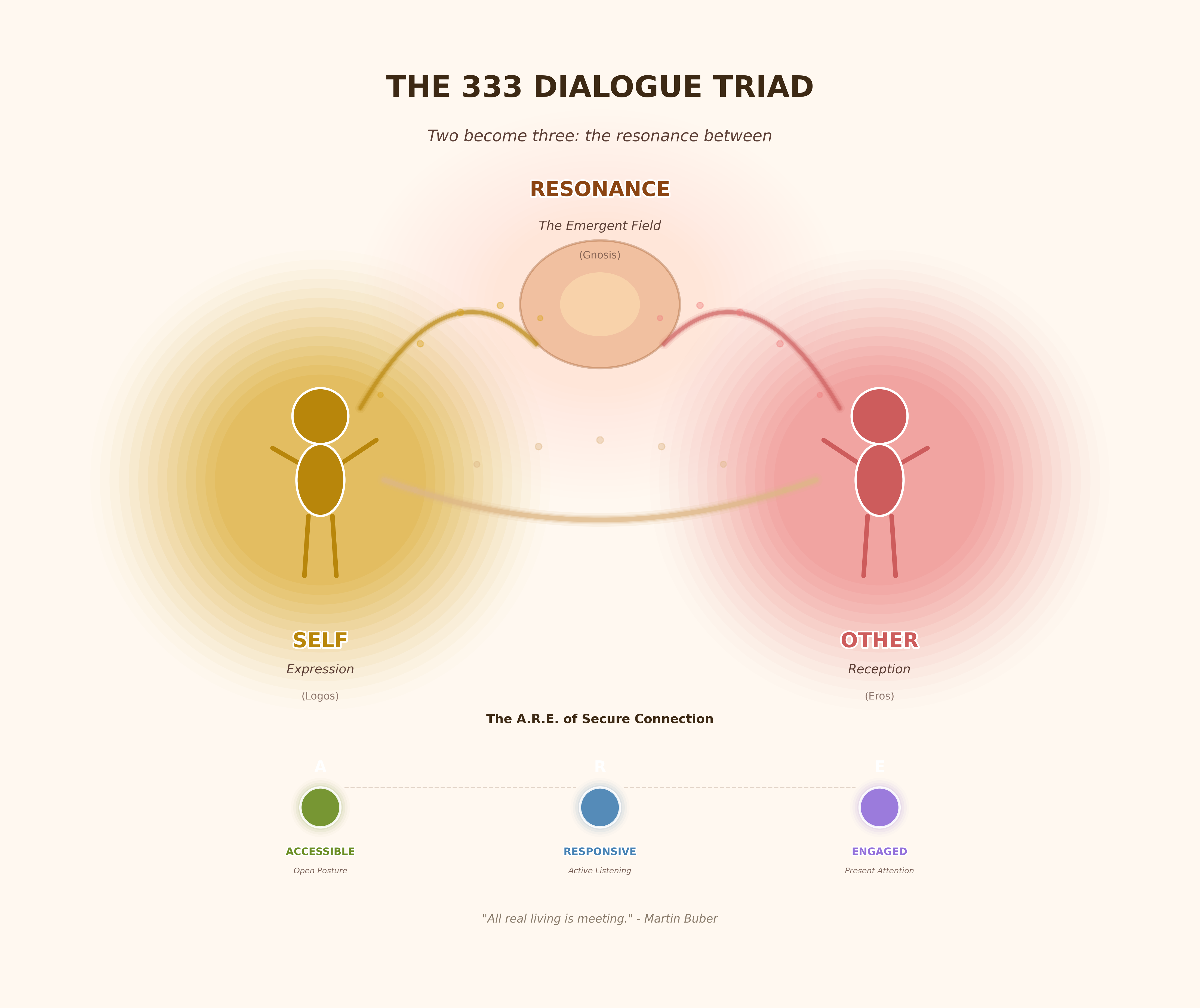
Expression (Logos): Putting truth into form that can be transmitted Reception (Eros): Creating space to receive another’s transmission Resonance (Gnosis): The alive quality that emerges when expression and reception meet
These three aren’t sequential steps so much as simultaneous aspects of complete communication. But we can examine each one separately to understand the whole.
Element 1: Expression / Logos / Voice
Definition: How consciousness puts truth into transmittable form—voice, word, gesture, presence.
The Ancient Understanding
Logos is one of the richest concepts in Western philosophy. Coming from the Greek lego (I say, I gather, I reason), logos encompasses:
- The spoken or written word
- Rational thought and logic
- The ordering principle of the cosmos
- Divine reason or creative intelligence
The opening of the Gospel of John crystallizes this: “In the beginning was the Logos, and the Logos was with God, and the Logos was God.” The creative/communicative principle is here identified with the divine itself. Speech is not merely human—it participates in cosmic creation.
In the Hindu tradition, Vak (speech) is a goddess with four levels:
- Para-vak: Transcendent, pre-linguistic vibration (5D)
- Pashyanti: Visionary, intuitive knowing before words (4D-5D)
- Madhyama: Mental formulation, thought-language (3D-4D)
- Vaikhari: Spoken, manifest speech (3D)
This maps directly onto our dimensional framework: expression originates in the highest dimensions and descends through the levels into physical form. True expression isn’t manufactured—it’s channeled from deeper sources.
The Modern Understanding
Neuroscience reveals expression as a whole-body phenomenon:
- Broca’s area (posterior inferior frontal gyrus): Core speech production
- Motor cortex: Coordinating mouth, tongue, breath for vocalization
- Insula: Integrating emotional significance with expression
- Mirror neurons: Firing both when expressing and when witnessing expression
But perhaps most important: Research shows that up to 60-90% of communicative content is carried non-verbally—through tone, rhythm, gesture, posture, facial expression, and presence. The words are only part of expression; the body speaks too.
HeartMath research demonstrates that the heart generates the largest electromagnetic field in the body—about 60 times stronger than the brain’s field in amplitude, measurable several feet from the body2. When we express from a coherent heart state, we’re not just speaking words; we’re broadcasting a field.
Expression Across Dimensions
3D Expression
Words as symbols. Dictionary definitions, information transfer, propositional content.
4D Expression
Tone and resonance. Emotional coloring, what’s felt beneath words, symbolic meaning.
5D Expression
Transmission beyond words. Presence, recognition, direct gnosis carried through form.
Key insight: Complete expression integrates all three levels. The words (3D) carry emotional truth (4D) from essential presence (5D). When these align, we call it authentic expression—speaking from the whole of yourself.
What blocks expression:
- Fear of judgment (3D concern blocks 4D/5D flow)
- Suppressed emotion (4D blocks create incongruence)
- Disconnection from essence (5D signal lost)
- Speaking from strategy rather than truth
- Words contradicting tone and body
Element 2: Reception / Eros / Listening
Definition: How consciousness creates space to receive another’s transmission—listening, witnessing, welcoming.
The Ancient Understanding
Eros in the Greek tradition means far more than romantic or sexual love. Plato’s Symposium describes Eros as:
- A daimon (intermediary being) between mortal and divine
- The force that draws the soul toward Beauty, Truth, and the Good
- The engine of philosophical ascent
- Neither god nor mortal, but the bridge between them
Eros is the receptive principle that opens us to what is greater. To receive with Eros is to be drawn by what we encounter, transformed by the meeting.
The Hebrew Shema (“Hear, O Israel”) places listening at the center of religious life. Deep listening isn’t passive—it’s the primary spiritual act, the opening through which divine communication enters.
The Chinese principle of Yin embodies receptive power:
- Yielding, soft, dark, feminine
- The valley that receives water
- Strength through receptivity
- “The softest thing in the world overcomes the hardest”
Reception isn’t weakness. It’s a different form of power—the power that allows what is other to enter.
The Modern Understanding
Listening engages vast neural networks:
- Auditory cortex: Processing sound frequencies
- Wernicke’s area: Language comprehension
- Prefrontal cortex: Attention, meaning-making
- Mirror neurons: Simulating the speaker’s experience internally
- Limbic system: Emotional resonance with what’s heard
- Insula: Interoceptive awareness—feeling the impact in one’s own body
Research on social interaction shows that when we truly listen:
- Our brainwave patterns begin to mirror the speaker’s
- Heart rate variability patterns synchronize
- Respiratory rhythms entrain
- Neural activity in the listener’s brain can actually precede the speaker’s, suggesting anticipatory coupling
We don’t just passively receive—we actively co-create through listening.
Polyvagal theory (Stephen Porges) describes the “social engagement system”—a neural circuit that enables receptive, connected presence3:
- Ventral vagal activation creates openness and safety
- Facial muscles and middle ear tune to human voice frequencies
- The capacity to receive is a physiological state, trainable and expandable
Reception Across Dimensions
3D Reception
Literal hearing. Semantic content, words as units, information extraction.
4D Reception
Emotional sensing. Feeling what’s beneath the words, symbolic listening, empathy.
5D Reception
Presence with. Being with beyond words, receiving essence, shared awareness.
Key insight: Deep listening is itself an act of love. To truly receive another is to create a space where they can exist fully. This receiving doesn’t just acknowledge the other—it can transform them through the quality of witness.
What blocks reception:
- Planning your response while the other speaks
- Filtering through judgment or interpretation
- Defending against what might challenge you
- Staying in 3D-only mode (content without feeling)
- Nervous system in survival state (fight/flight/freeze)
Element 3: Resonance / Gnosis / Presence
Definition: The alive quality that emerges when expression and reception meet—the third thing, the space between, the field of genuine meeting.
In a great conversation, resonance might manifest as: sudden laughter neither person was planning, a shared insight that neither possessed alone, or the felt sense of being understood without words. It’s not what you said plus what they said—it’s what emerged between you.
The Ancient Understanding
Gnosis means direct knowing—not belief, not conceptual understanding, but experiential wisdom that transforms.
- Knowledge by acquaintance, not description
- The state of knowing that arises through presence
- In Gnostic traditions: salvific knowledge that liberates
Gnosis cannot be transmitted through words alone. It arises in the meeting, in the space between, through the quality of presence that expression and reception together create.
Multiple traditions name this third element:
- Pneuma (Greek) / Ruach (Hebrew) / Prana (Sanskrit): Spirit, breath, life force—what animates and connects
- Wu Wei (Chinese): Effortless action, flow state, the harmony between doing and not-doing
- Presence in contemplative traditions: Not the absence of activity, but the alive quality that makes activity meaningful
The Modern Understanding
Research on flow states (Csikszentmihalyi) identifies characteristics:
- Action and awareness merge
- Self-consciousness disappears
- Time perception alters
- Intrinsic motivation dominates
These same qualities appear in genuine communication when resonance is present.
Neural synchronization research shows:
- When people genuinely connect, their brainwaves synchronize
- Heart rate variability patterns entrain between close individuals
- Respiratory rates align during rapport
- This synchronization IS resonance at the physiological level
HeartMath research suggests: “When two people are in a caring relationship and at conversational distance, the electromagnetic signal from one person’s heart can affect the other’s brain waves.”2 Resonance may involve literal field coupling between organisms.
Resonance Across Dimensions
3D Resonance
Information match. “We agree on facts,” shared understanding of content.
4D Resonance
Emotional attunement. “We feel each other,” shared emotional field, empathy.
5D Resonance
Presence meeting presence. “We are together,” recognition beyond form, gnosis.
Key insight: Resonance is not something we create—it’s what becomes possible when expression and reception are both coherent. We can’t force it, only invite it. It’s the space in which something new can emerge between beings.
What blocks resonance:
- Rushing past the silence between exchanges
- Treating communication as transaction rather than communion
- One party expressing while the other defends (asymmetry)
- Absence of love (boundaries remaining impermeable)
- Disconnection from presence in either party
When was the last time you felt truly received by another person? Not just heard, but received—your whole being met by their whole being? What made that possible?
2.4 Speaking, Listening, Presence
The Practical Framework
The ancient terms (Logos, Eros, Gnosis) carry depth, but for daily practice, we can translate them into more immediate language:
| Element | Greek | Practice Term | Description |
|---|---|---|---|
| Expression | Logos | Speaking | Voice your truth fully, with body and heart |
| Reception | Eros | Listening | Create space to receive without agenda |
| Resonance | Gnosis | Presence | Rest in the alive quality of meeting |
These aren’t sequential steps but aspects of complete communication that can be cultivated.
Conscious Speaking
What it looks like:
- Speaking from embodied truth, not just ideas
- Allowing voice, posture, and gesture to carry the message naturally
- Including what you think (3D), what you feel (4D), and what you sense is true (5D)
- Pacing that allows space—not filling every gap
- Speaking to the other as thou, not it (Martin Buber’s distinction)
What gets in the way:
- Speaking to control the outcome rather than to express truth
- Editing and filtering to manage others’ perceptions
- Dissociation from body during speech (all head, no heart)
- Speed that overwhelms the listener’s capacity to receive
A practice: Before speaking something important, pause. Take one conscious breath. Feel your feet on the ground, your heart in your chest. Then speak from here, from this present embodied location, rather than from a mental script.
Conscious Listening
What it looks like:
- Full attention without planning your response
- Receiving with the whole body, not just ears
- Feeling the emotional texture beneath the words
- Letting yourself be affected by what you hear
- Pausing before responding—allowing the transmission to land
What gets in the way:
- Preparing your rebuttal while the other speaks
- Listening for something (confirmation, ammunition, error)
- Filtering through judgment before truly receiving
- Physical tension that signals unavailability
- Trying to fix, advise, or respond before simply receiving
A practice: In your next important conversation, commit to waiting three full seconds after the other person finishes speaking before you respond. Use that time to notice what you’re feeling, not what you’re thinking.
Conscious Presence
What it looks like:
- Resting in the space between—not filled with expression or reception, but present to both
- Allowing silence to exist without anxiety
- Noticing what’s arising in the field between you
- Letting the resonance guide what happens next
- Trusting that the most important exchange may happen without words
What gets in the way:
- Impatience with silence
- Urgency to “accomplish” the communication
- Disconnection from your own presence
- Anxiety about intimacy (resonance requires intimacy)
- The habit of treating conversation as transaction
A practice: After an important exchange, before moving on, take three breaths in shared silence. Notice what’s present that wasn’t there before. Let the resonance complete itself.
2.5 The Buber Principle: I-Thou Communication
From Object to Presence
Martin Buber’s I and Thou (1923) articulates one of the most important distinctions in human communication4:
I-It Relationship:
- The other is experienced as object, tool, resource
- Communication is information exchange
- No genuine meeting occurs
- The other is used or analyzed but not met
- Both parties remain fundamentally unchanged
I-Thou Relationship:
- The other is experienced as presence, as Thou
- Meeting transcends subject-object duality
- Both are transformed by the encounter
- The other is not analyzed but beheld
- Something new emerges that neither possessed alone
Buber’s famous line: “All real living is meeting.”
Mapping to the 333 Triad
The distinction maps precisely:
| Communication Type | 333 Triad Status | Quality |
|---|---|---|
| I-It | Expression without Reception (monologue) | Talking at, not with |
| I-It | Reception without Expression (passive consumption) | Taking without engaging |
| I-Thou | Expression + Reception + Resonance | Genuine meeting, both transformed |
Most of our communication is I-It. We’re encoding information, managing impressions, extracting what we need. There’s nothing wrong with this for many interactions—ordering coffee doesn’t require I-Thou depth.
But when I-It becomes our only mode, something essential dies. We become surrounded by objects rather than presences. Loneliness increases even in crowds. The hunger for genuine meeting goes unfed.
Why I-Thou Requires Love
Here’s the connection: I-Thou communication requires love because love is what makes boundaries transparent.
In I-It, I maintain my boundary absolutely. I observe you through my defenses, interact with my representation of you, never touch the actual you. This is safe, but it’s also isolating.
In I-Thou, the boundary softens. Not dissolves—I remain I, you remain you—but becomes permeable. Something of you enters me; something of me reaches you. This is love: the state in which genuine exchange becomes possible.
This isn’t merely philosophical. The HeartMath research on heart-field coupling, the neural synchronization research on genuine conversation, the polyvagal research on social engagement—all describe the physiology of I-Thou meeting[2]3. Love has biological signatures.
Living the Principle
You cannot force I-Thou. You can only create conditions for it:
- Practice the 333 Triad: conscious expression, reception, and presence
- Slow down enough for resonance to arise
- Choose coherence before speaking
- Receive before responding
- Let love be the carrier wave, not just information
2.6 A.R.E. — The Attachment Language of Coherence
The Core Question of Every Heart
I thought I was doing it right.
I was there. I mean, I was physically there. Present. In the room. Available. I answered when she called. I showed up when she asked. I was accessible—my definition of accessible, anyway. Check, check, check.
So when she said, “You’re not really here,” my first response was confusion. “What do you mean? I’m right here. Look—here I am.” I could feel my jaw tightening. My shoulders lifting toward my ears. What more did she want?
“You’re available,” she said. “But you’re not responsive.”
I had no idea what that meant. The difference felt like semantics—some therapist wordplay designed to make me wrong no matter what I did. I was defensive before I even understood what she was pointing at.
It took months. Painful months. Arguments that looped back to the same stuck place. And then one day, mid-conversation, I noticed: I was already planning my response while she was still speaking. My eyes were on her face, but my attention was somewhere else entirely—calculating, defending, preparing. I was there, but I wasn’t there.
That’s when it landed: accessibility without responsiveness is just presence without care. You can be in the room and utterly absent. You can be available and still unreachable. Being responsive means tuning in—actually receiving what’s being transmitted, not just hearing the words while your mind races ahead.
It’s the difference between a door that’s technically unlocked and a door that swings open when someone knocks.
I still catch myself doing it. The old pattern resurfaces under stress—I go “available but not responsive” without noticing. But now I can see it. And seeing is the beginning of changing.
Dr. Sue Johnson, creator of Emotionally Focused Therapy (EFT), has spent over 35 years researching what makes relationships thrive or fail5. Her work, grounded in attachment theory (John Bowlby) and validated through rigorous clinical studies, has identified a single question that underlies every relational rupture and repair:
“Are you there for me?”
This isn’t a question about physical presence. It’s a question about emotional availability, about whether the space between us is safe for vulnerability, about whether my reaching will be met with response.
Johnson articulates this through the A.R.E. framework—three qualities that define secure connection and that map directly onto the 333 Triad:
A.R.E.: Accessibility, Responsiveness, Engagement
ACCESSIBILITY — “Can I reach you?”
- Being available when your partner (or any loved one) needs you
- Not just physically present, but emotionally reachable
- The door is open; the fortress is down
- The opposite: being preoccupied, distracted, unavailable, or emotionally shut behind defenses
In 333 terms: Accessibility is the prerequisite for Reception. Before I can truly receive you, I must be accessible—available, reachable, not defended against your approach.
RESPONSIVENESS — “Will you tune in to me?”
- Actively tuning in to emotional signals
- Offering comfort, validation, and care when distress is communicated
- Responding to the feeling beneath the words
- The opposite: dismissing, minimizing, deflecting, or responding only to content while ignoring emotion
In 333 terms: Responsiveness IS Reception/Eros in action—the capacity to feel what another is transmitting and offer care in return.
ENGAGEMENT — “Will you be present with me?”
- Being fully absorbed in the connection
- Not half-present or going through the motions
- Bringing the whole self into the meeting
- The opposite: emotional absence, dissociation, checking out, being physically there but gone
In 333 terms: Engagement IS Resonance/Gnosis—the alive quality of genuine meeting, the presence that makes the space between sacred.
A.R.E. Mapped to the 333 Triad
| A.R.E. Element | 333 Element | Function | Core Question |
|---|---|---|---|
| Accessibility | Prerequisite to Reception | Creating openness to receive | “Can I reach you?” |
| Responsiveness | Reception/Eros | Tuning in and offering care | “Will you tune in to me?” |
| Engagement | Resonance/Gnosis | Full presence in the meeting | “Will you be present with me?” |
The mapping reveals something important: A.R.E. is the attachment-level embodiment of the 333 Triad. Johnson discovered empirically what the Triad describes metaphysically: authentic connection requires that we be reachable, that we respond with care, and that we remain present.
Why Couples Fight: The Demon Dialogues
Johnson’s research identified three patterns of disconnection—she calls them “demon dialogues”—that emerge when A.R.E. breaks down5:
1. Find the Bad Guy (Blame Cycle)
- Both partners accuse and defend
- Each believes the other is the problem
- Surface content dominates; deeper needs hide
- 333 Translation: Expression without Reception—two monologues, no meeting
2. The Protest Polka (Pursue-Withdraw Pattern)
- One partner pursues, criticizes, demands response
- The other withdraws, shuts down, goes silent
- Johnson’s metaphor: “One is banging on the door, the other is pushing it closed”
- 333 Translation: Asymmetric Expression/Reception—one expresses more, one receives less, resonance collapses
3. Freeze and Flee (Hopeless Withdrawal)
- Both partners give up fighting and check out
- The most dangerous pattern: no one fights for the relationship
- Colored by hopelessness and despair
- 333 Translation: Absence of all three—no expression, no reception, no resonance. The space between has gone dead.
ARE YOU NEEDY? TAKE THE TEST
Do you want your partner to respond when you reach out? (Normal)
Do you prefer consistency and reliability in your relationship? (Normal)
Does distance or silence between you create anxiety? (Normal)
Do you long to be truly known and chosen? (Normal)
Do you feel more settled when you know someone is there for you? (Normal)
None of this is neediness. This is secure attachment forming.
We’ve pathologized the most fundamental human need. Somewhere along the way, wanting connection became “clingy.” Needing reassurance became “insecure.” Reaching for your partner became “too much.”
But here’s what the attachment research actually shows: these needs aren’t weakness. They’re biology. They’re the nervous system doing exactly what millions of years of evolution designed it to do—seeking safety through connection.
The problem isn’t that you need. The problem is that we’ve been shamed for needing.
A.R.E. isn’t about becoming less needy. It’s about having those needs met—and learning to meet them in others.
The Daily A.R.E. Check-In
Before we can practice the full 333 Dialogue (covered in Chapter 10), we can cultivate A.R.E. through a simple daily check:
Ask yourself about your closest relationships:
Accessibility:
- Am I available to my partner/friend/family member when they need me?
- What walls am I putting up? What makes me unreachable?
Responsiveness:
- Do I tune in to their emotional needs, or just the content of their words?
- When they show distress, do I offer comfort or solutions?
Engagement:
- Am I fully present when we’re together, or half-present?
- Do they have my whole attention, or just the part that isn’t on my phone/work/worries?
The A.R.E. question distilled: “Am I there for them?”
2.7 The Triple-Nested Triad
A Note from Tyler: How the Nesting Became Obvious
I spent years confused by a pattern I couldn’t name.
I’d work with someone doing deep individual healing—breathwork, meditation, somatic practices. They’d have genuine breakthroughs. Their nervous system would settle. They’d report feeling more themselves than they had in years.
Then they’d go home to their partner. And nothing changed.
The same cycles. The same arguments. The same withdrawal or pursuit or freeze. All that beautiful individual coherence—dissolved in the first difficult conversation.
So I shifted to couples work. Taught them communication techniques. The 333 Dialogue. Reflective listening. Vulnerability practices. And they’d practice beautifully—in session. But between sessions, one person would arrive dysregulated from work stress, the other would be carrying unprocessed grief, and none of the techniques could bridge that gap.
Individual work wasn’t transferring to relationships. Relationship work wasn’t holding when individual coherence fractured.
It took longer than I’d like to admit for the obvious to land: you can’t skip scales.
You can’t communicate authentically (333) if you’re not individually coherent (1). But individual coherence naturally seeks relational expression (22). And relational coherence participates in something larger than the dyad—collective fields that either support or undermine the work.
The nesting wasn’t theory I invented. It was pattern I finally stopped ignoring. Reality had been teaching me for years. I was just slow to listen.
Three Scales of Coherence
The 333 Triad doesn’t exist in isolation. It’s the outermost ring of a triple-nested structure, each scale containing and transcending the previous:
Scale 1 (1x1x1):      Mind x Field x Soul       (Inner Coherence)
Scale 2 (22x22x22):   Individual x Relational x Collective   (Scale Coherence)
Scale 3 (333x333x333): Expression x Reception x Resonance    (Language/Love Interface)
Scale 1: Inner Coherence (1x1x1)
This is the 3D/4D/5D framework from Chapter 7:
| Element | Dimension | Function |
|---|---|---|
| Mind (1) | 3D / Ego | Thinking, believing, physical action |
| Field (1) | 4D / Subconscious | Feeling, filtering, energetic patterning |
| Soul (1) | 5D / Higher Self | Knowing, being, essential purpose |
Scale 1 question: “Am I internally coherent? Are my thoughts, feelings, and essence aligned?”
This is prerequisite. You cannot authentically communicate with others if you’re not in relationship with yourself. The 3D/4D/5D work comes first.
Scale 2: Scale Coherence (22x22x22)
This describes how individual coherence relates to larger wholes:
| Element | Description | Examples |
|---|---|---|
| Individual (22) | Single node coherence | Personal consciousness, self-work |
| Relational (22) | Dyadic/small group coherence | Partnerships, families, intimate groups |
| Collective (22) | Large group/species coherence | Communities, nations, humanity |
The number 22 is a “Master Number” in numerological systems, representing the Master Builder—practical application of spiritual insight. It signifies the bridge between individual vision and collective manifestation.
HeartMath’s Global Coherence Initiative research and the Maharishi Effect studies suggest measurable effects of group coherence2. When enough individuals cohere, the field shifts for everyone.
Scale 2 question: “How does my coherence relate to larger wholes? Am I coherent in my relationships? What is my relationship to collective consciousness?”
Scale 3: Language/Love Interface (333x333x333)
This is the 333 Triad: Expression, Reception, Resonance. The outermost scale describes how consciousness communicates across all boundaries:
| Element | Greek | Function |
|---|---|---|
| Expression (333) | Logos | Putting truth into transmittable form |
| Reception (333) | Eros | Creating space to receive |
| Resonance (333) | Gnosis | The alive quality of genuine meeting |
The number 333 appears across traditions as the triple trinity—completion amplified, divine communication, the bridge between human and cosmic. The sum (3+3+3=9) represents universal completion.
Scale 3 question: “How do I communicate across boundaries? Is my expression authentic? Am I genuinely receiving? Is resonance present?”
The Nested Relationship
Each scale contains the previous:
- You cannot communicate authentically (333) without relational coherence (22)
- You cannot achieve relational coherence without individual coherence (1)
- But individual coherence naturally seeks expression in relationship
- And relational coherence naturally participates in the larger communication of collective consciousness
The scales are not separate domains but nested aspects of one reality. The cosmic is found in the individual breath. The individual breath participates in cosmic communication.
2.8 The Somatic Triad at the Horizontal Scale
Movement, Stillness, Breath—Between People
The Somatic Triad (Movement/Stillness/Breath) was introduced as an individual practice. But the same principles operate at the horizontal scale, between entities:
| Individual Scale | Inter-Subjective Scale | Description |
|---|---|---|
| Movement | Expression/Logos | The active, projective, form-giving aspect |
| Stillness | Reception/Eros | The receptive, space-creating, listening aspect |
| Breath | Resonance/Gnosis | The aliveness that circulates between beings |
Movement Between Bodies
When two bodies meet, there’s a dance. Gestures echo. Postures mirror or complement. We lean in or lean back. This is the Movement aspect of communication—how physical expression creates and shapes the space between.
Mirror neurons fire both when we perform an action and when we witness another performing it6. We don’t just see movement—we internally simulate it. The other’s movement lives in our body.
What coherent inter-subjective movement looks like:
- Natural mirroring of posture and gesture
- Physical ease and openness toward each other
- Bodies oriented toward each other (not closed or turned away)
- Movement that invites rather than defends
Stillness Between Bodies
Shared stillness is one of the most powerful relational experiences. Two people sitting in silence together, not awkwardly, but peacefully. The quality of collective meditation. The moment after music ends.
This is the Stillness aspect—mutual receptivity, shared space, the willingness to be together without doing anything.
What coherent inter-subjective stillness looks like:
- Silence that feels full rather than empty
- Both parties relaxed, available, present
- No urgency to fill the space
- A quality of mutual witnessing
Breath Between Bodies
Research shows that in close connection, breathing rhythms synchronize7. Partners sleeping together, mothers and infants, deep conversation partners—their respiratory cycles entrain.
This is the Breath aspect—the life force circulating between beings, the invisible link that animates the exchange.
What coherent inter-subjective breath looks like:
- Natural synchronization without forcing it
- Shared rhythm emerging organically
- The sense of breathing together even without explicit practice
- Life flowing between and around both parties
The Practice Implication
When you’re in conversation or connection with someone, you can bring awareness to all three aspects:
- Movement: How are our bodies relating? Open or closed? Mirroring or opposing?
- Stillness: Is there space for silence? Are we both able to receive?
- Breath: Is there life in this exchange? Does something circulate between us?
2.9 Heart Coherence and the Love Frequency
The Heart as Relational Organ
The heart generates the largest electromagnetic field in the body2:
- About 60 times greater in amplitude than brain’s electrical field
- Detectable several feet from the body
- Changes in real-time with emotional states
HeartMath research suggests this field interacts with others’ fields2:
- The heart’s electromagnetic field can be detected in another person’s brainwaves
- People in coherent heart states positively affect others physiologically
- Groups practicing heart coherence together show collective synchronization
This provides a physiological basis for what we’ve always intuited: love isn’t just a feeling—it’s a field phenomenon.
The Physics of Connection
When two people are in heart-coherent states:
- Each heart generates a coherent electromagnetic pattern
- These fields extend beyond the body and overlap
- Where they overlap, entrainment can occur
- Neural and cardiovascular synchronization follows
- This synchronization is experienced as connection, attunement, love
The “love frequency” (528 Hz) has been studied for its effects on stress reduction and coherence. While specific claims require more validation, the research direction suggests that love may have literal frequency signatures.
Cultivating Heart Coherence for Communication
Before important conversations, you can prepare the field:
Heart-Focused Breathing:
- Focus attention on heart area
- Breathe slowly (5 seconds in, 5 seconds out)
- Generate a feeling of appreciation or care
- Maintain for 2-3 minutes
- Enter conversation from this state
This practice reliably increases HRV coherence, which correlates with improved emotional regulation, cognitive function, and social engagement capacity2.
The implication: the quality of your internal state shapes the quality of the relational field. By cultivating your own coherence, you contribute to the coherence available for the exchange.
Interactive 3D Visualization
Explore harmonic ratios and cymatics patterns interactively. Each sphere represents a harmonic interval (1:1, 1:2, 2:3, 3:4, 4:5). Drag to rotate, scroll to zoom.
2.10 Language as Spiritual Practice
Beyond Technique
Everything in this chapter could be reduced to technique: steps for better communication, formulas for connection. But technique alone misses the point.
Authentic communication is a spiritual practice. Not religious in any specific sense, but spiritual in the deepest sense: engaging with the reality that consciousness extends beyond the individual, that we participate in something larger through our speaking and listening, that the space between us is sacred ground.
Every wisdom tradition has practices of sacred speech:
- Mantra (Sanskrit): Repeated sacred sounds that transform consciousness
- Prayer (multiple traditions): Speaking with the divine, listening for response
- Blessing (multiple traditions): Words that invoke and transmit grace
- Silence (contemplative traditions): The speech that transcends speech
These aren’t primitive superstitions. They’re technologies of consciousness, recognition that language participates in the fabric of reality.
The Sacredness of the Space Between
Here’s the secret at the heart of this chapter: the space between us is where something new can be born.
No individual possesses the full truth. Each consciousness has its vantage point, its gifts, its limitations. When we communicate authentically—expressing, receiving, allowing resonance—we create a space that belongs to neither party alone. In that space, understanding can emerge that neither possessed before. Healing can happen that neither could accomplish alone. Love can manifest that exists only in the meeting.
This is why relationship is central to every spiritual tradition. Not just as social obligation, but as ontological necessity. We are not complete in isolation. We discover aspects of reality only through each other. The divine is encountered not only in solitary communion but in the eyes of the other.
What would change if you treated every conversation as potentially sacred—as a space where something new could be born between you and another?
2.11 Chapter Summary: Key Takeaways
Chapter Summary: Key Takeaways
- Communication has three elements: Expression, Reception, and Resonance.
- Expression (Logos): Putting truth into transmittable form
- Reception (Eros): Creating space to receive
- Resonance (Gnosis): The alive quality of genuine meeting
- Love is not separate from language—it’s what makes authentic communication possible.2
- Love is the coherence that makes boundaries transparent
- Communication without love is information transfer, not meeting
- Love has physiological signatures (heart coherence, field coupling, neural synchronization)
- The Triple-Nested Triad integrates individual and collective dimensions.
- Scale 1 (1x1x1): Mind × Field × Soul (Inner Coherence)
- Scale 2 (22x22x22): Individual × Relational × Collective (Scale Coherence)
- Scale 3 (333x333x333): Expression × Reception × Resonance (Language/Love Interface)
- The Somatic Triad operates between people as well as within.
- Movement ↔︎ Expression: How bodies relate in space
- Stillness ↔︎ Reception: Shared quiet, mutual receptivity
- Breath ↔︎ Resonance: Life circulating between beings
- I-Thou communication transcends I-It transaction.4
- I-It: The other as object; information exchange; no transformation
- I-Thou: The other as presence; genuine meeting; both transformed
- The 333 Triad creates conditions for I-Thou
- Heart coherence creates a field for connection.2
- The heart’s electromagnetic field extends beyond the body
- Coherent states affect others physiologically
- Cultivating your coherence contributes to collective coherence
- Language is spiritual practice.
- Speaking and listening participate in the fabric of reality
- The space between us is where something new can be born
- Conscious communication is evolutionary work
In Chapter 11, we’ll explore how sacred geometry provides the visual language of coherence—the shapes that consciousness takes when it organizes itself. The Flower of Life, the Vesica Piscis, the golden ratio—these aren’t just pretty patterns. They’re the language of the universe, visible beneath and within all communication.
The geometry of the space between is as real as the geometry of the world within.