Daily Coherence Practice Suite
Meeting Yourself Where You Are
Introduction: Meeting Yourself Where You Are
“We are what we repeatedly do. Excellence, then, is not an act, but a habit.” — Will Durant (summarizing Aristotle)
“The ordinary arts we practice every day at home are of more importance to the soul than their simplicity might suggest.” — Thomas Moore, Care of the Soul
Life doesn’t always offer forty-day windows. Some days give you five minutes. Others offer an hour. Some mornings you wake ready to expand; other evenings you crawl home barely able to function.
This chapter provides a coherence practice for every circumstance. Not “ideal” practices requiring ideal conditions, but actual practices for actual lives.
The organizing principle is simple:
Any practice is better than no practice. And the right practice for right now is the one you’ll actually do.
Bonobo — Black Sands for gentle activation, Sigur Rós — () (Untitled Album) for deeper contemplation, or simply: silence. Sometimes the most powerful practice is meeting yourself without soundtrack.
How to Use This Guide
Three Organizing Systems
This guide organizes practices three ways so you can quickly find what you need:
- By Time Available: 5-minute, 15-minute, and 30-minute practice suites
- By Goal: Grounding, Clearing, Activating, Integrating
- By State: What to do when you’re anxious, depleted, scattered, or stuck
The Core Principle
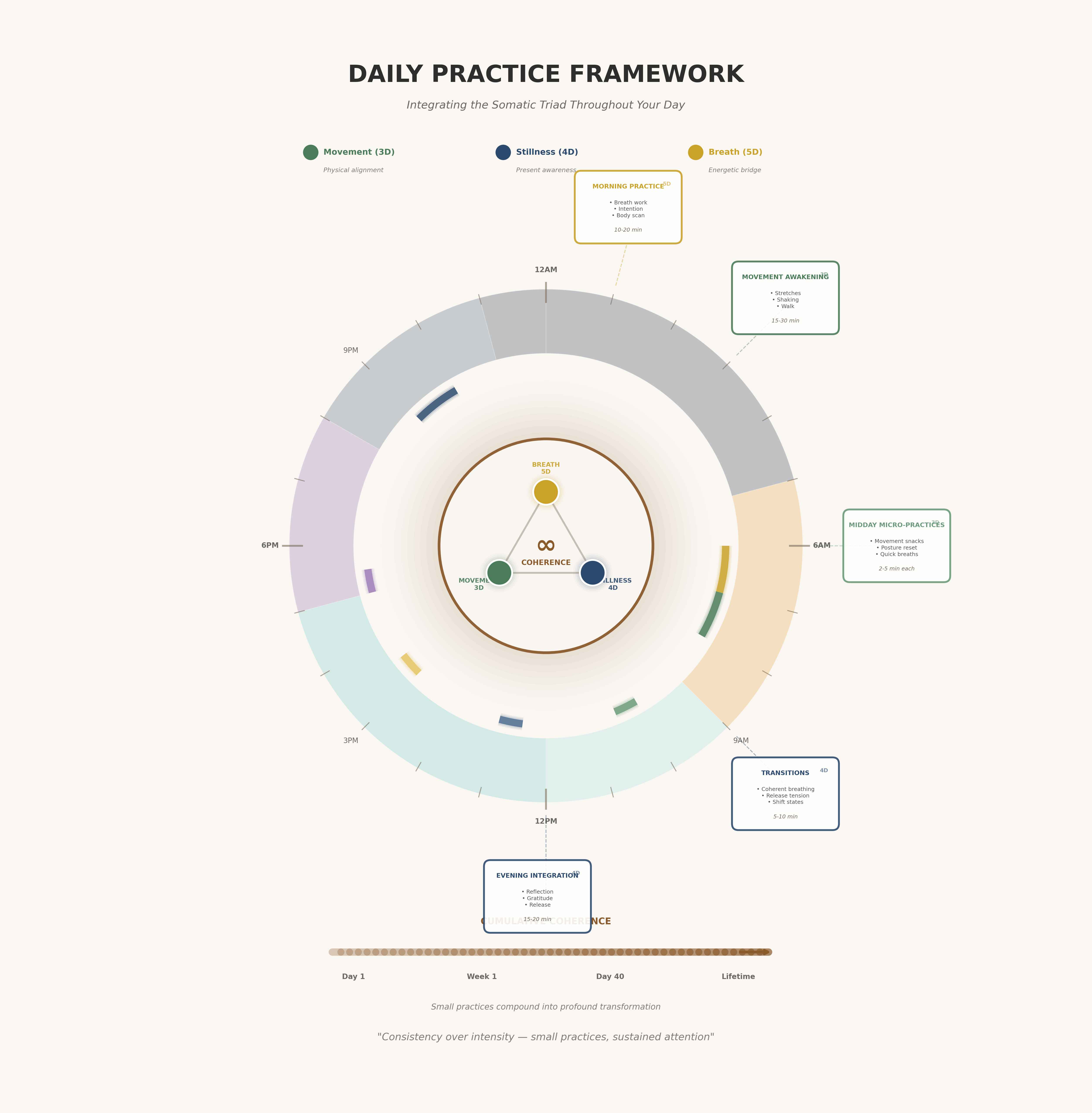
Every practice suite, regardless of length, includes the Somatic Triad:
- Movement (grounding the 3D body)
- Stillness (opening the 4D field)
- Breath (bridging all dimensions)
Even a 5-minute practice touches all three. The ratio changes with time available, but the triad remains complete.
Meet Yourself Where You Are
Before choosing a practice, pause and notice:
- Energy Level: High / Medium / Low / Depleted
- Nervous System State: Activated (anxious, wired) / Regulated / Shutdown (numb, flat)
- Time Available: 5 min / 15 min / 30 min / Unlimited
- Goal: Ground / Clear / Activate / Integrate
Let these inform your choice. Don’t force a high-activation practice on a depleted system. Don’t choose a gentle settling practice when you’re already numb.
SECTION 1: Quick Practices (5 Minutes)
When time is scarce but practice matters.
5-Minute Practice 14.1: The 3-Breath Reset
Duration: 2-5 minutes Best For: Grounding, quick state shift, any nervous system state Dimensional Focus: 3D → 4D → 5D progression
The simplest complete practice. Three breaths, three dimensions.
Instructions:
Breath 1: 3D (Body)
- Stand or sit with feet firmly grounded
- Inhale slowly through nose (4-5 counts)
- Exhale slowly through nose (4-5 counts)
- As you breathe, scan your physical body—feet, legs, pelvis, spine, chest, shoulders, neck, head
- This breath grounds you in 3D physical presence
Breath 2: 4D (Field)
- Same breath rhythm
- As you breathe, expand awareness beyond skin
- Notice the space around you—the room, the sounds, the temperature
- Notice any emotional texture present
- This breath opens 4D field awareness
Breath 3: 5D (Space)
- Same breath rhythm
- As you breathe, let awareness expand further
- Don’t try to go anywhere—simply allow space
- Notice that you are aware of being aware
- This breath touches 5D spaciousness
After: Take one more natural breath. Notice how you feel compared to before.
Somatic Triad Mapping:
| Element | How It Appears |
|---|---|
| Movement | The micro-movements of breathing; optional body scan |
| Stillness | Pause between breaths; receptive awareness |
| Breath | The three conscious breaths are the container |
Use This Practice When:
- Transitioning between activities
- Before difficult conversations
- When you have “no time” but need reset
- As a “door opener” before longer practice
5-Minute Practice 14.2: The Standing Wave
Duration: 5 minutes Best For: Grounding, coming back to body, activating Dimensional Focus: 3D primary, 4D secondary
This feels absurdly simple. That’s why it works. The first time someone taught me this, I almost laughed. “I’m just… rocking?” I said. “Like seaweed?” Yes. That’s it. And I felt like an idiot for about thirty seconds. Then something happened. My mind stopped chattering. My feet felt like they actually belonged to me. The anxiety I’d been carrying—it didn’t disappear, but it stopped feeling like an emergency. I use this one more than almost any other practice now. Not because it’s profound. Because it’s available.
This practice uses gravity and micro-movement to restore 3D presence.
Instructions:
Setup (30 seconds)
- Stand with feet shoulder-width apart
- Soften knees slightly—not bent, just not locked
- Let arms hang naturally
- Close eyes or soften gaze downward
The Wave (3 minutes)
- Begin shifting weight slowly forward toward toes
- Then slowly back toward heels
- Find a slow, rhythmic rocking—like seaweed in gentle current
- Let the movement be minimal, almost invisible
- Coordinate with breath: inhale forward, exhale back (or reverse—find what feels natural)
- Let the wave ripple up through spine
Deepening (1 minute)
- Gradually reduce the movement until you’re standing still
- Notice: your body is still subtly oscillating even when “still”
- Feel the aliveness in stillness
Closing (30 seconds)
- Open eyes
- Feel feet on ground
- Notice how body feels compared to before
Expected Outcomes:
- Increased sense of grounding
- Calmer nervous system
- Improved body awareness
- Subtle energization without agitation
Variations:
- Side to side: Shift weight gently between left and right feet instead
- Spiral: Let the wave spiral slightly through spine as you rock
- With sound: Add a soft hum on exhale
Contraindications:
- If you feel dizzy, reduce movement or open eyes
- Not recommended if actively dissociating—use grounding practice first
5-Minute Practice 14.3: Box Breath Reset
Duration: 5 minutes Best For: Focus, calming without sedating, performance preparation Dimensional Focus: 3D stabilization, 4D entry
I discovered this one at 3am when my mind wouldn’t stop spinning. I’d tried everything—meditation, reading, counting sheep. Nothing. Then I remembered box breathing. Four counts in. Four counts hold. Four counts out. Four counts hold. By the third round, something shifted. Not sleep exactly, but the spinning slowed. The thoughts stopped their frantic chase. I’ve used it before presentations, after arguments, in the middle of panic. It’s not magic. It’s simpler than that—it’s just giving your nervous system a shape to follow when everything else feels shapeless.
The classic focus-building breath used by Navy SEALs, performers, and meditators alike.
Instructions:
Setup (30 seconds)
- Sit comfortably with spine supported but not rigid
- Rest hands on thighs
- Close eyes or soften gaze
- Take one natural breath
The Box (4 minutes)
INHALE: 1...2...3...4 (through nose, smooth and steady)
HOLD (lungs full): 1...2...3...4 (gentle suspension, not straining)
EXHALE: 1...2...3...4 (through nose, smooth and steady)
HOLD (lungs empty): 1...2...3...4 (relaxed pause, not forcing)

Repeat for 8-12 cycles.
Movement Element:
- During holds, notice the subtle movements still happening in your body
- Heartbeat, micro-swaying, internal aliveness
- Even “holding” is not truly still
Closing (30 seconds)
- Release the structure
- Let breath return to natural rhythm
- Notice any shift in mental clarity or nervous system state
Expected Outcomes:
- Increased focus and clarity
- Calm alertness (not sleepy, not wired)
- Parasympathetic activation
- Ready for demanding task or conversation
Modifications:
- Shorter box (3:3:3:3): If 4 counts feels strained
- Longer box (5:5:5:5 or 6:6:6:6): For experienced practitioners
- Skip empty hold: If holding empty lungs creates anxiety, just go: inhale → hold → exhale → inhale…
Contraindications:
- High blood pressure: skip the holds or use shorter holds
- Anxiety during holds: reduce to gentle pause rather than full hold
- Pregnancy: keep holds very brief or skip
5-Minute Practice 14.4: Compassionate Scan
Duration: 5 minutes Best For: Clearing, emotional processing, self-connection Dimensional Focus: 4D primary
I thought compassion meant fixing. I learned it means meeting. For years, whenever I noticed tension or discomfort in my body, I’d try to breathe it away, release it, make it different. That’s not compassion—that’s a negotiation. This practice taught me something simpler and harder: just notice. Just say “I see you” to the tight place without needing it to change. The weird thing? That’s often when it changes. Not because you forced it, but because being witnessed—even by yourself—is sometimes all a held place needs.
A gentle body-emotion scan that meets sensation with kindness rather than analysis.
Instructions:
Setup (30 seconds)
- Sit or lie down
- Close eyes
- Take three settling breaths—each one softer than the last
- Set intention: “I meet myself with kindness”
The Scan (3-4 minutes)
Move attention slowly through the body, noticing what’s present without trying to change it:
- Feet and legs: Any tension, warmth, numbness, tingling? Just notice.
- Pelvis and low back: Any holding, pressure, openness? Just notice.
- Belly: Tight? Soft? Guarded? Just notice.
- Chest and heart: Constricted? Open? Aching? Just notice.
- Throat and jaw: Clenched? Relaxed? Just notice.
- Face and head: Any expression you’re holding? Just notice.
For each area, silently say: “I see you. It’s okay.”
If you find an area with strong sensation or emotion:
- Stay there for 2-3 breaths
- Breathe toward that area (imagine breath flowing there)
- Don’t try to fix or release—just accompany
Closing (30 seconds)
- Notice the whole body at once
- One final breath to all of you
- Gently open eyes
Expected Outcomes:
- Increased interoception (body awareness)
- Emotional material moving (may feel more or less intense)
- Self-compassion activation
- 4D field softening
This practice can surface difficult material. If strong emotion arises, you can continue the practice (breathing toward the feeling) or gently open eyes and ground through feet and surroundings.
5-Minute Practice 14.5: Sound Current
Duration: 5 minutes Best For: Clearing, activating, vagal toning Dimensional Focus: 4D clearing, 5D touch
Making sound alone feels ridiculous at first. Get over it. Worth it. I resisted this for years. Humming? In my apartment? By myself? No thank you. Then one day I was so stuck—nothing was moving, not my thoughts, not my energy, not anything—that I closed the windows and just started humming. Quiet at first, embarrassed even alone. Then louder. And something cracked open. The vibration moved things that thinking couldn’t touch. Now I hum in the car, in the shower, sometimes walking down the street. I’ve stopped caring who hears. The stuck feeling cared more.
Using the voice to vibrate and clear the field.
Instructions:
Setup (30 seconds)
- Sit comfortably
- Take three clearing breaths
- Notice: you’re about to make sound, so whatever judgments about “sounding weird” might arise—let them pass
Humming (2 minutes)
- Inhale through nose
- On exhale, make a low hum: “Hmmmmmm”
- Feel the vibration in chest, throat, face
- Let the pitch find itself—whatever feels natural
- Continue for 8-10 breaths
Toning (1-2 minutes)
- Shift from hum to open tone: “Ahhhhh” or “Ohhhhhm”
- Let it be gentle, not forced
- Notice where the sound resonates in your body
- Play with pitch—higher opens head, lower opens chest/belly
Silence (1 minute)
- Stop making sound
- Stay still
- Notice the quality of silence after sounding
- Feel any residual vibration in the body
Expected Outcomes:
- Vagal nerve stimulation 1
- Cleared, lighter feeling in 4D field
- More present, less stuck in thoughts
- Physical relaxation in throat, jaw, chest
Variations:
- Specific frequencies: If you have a 528Hz or 432Hz tone, hum along with it
- Partner/group: Humming together amplifies the effect through field entrainment
- Location specific: Hum while focusing on a tense body part
Contraindications:
- Avoid if you have acute throat pain or laryngitis
- In shared spaces, you may need to hum quietly or use Practice 3 instead
Quick Practice Selection Guide
| If You’re Feeling… | Use This Practice | Why |
|---|---|---|
| Scattered/unfocused | Box Breath Reset | Builds coherence and focus |
| Anxious/activated | Standing Wave | Grounds without sedating |
| Disconnected from body | Compassionate Scan | Rebuilds interoception |
| Stuck/heavy | Sound Current | Moves stagnant energy |
| Need fast reset | 3-Breath Reset | Quickest dimensional touch |
| Depleted | Compassionate Scan or 3-Breath | Gentle, not demanding |
SECTION 2: Moderate Practices (15 Minutes)
When you have breathing room but not a full practice block.
15-Minute Practice 14.1: Somatic Triad Foundation
Duration: 15 minutes Best For: Daily maintenance, building capacity, all nervous system states Dimensional Focus: Balanced 3D/4D/5D
The core daily practice. If you only have one practice, this is it.
Instructions:
Movement (5 minutes)
Minutes 1-2: Spinal Awakening
- Stand or sit
- Slowly roll spine down, vertebra by vertebra, chin toward chest
- Let arms hang heavy
- Slowly roll back up, stacking vertebrae
- Repeat 3-4 times
Minutes 3-5: Gentle Movement Flow
- Choose movement that your body wants:
- Shoulder circles (forward, then backward)
- Hip circles (standing)
- Gentle twisting (seated or standing)
- Arm swings
- Whatever invites itself
- The goal is not exercise—it’s waking up the body’s conversation with itself
- Follow impulse rather than choreography
Stillness (5 minutes)
Minutes 6-8: Settling
- Find comfortable seated position
- Close eyes
- Let movement settle into stillness
- Notice the residue of movement—the tingling, the warmth
- Simply be with whatever sensation remains
Minutes 9-10: Open Awareness
- Without directing attention anywhere specific
- Let awareness be receptive—sounds, sensations, the quality of the space
- You are not doing anything; you are allowing everything
Breath (5 minutes)
Minutes 11-15: Coherent Breathing (5:5)
INHALE: 1...2...3...4...5 (through nose)
EXHALE: 1...2...3...4...5 (through nose)

Continue for full 5 minutes.- Smooth, continuous flow
- Belly rises on inhale, falls on exhale
- If mind wanders, gently return to counting
- The coherence emerges through repetition
Closing:
- Let the breath return to natural
- Open eyes slowly
- Notice: How do you feel compared to when you started?
Expected Outcomes:
- Nervous system regulation
- Improved body awareness
- Mental clarity
- Foundation for longer practices
15-Minute Practice 14.2: Clearing Practice
Duration: 15 minutes Best For: When you feel “off,” carrying difficult energy, after conflict Dimensional Focus: 4D clearing primary
This one moves stuck energy fast. Bring tissues. I mean it. I learned this after carrying something for weeks—a conversation that went wrong, a grief that wouldn’t settle, something heavy I couldn’t name. My therapist said: “Have you tried shaking?” I rolled my eyes. She waited. So I shook. Hands first, then arms, then my whole body trembling like a wet dog. And then—I don’t know how else to say this—something let go. I sat down and cried for ten minutes. Not sad crying. Relief crying. The kind where your body finally says, “Thank you for letting me release this.” It’s not subtle. It works.
When something is stuck in your field, this practice moves it.
Instructions:
Movement: Shaking (4 minutes)
- Stand with feet shoulder-width apart
- Begin shaking hands—let them be loose, floppy
- Let the shake spread to arms, shoulders
- Let it move to legs, pelvis, spine
- Increase intensity if it feels right
- Let sound come if it wants (sighs, grunts, whatever)
- Continue for 3 minutes at whatever intensity serves
- Final minute: gradually slow and stop
Stand still for 30 seconds after. Feel the buzzing.
Breath: Extended Exhale (4 minutes)
- Sit comfortably
- The pattern:
INHALE: 1...2...3...4 (through nose)
EXHALE: 1...2...3...4...5...6...7...8 (through nose or mouth)

Continue for 4 minutes.- Extended exhale activates parasympathetic nervous system
- Imagine exhaling whatever doesn’t serve you
- Each exhale clears a little more
Stillness: Receptive Clearing (5 minutes)
- Remain seated
- Close eyes
- Imagine your field (the space around you) as water
- Anything stuck is like sediment stirred up
- You’ve shaken it loose (movement), exhaled much of it (breath)
- Now simply let the sediment settle
- Don’t force anything—just allow clearing
- Breathe naturally
Movement: Sealing (2 minutes)
- Stand
- Place both hands on belly
- Take 3 deep breaths, feeling hands rise and fall
- Trace hands up body to heart, then shoulders, then overhead
- Bring hands together above head, then down to heart
- This seals the clearing
Expected Outcomes:
- Lightness, cleared feeling
- Whatever was stuck has moved
- Restored sense of self vs. not-self
- Ready to re-engage
This practice can release strong emotions. Allow them. If they overwhelm, use grounding (next practice) to stabilize.
15-Minute Practice 14.3: Grounding Practice
Duration: 15 minutes Best For: When anxious, overwhelmed, “up in the head,” after intense experience Dimensional Focus: 3D primary, stabilizing
When the system is activated and needs to return to earth.
Instructions:
Movement: Ground Connection (5 minutes)
Standing:
- Feel feet on floor. Really feel them.
- Press down slightly through feet—notice the floor pressing back
- Bend knees slightly and straighten them slowly, 5 times
- Feel your weight descending with gravity
Walking in Place (2 minutes):
- Lift one foot slightly, place it down, feel the contact
- Other foot, slowly
- Continue slowly walking in place
- Feel how the earth meets each step
Standing to Seated:
- Slowly lower yourself to seated position
- Feel the support beneath you—chair, floor, cushion
- Feel how you are held without effort
Breath: Grounding Breath (4 minutes)
INHALE: 1...2...3...4 (through nose)
Imagine drawing breath down through body to feet
EXHALE: 1...2...3...4...5...6 (through nose)
Imagine breath releasing down through feet into earth

Continue for 4 minutes.
Each breath sends roots deeper.
Stillness: Earth Connection (4 minutes)
- Seated or lying down
- Feel every point of contact between your body and surface beneath
- Imagine weight pouring downward, surrendering to gravity
- You are not floating—you are held
- Notice: the earth doesn’t ask you to do anything
- Simply rest on what supports you
Closing (2 minutes)
- Slowly look around the room
- Name 5 things you can see (silently or aloud)
- Name 3 things you can hear
- Name 1 thing you can feel against your skin
- Take 3 natural breaths
- Notice: you are here, in a body, on the earth
Expected Outcomes:
- Reduced anxiety and activation
- Return to 3D presence
- Calmer, more settled
- Restored capacity for action
1 Grounding practices activate the ventral vagal complex, supporting safety physiology.
15-Minute Practice 14.4: Activating Practice
Duration: 15 minutes Best For: When depleted, flat, numb, needing energy Dimensional Focus: 3D → 4D energization
When the system is shutdown and needs gentle awakening.
Instructions:
Movement: Gentle Activation (6 minutes)
Seated or Standing:
- Begin with micro-movements—small finger movements, wrist circles
- Gradually expand: shoulder rolls, neck circles, gentle arm reaches
- Increase movement size slowly over 3 minutes
- Add breath: inhale on expansion, exhale on contraction
- Final 2 minutes: whatever movement invites itself—maybe larger movements, maybe dance-like, maybe just continuing what you’re doing
The key: gradual increase, not sudden burst.
Breath: Energizing Breath (4 minutes)
Kapalabhati (Skull Shining) - Gentle Version:
- Sit comfortably
- Take a deep inhale
- Begin quick, sharp exhales through nose (like blowing out candles) while passive inhales happen naturally
- Pace: about 1 exhale per second
- Continue for 30 seconds, then pause and breathe naturally for 30 seconds
- Repeat 2-3 times
If Kapalabhati feels too intense, use:
Rapid Breath (gentler):
INHALE: 1...2 (through nose)
EXHALE: 1...2 (through nose)
Continue quickly for 30 seconds, then rest.
Stillness: Energized Presence (4 minutes)
- Sit still but alert
- Spine upright, not collapsed
- Eyes open, softly focused on a point in front of you
- Notice the buzzing aliveness after movement and breath
- Don’t try to keep the energy—just witness it
- You are present and energized, not doing anything, but alive
Closing (1 minute)
- Take 3 deep breaths
- Feel the energy available in your body
- Set a simple intention for the next activity
- Gently engage with what’s next
Expected Outcomes:
- Increased energy without agitation
- Lifted from flatness or numbness
- Ready for engagement
- Clear, alert presence
Contraindications:
- High blood pressure: skip Kapalabhati, use gentle rapid breath
- Pregnancy: skip Kapalabhati entirely
- Vertigo: use slower activation, keep eyes open
- If numbness is trauma-related: add more grounding before and after
15-Minute Practice 14.5: Integration Practice
Duration: 15 minutes Best For: After intense experiences, processing insights, bridging practice and life Dimensional Focus: All dimensions in dialogue
When you need to integrate rather than activate or calm.
Instructions:
Movement: Sensing Movement (4 minutes)
- Begin standing or seated
- Close eyes
- Ask: “What movement does my body want to make?”
- Wait. Don’t force.
- Let movement emerge—it might be tiny (finger twitching) or larger (swaying)
- Follow the impulse without editing
- The body is processing through movement
Stillness: Listening (4 minutes)
- Sit comfortably
- Place one hand on heart, one on belly
- Ask: “What wants to be known?”
- Listen. Don’t manufacture answers.
- If something arises, receive it. If nothing arises, receive that.
- This is not thinking—it’s listening
Breath: Integration Breath (4 minutes)
INHALE: 1...2...3...4...5 (receiving)
HOLD: 1...2...3 (integrating)
EXHALE: 1...2...3...4...5 (releasing)
HOLD: 1...2...3 (resting)

Continue for 4 minutes.
During holds, sense integration happening—the joining of parts.
Closing: Bridging (3 minutes)
- Open eyes slowly
- Look around the room
- Ask: “How does what I practiced connect to my life today?”
- Receive whatever answer comes
- Make one simple commitment: “Today I will…” (something small that carries the practice forward)
- Stand. Feel your feet. Step into the day.
Expected Outcomes:
- Insights landing more fully
- Sense of wholeness
- Connection between practice and life
- Clarity about next steps
15-Minute Practice 14.Selection Guide
| If You Need… | Use This Practice | Somatic Triad Emphasis |
|---|---|---|
| Daily maintenance | Somatic Triad Foundation | Balanced |
| Clearing stuck energy | Clearing Practice | Breath + Movement |
| Coming down from anxiety | Grounding Practice | Movement + Stillness |
| Rising from depletion | Activating Practice | Movement + Breath |
| Processing/integrating | Integration Practice | Stillness + Breath |
SECTION 3: Deep Practices (30 Minutes)
When time and space allow depth.
30-Minute Practice 14.1: Complete Somatic Triad Journey
Duration: 30 minutes Best For: Full practice, nervous system reset, comprehensive coherence building Dimensional Focus: 3D → 4D → 5D progression
The complete journey through the Somatic Triad and all dimensions.
Instructions:
Phase 1: Movement (10 minutes)
Minutes 1-3: Grounding Movement
- Stand with feet rooted
- Gentle swaying, feeling gravity
- Micro-movements in feet, ankles, knees
- Establishing 3D presence
Minutes 4-6: Opening Movement
- Begin to move more fully
- Shoulder circles, hip circles, spinal rolls
- Whatever invites itself
- The body is warming, awakening
Minutes 7-9: Free Movement
- Let movement become whatever it wants
- Fast or slow, large or small
- Don’t choreograph—follow
- This is the body’s intelligence expressing itself
Minute 10: Settling
- Gradually slow movement
- Find stillness standing
- Feel the residue of movement vibrating through you
Phase 2: Stillness (10 minutes)
Minutes 11-13: Seated Transition
- Find comfortable seated position
- Let the transition from standing to sitting be slow and conscious
- Arrive in stillness gradually
Minutes 14-17: Open Awareness
- Eyes closed or softly open
- No agenda, no direction
- Simply be aware of whatever is present
- Sound, sensation, thought—all arising and passing
- You are the space in which everything appears
Minutes 18-20: Deep Stillness
- Even less doing
- Let awareness rest rather than reach
- If thoughts continue, no problem—thoughts are allowed
- The stillness is not absence of thoughts; it’s non-attachment to them
Phase 3: Breath (10 minutes)
Minutes 21-24: Coherent Breathing (5:5)
- Smooth, continuous
- Building coherence through repetition
- Let it become effortless
Minutes 25-27: Extended Breath (5:7 or 5:8)
- Gradually extend exhale
- Moving deeper into parasympathetic rest
- Exhales can extend to 7 or 8 counts as comfortable
Minutes 28-30: Natural Breath
- Release any pattern
- Let breath breathe itself
- Remain aware but not directing
- This is where 5D opens—in the surrender of control
Closing:
- Let eyes open when ready
- Notice: how is your experience different from 30 minutes ago?
- Take this awareness into your day
Expected Outcomes:
- Deep nervous system reset
- Comprehensive coherence across dimensions
- Clarity and calm
- Foundation for life’s activities
30-Minute Practice 14.2: Dimensional Journey
Duration: 30 minutes Best For: Expanding consciousness, touching 5D, integration of frameworks Dimensional Focus: Explicit 3D → 4D → 5D progression
A journey through all three dimensions of the Normal Map.
Instructions:
3D: Body (10 minutes)
Movement (5 minutes):
- Stand and feel feet on ground
- Move in whatever way anchors you in physical body
- Focus on sensation—muscles, joints, weight, gravity
- You are a body, made of matter, here on earth
Breath (5 minutes):
- Diaphragmatic breathing—belly expands on inhale
- Count: 4:4 inhale:exhale
- Attention on physical sensation of breathing
- You are a body that breathes
Throughout, affirm: “I am here, in a body, on the earth.”
4D: Field (10 minutes)
Transition:
- Sit comfortably
- Close eyes
- Shift attention from physical body to the space around the body
Awareness Expansion (5 minutes):
- Notice: you have a field that extends beyond skin
- This field contains emotions, impressions, intuitions
- Sense the quality of your field right now—is it contracted? Open? Murky? Clear?
- Simply notice without changing
Breath (5 minutes):
- Coherent breathing (5:5)
- Imagine breathing not just into body but into field
- Each breath clearing and coherent-ing the 4D space
- Let the field brighten, expand, clarify
Throughout, affirm: “I am the field that holds my experience.”
5D: Space (10 minutes)
Transition:
- Let even the field soften
- Expand beyond the personal
Spacious Awareness (7 minutes):
- Notice: awareness itself has no edges
- You are not finding awareness; you ARE awareness
- The body exists in awareness
- The field exists in awareness
- But awareness itself is boundless
- Rest as awareness, not in awareness
Natural Breath (3 minutes):
- Let go of all technique
- Breath breathes itself
- Thoughts think themselves
- Everything happens; you watch
- This is 5D—the witness that doesn’t interfere
Throughout, affirm: “I am the space in which all appears.”
Closing:
- Allow attention to return to body (3D)
- Notice the field settling (4D)
- Remember you are the space that contains all (5D)
- All three are always here—now you know how to access each
- Open eyes. Return.
Expected Outcomes:
- Direct experience of 3D/4D/5D
- Integration of book’s framework into practice
- Expanded sense of self
- Access to all three dimensions at will
30-Minute Practice 14.3: Healing Intensive
Duration: 30 minutes Best For: Processing difficult emotions, nervous system recalibration, trauma-informed work Dimensional Focus: 4D primary with 3D support
When something needs tending.
Instructions:
Opening: Container Building (5 minutes)
- Sit or lie down
- Close eyes
- Imagine a safe container around you—maybe a circle of light, a protective bubble, a trusted presence
- Know: whatever arises can be held by this container
- Take 5 slow breaths, establishing safety
- Affirm: “I am safe enough to feel what’s here.”
Movement: Discharge (7 minutes)
- Stand
- Begin gentle shaking—hands, arms, legs
- Increase if it wants to increase
- Let the body do what it needs: shake, sway, move
- If sound wants to come, let it
- This is the body releasing what it’s holding
- After 5 minutes, slow down
- Stand still for 2 minutes, feeling the aftermath
Stillness: Tending (10 minutes)
- Sit or lie down
- Place hand on part of body that draws attention
- Breathe toward that place
- Ask: “What is here?”
- Listen. Don’t fix.
- Whatever arises—emotion, memory, sensation—simply accompany it
- You are not alone with this; you are with yourself
- Continue for 10 minutes, moving hand if attention shifts
Breath: Soothing (5 minutes)
INHALE: 1...2...3...4 (receiving)
EXHALE: 1...2...3...4...5...6 (releasing)

Continue for 5 minutes.- Extended exhale calms the nervous system
- Imagine exhaling anything that’s ready to release
- Don’t force release—allow it
Closing: Integration (3 minutes)
- Place both hands on heart
- Take 3 deep breaths
- Affirm: “I can feel this and still be okay.”
- Slowly open eyes
- Look around the room
- Name 3 things you see
- Feel feet on floor
- The practice is complete; integration continues
Expected Outcomes:
- Moved difficult material
- Increased capacity to be with difficulty
- Nervous system recalibration
- Self-compassion strengthened
This practice can surface intense material. If you become overwhelmed, open eyes, feel feet, orient to room. Consider having a therapist or trusted person available after first attempts. If you have PTSD or complex trauma, do this practice with professional support initially.
30-Minute Practice 14.4: Energy Cultivation
Duration: 30 minutes Best For: Building vital energy, morning practice, preparation for demanding activities Dimensional Focus: 3D grounding, 4D activation, 5D touch
For when you want to increase capacity and vitality.
Instructions:
Grounding (5 minutes)
- Stand with feet shoulder-width apart
- Feel the ground beneath you
- Bend knees slightly and straighten, 5 times
- Each time: inhale rising, exhale descending
- Feel roots extending from feet into earth
- Draw earth energy upward on inhales
Activation Movement (10 minutes)
Dynamic Flow:
- Begin with arm circles—forward 10 times, backward 10 times
- Add torso rotation as arms circle
- Add gentle bouncing in the knees
- Increase pace and intensity gradually
- Let movements become full-body
- For final 3 minutes: free movement, whatever energizes you
- Breath naturally throughout—don’t hold breath
Breath of Fire (5 minutes) [INTERMEDIATE]
- Sit comfortably
- Take a deep inhale
- Begin rapid exhales through nose (passive inhales)
- Pace: 2 exhales per second
- Start with 30 seconds, then rest with normal breath for 30 seconds
- Repeat 4 times
- Feel the energy building
Stillness: Energy Circulation (5 minutes)
- Remain seated
- Hands on lower belly (dantian in Chinese tradition)
- Visualize energy circulating in the body
- On inhale: energy rises up spine to crown of head
- On exhale: energy descends down front body to lower belly
- This is the small heavenly circuit (microcosmic orbit)
- Let the visualization be gentle, not forced
Sealing (5 minutes)
- Stand
- Place hands on lower belly
- Take 3 deep breaths, sealing energy in the center
- Slowly raise arms overhead on inhale
- Bring them down to heart on exhale
- Repeat 3 times
- Final pose: hands at heart, standing tall
- Feel the vitality available to you
- Bow to yourself, recognizing your practice
Expected Outcomes:
- Increased vital energy
- Clear, energized state without agitation
- Strengthened energy body
- Ready for demanding activities
Contraindications:
- Breath of Fire: Not for pregnancy, high blood pressure, or during menstruation
- If you feel lightheaded, stop Breath of Fire and use normal breathing
- Do not practice if you are already highly activated/anxious
30-Minute Practice 14.5: Relational Practice (For Two)
Duration: 30 minutes Best For: Couples, close friends, family members, deepening connection Dimensional Focus: 22×22×22 (relational scale) and 333 Triad
A complete partner practice using all elements of the Somatic Triad.
Instructions:
Opening: Arriving Together (3 minutes)
- Sit facing each other, comfortable distance
- Make soft eye contact
- Take 3 breaths together—one person counts: “Breathing in… breathing out…”
- Silently acknowledge: “We are here together.”
Movement: Mirror Practice (7 minutes)
- Stand facing each other
- One person is “leader,” one is “mirror”
- Leader moves slowly; mirror follows
- Any movement—arms, torso, gentle steps
- No words; just movement dialogue
- After 3 minutes, switch roles
- Final minute: no leader, co-create movement together
Breath: Synchronized Breathing (7 minutes)
- Sit facing each other
- Close eyes or keep soft eye contact
- Begin breathing together:
INHALE: 1...2...3...4...5
EXHALE: 1...2...3...4...5- One person counts aloud for first minute, then continue in silence
- Feel the field between you synchronizing
- Notice when your breaths naturally align
- Continue for 7 minutes
Stillness: Present Together (7 minutes)
- Remain seated
- Open eyes and make soft eye contact
- No speaking, no touching
- Simply be present with each other
- Notice any impulse to look away, laugh, fill the silence
- Let those impulses pass
- Rest in being-with
- This is the 333 Triad: Expression (you showing yourself) × Reception (you receiving the other) × Resonance (the field between)
Closing: Sharing (6 minutes)
- Each person takes 3 minutes to share:
- “What I noticed in my body…”
- “What I noticed in the space between us…”
- “What I’m grateful for…”
- The listener does not respond—simply receives
- After both share, bow to each other silently
- The practice is complete
Expected Outcomes:
- Deepened connection
- Field entrainment between partners
- Experience of non-verbal communication
- 333 Triad in action: expression, reception, resonance
Variations:
- Three people: Form triangle, rotate leaders during mirror practice
- Group: Sit in circle, synchronized breathing, eye contact with different people
- Distance: Can be done over video call with modifications
30-Minute Practice 14.Selection Guide
| If You Seek… | Use This Practice | Key Benefit |
|---|---|---|
| Complete practice | Somatic Triad Journey | Comprehensive reset |
| Spiritual depth | Dimensional Journey | 3D/4D/5D access |
| Emotional healing | Healing Intensive | Processing difficult material |
| Increased energy | Energy Cultivation | Building vital capacity |
| Connection with another | Relational Practice | Deepened relationship |
SECTION 3.5: The Daily Flow Protocol
Using the neuroscience of peak performance to build coherence.
In Flow States: Transcendence You’ve Already Tasted we explored how flow states are micro-transcendence—the same mechanism as mystical experience, available in any absorbed activity. The practices below turn that insight into repeatable protocol.
Flow isn’t accidental. It follows a structure. These practices work with that structure rather than hoping flow will arrive on its own.
What is flow? Flow is a state of complete absorption where self-consciousness temporarily recedes, performance increases, and experience takes on qualities of effortlessness and timelessness. Psychologist Mihaly Csikszentmihalyi identified it as the peak of human experience. Neuroscientists describe the underlying mechanism as transient hypofrontality—temporary downregulation of the prefrontal cortex, the brain’s self-monitoring center. Your nervous system already knows how to do this. These practices help you invite it reliably.
Flow Practice 14.F1: The 90-Minute Flow Block
Duration: 90-120 minutes (including recovery) Best For: Deep work, creative projects, skill development, any demanding practice Dimensional Focus: 3D embodied performance → 4D field coherence Flow Cycle Stage: Full cycle (Struggle → Release → Flow → Recovery)
The core flow practice. Built around the body’s natural ultradian (approximately 90-minute) performance rhythm.
I spent years fighting the “struggle” phase—that first twenty minutes where nothing comes easily and I feel like a fraud who has no idea what he’s doing. I used to interpret that as a sign that today wasn’t a flow day, or that I wasn’t ready, or that I should wait until I felt more like myself. Then I learned it’s the Nigredo. It’s supposed to feel like this. The struggle isn’t a sign you’re doing it wrong. It’s evidence you’re doing it right. Now I set a timer for twenty minutes and refuse to judge the work before it goes off. By the time it rings, I’m usually already in something I didn’t know was possible when I started.
Before You Begin:
- Choose a single challenge slightly beyond your current comfort level—not too easy (you’ll stay bored), not too hard (you’ll stay anxious). Steven Kotler uses a heuristic sometimes called the “4% stretch”—the task should be approximately four percent more demanding than your current skill level. The precise number is a practical guideline rather than a laboratory-established threshold, but the principle is sound: stretch just past comfort without shattering into anxiety.
- Write one sentence on paper or screen: “In the next 90 minutes, I will…” One specific thing. Not three things.
- Silence your phone. Close browser tabs not needed for the work. Remove all notifications. Every distraction is a flow reset.
The Practice:
Phase 1: Struggle (15-20 minutes)
- Begin the work immediately—no warm-up, no checking email first
- When you find it difficult: that’s normal. If it feels right, stay with it.
- When frustration rises: that’s the Nigredo. It means something real is happening.
- You might notice your mind generating escape routes (check phone, make coffee, “plan” more before starting). You might notice these as signals that something real is happening—or you may find your system is telling you to actually take a break. Trust your read.
- Do not judge the quality of what you’re producing. Judgment interrupts loading.
Phase 2: Release (2-5 minutes, not always distinct)
- At some point the grip loosens. You stop managing and start moving.
- You might notice: “When did I stop thinking about it and start doing it?”
- When this happens, take three slow breaths and soften your focus. You’re at the threshold.
- When absorption arrives, simply stay with it—don’t interrupt it to check how you’re doing.
Phase 3: Flow (variable, 20-90 minutes)
- When absorption arrives, simply stay with it.
- You might find the simplest thing is to let other demands wait while this is happening.
- If the phone buzzes, don’t look. If a thought about something unrelated arises, let it pass without following.
- You may lose track of time. That’s the sign.
- You can stop at any time—but see if you can stay with what’s alive rather than retreating to comfort.
Phase 4: Recovery (15-20 minutes, strongly recommended)
- When you finish, stop.
- Do not immediately check email, messages, or social media. The brain needs integration time. Even 5 minutes of non-screen, non-demanding activity captures much of the benefit.
- Choose non-demanding activity: walk outside, drink water, sit quietly, do light movement.
- This isn’t wasted time—it’s when the neurochemical cascade consolidates and memory forms.
Closing Tracking:
Rate the session in your log (1-10):
Date: _________
Activity: _____________
Duration of actual flow: _____ min
Flow quality (1-10): ___
One thing that surprised me: _______________
What You Might Notice:
- The first few sessions may produce only brief flow windows (5-10 minutes). This is normal and builds with practice.
- You might notice that flow arrives more reliably with the same space, time, and starting ritual. That’s environmental entrainment—your nervous system learns the signal.
- Recovery may feel surprisingly important. Sessions where you skip it often feel less complete.
If you experience significant anxiety (not frustration—anxiety), reduce the challenge level rather than pushing through. Flow requires safety. The challenge-skills ratio should feel like stretch, not threat. If you have a trauma history around performance or failure, move gently with the “struggle” phase and know that you can stop at any time.
Flow Practice 14.F2: The Challenge-Skills Calibration
Duration: 5 minutes (check-in before any practice or project) Best For: Any demanding practice—meditation, movement, creative work, breathwork, skill learning Dimensional Focus: 3D grounding, 4D awareness Flow Cycle Stage: Pre-struggle preparation
The single most powerful thing you can do before any practice is calibrate the difficulty. Too easy, and you coast (boredom, no flow). Too hard, and you freeze (anxiety, no flow). The flow channel is narrow—this five-minute check finds it.
Instructions:
Rate your current capacity (1-10): How present, resourced, and skilled do you feel right now, in this domain, today? Not in general—today.
Rate the challenge you’re about to attempt (1-10): How demanding is the specific task or practice level you’re planning?
Calculate the gap:
- Gap = 0 or negative: Increase challenge, or choose a harder variation
- Gap = 1-2 points: You’re in the flow channel. Proceed.
- Gap = 3-5 points: Reduce challenge, choose an easier variation, or spend 5 extra minutes warming up first
- Gap > 5 points: This is the anxiety zone. Scale back significantly or choose a foundation practice instead.
Adjust accordingly before beginning—not after you’re stuck.
Applied to Specific Practices:
| Practice | Boredom Signal | Flow Channel | Anxiety Signal |
|---|---|---|---|
| Meditation | Mind barely wanders, feel sleepy | Some effort to return, some success | Can’t return attention at all |
| Breathwork | Pattern feels automatic | Requires attention, manageable | Creates dizziness, panic |
| Movement | Movements require no attention | Movements challenge coordination | Movements feel unsafe |
| Creative work | Work feels mechanical | Work requires genuine problem-solving | Blank, paralyzed |
What You Might Notice:
You might notice that “I should be able to do this” gets in the way of accurate calibration. The calibration works best when it’s honest rather than aspirational. Your nervous system doesn’t care what you think you should be able to do—only what you can actually access today.
Flow Practice 14.F3: The Flow Trigger Stack
Duration: 15 minutes (warm-up preceding any 90-minute flow block) Best For: Priming the nervous system for flow before demanding work Dimensional Focus: 3D body preparation, 4D field opening Flow Cycle Stage: Pre-Nigredo preparation
Flow triggers are environmental and behavioral conditions that reliably prime the nervous system for flow entry. Stacking multiple triggers dramatically reduces the time spent in the struggle phase. Think of this as building the conditions so that flow doesn’t have to be forced.
Instructions:
Step 1: Clear Goals (2 minutes)
- Write one sentence, by hand if possible: “In the next [time block], I will [specific output or activity].”
- One sentence. One thing. If you find yourself writing multiple goals, choose the one that matters most and let the rest wait.
- Ambiguity is a flow killer. Clear goals tell the nervous system: this direction, now.
Step 2: Eliminate Choice (2 minutes)
- Decisions during flow break flow. Eliminate them in advance.
- Close tabs you won’t need. Have water nearby. Decide what you’ll do if you get stuck (a pre-decided response, like “when stuck, I’ll move to the next section” rather than “when stuck, I’ll figure out what to do”).
- Everything that doesn’t require a decision in the next 90 minutes: decided now.
Step 3: Environmental Trigger (2 minutes)
- Same space, same playlist or silence, same ritual object if you have one.
- The nervous system learns. Repeated pairings of environment with flow state become triggers over time. You’re not wasting time with ritual—you’re training an associative network.
- If you don’t have an established ritual yet, choose one now and commit to it for 30 days.
Step 4: Embodiment Trigger (5 minutes)
- 5 minutes of movement to drop from head into body.
- Options: brisk walking in place, 10 shoulder rolls each direction, 5 sun salutations, shaking (hands to full body), or any movement that makes your body feel present and real.
- The goal is to stop being a floating head before you begin. Flow lives in full-body engagement, not just cognition.
Step 5: Focused Attention Trigger (4 minutes)
- Begin with the part of the work that is most engaging—not the easiest, not the most logical starting point, but the part that most interests you right now.
- Engagement is a flow primer. Boredom is not a warm-up.
- Read one paragraph from a key reference. Sketch the central idea. Play the one bar of music that excites you. Start in the middle if that’s where the energy is.
When you’re ready: begin the actual work. The stack has done its job.
What You Might Notice:
You might notice that skipping the embodiment step (Step 4) makes flow harder to enter. The body is not incidental to the process—it’s the substrate through which flow happens. Abstract cognition and embodied flow are not the same thing. Dropping into the body is not a detour; it’s the main road.
Flow Practice 14.F4: Group Flow Practice
Duration: 30-60 minutes Participants: 2 or more (works for couples, creative teams, practice groups, ensembles) Best For: Collaborative projects, ensemble work, relational deepening, collective coherence Dimensional Focus: 4D field coherence, 5D collective resonance Flow Cycle Stage: Full cycle, collectively
When multiple nervous systems enter flow together, something happens that individual flow cannot produce. Individual boundaries soften not just between self and activity, but between self and other. This is what the jazz ensemble experiences. What the surgical team finds in a complex coordinated procedure. What ensemble theater calls “the bubble.”
It can be invited deliberately.
Connection to the book’s framework: Group flow is the neurobiological substrate of what we’ve called “collective coherence” and “field entrainment” (see ?sec-chapter-11). The practices here bridge that theoretical framework into experiential reality. When it works, you will feel the difference between a group of individuals practicing simultaneously and a group practicing as one field.
Instructions:
Opening: Shared Declaration (3 minutes)
- Gather in person, in a circle if possible.
- Each person states aloud, in one sentence: “I’m here for [what I’m bringing to this session].”
- No responses, no dialogue yet—just receiving each declaration.
- When all have spoken: 60 seconds of shared silence. Feel the group.
Flow Primer: Synchronized Breath (5 minutes)
- One person leads the count aloud for the first minute, then drop into silence:
INHALE: 1...2...3...4...5
EXHALE: 1...2...3...4...5- Eyes closed or soft downward gaze.
- Notice when your breath naturally synchronizes with others in the room. This is field entrainment beginning.
- When you’re ready (as a group, felt not announced): open eyes.
The Work: Equal Participation (20-50 minutes)
Choose your shared activity—musical improvisation, collaborative writing, co-creation of any kind, or simply shared movement. The group flow conditions that make this work:
- Equal participation: No sustained leader-follower dynamic. Rotate who leads, or practice leaderless co-creation.
- Build on each other: In improv this is called “yes, and.” In practice: receive what comes from others as material to work with rather than something to overcome or correct.
- Shared risk: Everyone slightly outside comfort zone—not just the most skilled person stretching while others coast.
- Concentrated focus: No phones, no side conversations, no one foot out the door.
Closing: Shared Silence and Appreciation (5 minutes)
- When the work naturally completes (felt rather than timed): stop.
- 3 minutes of shared silence—remain present, don’t immediately debrief or check devices.
- Each person offers one short statement (a few words, not a paragraph): “What I noticed was…” No responses. Just receiving.
- Bow, shake hands, or use whatever acknowledgment fits your group. Mark the close.
What You Might Notice:
You might notice that the shared silence at the close feels surprisingly full—not empty. That’s the field settling. Resist the impulse to immediately analyze or debrief. The integration needs a few minutes of spaciousness.
You might notice that sessions where one person dominates produce less of the quality you’re seeking. Equal participation isn’t just a social nicety—it’s a flow trigger. When everyone is slightly stretched, the group nervous system enters coherence together rather than watching one person perform.
Group flow practices are not appropriate as a substitute for individual trauma processing. If the group context activates difficulty for any participant, pause and return to individual grounding (see Grounding Practice 14.3) before continuing. The group container should feel safe enough to engage fully—never pressured.
Flow Protocol Selection Guide
| What You’re Doing | Use This | Duration |
|---|---|---|
| Starting a major work session | Flow Trigger Stack → 90-Minute Flow Block | 15 + 90 min |
| Before any practice session | Challenge-Skills Calibration | 5 min |
| Collaborative or ensemble work | Group Flow Practice | 30-60 min |
| Quick flow primer only | Embodiment Trigger (Step 4 alone) | 5 min |
| Full flow day | Calibration → Trigger Stack → Flow Block → Recovery | ~3 hours |
Dimensional Connection:
| Flow Stage | Alchemical Stage | 3D/4D/5D Layer |
|---|---|---|
| Struggle | Nigredo | 3D (effortful doing) |
| Release | Albedo | 4D (field opening) |
| Flow | Citrinitas/Rubedo | 4D/5D (coherence peak) |
| Recovery | Integration | Integration of all three |
SECTION 4: Practice by State
What to do when you don’t know what to do.
When Anxious or Activated
Your nervous system is in sympathetic (fight/flight) mode. You need practices that down-regulate without fighting the activation.
Best Practices:
- Extended Exhale (any length version) — Parasympathetic activation
- Grounding Practice (15 min) — Returns to 3D and earth
- Standing Wave (5 min) — Uses movement to discharge while grounding
What to Avoid:
- Breath of Fire or activating breaths
- Pushing through intense movement
- Trying to “meditate your way out” of activation
Key: Work WITH the energy, not against it. Ground and lengthen exhales.
When Depleted or Flat
Your nervous system is in dorsal vagal (shutdown) mode. You need practices that gently activate without overwhelming.
Best Practices:
- Activating Practice (15 min) — Gentle building of energy
- Energy Cultivation (30 min) — Comprehensive vitality building
- Sound Current (5 min) — Vibration wakes up the system
What to Avoid:
- Passive meditation (can deepen shutdown)
- Intense exercise (too much, too fast)
- Practices that require “willpower” you don’t have
Key: Gradual increase. Start with smallest movement and let it build.
When Scattered or Unfocused
Your attention is fragmented. You need practices that build coherence and single-pointed focus.
Best Practices:
- Box Breath Reset (5 min) — Structure builds focus
- Somatic Triad Foundation (15 min) — Comprehensive coherence
- Coherent Breathing (any duration) — Rhythm creates order
What to Avoid:
- Open-ended “just sit” meditation
- Free movement without structure
- Multiple practices in quick succession
Key: Structure. Counting. Clear containers.
When Stuck or Heavy
Something is lodged in your field. You need practices that move stagnant energy.
Best Practices:
- Clearing Practice (15 min) — Designed for this
- Sound Current (5 min) — Vibration dislodges stuck energy
- Healing Intensive (30 min) — Goes deeper if needed
What to Avoid:
- Forcing yourself to “think positive”
- Ignoring the stuckness and pushing through
- Dissociating into “spirituality”
Key: Move. Make sound. Shake. Let the body do its work.
When Needing Integration
You have information or experience that hasn’t landed. You need practices that help things settle into coherence.
Best Practices:
- Integration Practice (15 min) — Designed for this
- Dimensional Journey (30 min) — Context creates integration
- Compassionate Scan (5 min) — Receive what’s present
What to Avoid:
- More input (reading, learning, adding)
- High-intensity practices
- Distraction or numbing
Key: Less doing. More receiving. Let things settle.
When Your Practice Fails
This section is the most important one in this chapter.
I’ve designed countless perfect 40-day practices. Gorgeous sequences. Progressive builds. Daily journaling prompts. The ones that actually worked? They were ugly. Abbreviated. Sometimes just three breaths while hiding in the bathroom at work.
Here’s what I didn’t understand for years: the practice that fails is still practice.
The Days You Can’t
Some days you wake up and your body says no. Not resistance—actual depletion. The kind where even sitting up feels like a decision that takes everything you have.
I used to push through those days. I’d done the research. I knew consistency mattered. I knew neural pathways needed repetition. So I’d force myself onto the meditation cushion and sit there angry, or collapsed, or going through motions that weren’t reaching anything.
That’s not practice. That’s punishment wearing practice’s clothes.
What I Learned the Hard Way
The practices that work are the ones you can do on your worst days.
Not your aspirational practices—your floor practices. The irreducible minimum when everything else falls apart.
For me, that’s three conscious breaths. Just three. Inhale, notice I’m breathing. Exhale, notice I’m still here. That’s it. Some days that’s all I have. And it counts. It actually counts—not as a consolation prize, but as legitimate practice.
Perfect is the enemy of practice.
I spent years treating practice like a performance I could fail. But practice isn’t a test. It’s a relationship. And relationships survive bad days. Relationships survive showing up imperfectly. What kills relationships is disappearing.
When You Skip Days (And You Will)
You will skip days. Not if. When.
And here’s what will happen: the voice in your head will say, “You’ve broken the streak. You failed. Might as well stop.”
That voice is lying.
Missing one day doesn’t erase what came before. Missing a week doesn’t either. The nervous system doesn’t delete its learning because you got sick, or overwhelmed, or life happened. You return. That’s all. You return without punishment, without making up for lost time, without negotiating with yourself about whether you deserve to continue.
You just return.
The Actual Secret
I used to think the people who maintained long-term practices had more discipline than me. More willpower. Some quality I lacked.
Turns out they’d just failed more times. They’d learned that falling off doesn’t mean failure—it means you’re in the practice long enough to fall. The only people who never struggle with practice are the ones who quit early.
So when your practice fails—and it will—when you can’t find five minutes, when your mind won’t settle, when you do the practice and feel nothing, when you skip days or weeks or months:
That’s not you failing the practice. That’s the practice including failure.
Show up imperfect. Show up frustrated. Show up having skipped six days and feeling like a fraud. The mat doesn’t care. The breath doesn’t care. The practice is waiting for you exactly as you are, not as you think you should be.
The Minimum That Counts
If nothing else lands from this section, let it be this:
One breath, taken consciously, is practice.
Not a warmup for practice. Not practice-lite. Practice.
Start there. Stay there as long as you need. Some days one breath is the mountain you climb. Climb it anyway.
SECTION 5: Practical Integration
Building Your Personal Suite
After experimenting with these practices, create your personal “suite”—the practices you return to most often.
Your Daily Minimum (5-10 minutes): Pick ONE practice you’ll do daily, no matter what: - _________________________________________________
Your Standard Practice (15 minutes): Pick ONE practice for regular use: - _________________________________________________
Your Deep Practice (30 minutes): Pick ONE practice for when you have more time: - _________________________________________________
Your Emergency Practice: What will you use when activated/overwhelmed? - _________________________________________________
Your Restoration Practice: What will you use when depleted? - _________________________________________________
Weekly Structure Option
If helpful, assign practices to days:
| Day | Practice | Duration |
|---|---|---|
| Monday | _____________ | ___ min |
| Tuesday | _____________ | ___ min |
| Wednesday | _____________ | ___ min |
| Thursday | _____________ | ___ min |
| Friday | _____________ | ___ min |
| Saturday | _____________ | ___ min |
| Sunday | _____________ | ___ min |
Tracking Your Practice
Daily Log (Simple Version):
Date: _________
Practice: _____________
Duration: _____ min
Before (1-10): Energy ___ | Presence ___ | Mood ___
After (1-10): Energy ___ | Presence ___ | Mood ___
One thing I noticed: _______________
Weekly Check-in:
Week of: _________
Days practiced: ___ / 7
Total practice time: ___ minutes
Subjective shift this week (1-10): ___
What worked: _______________
What to try next week: _______________
Closing: The Practice of Practice
This chapter gives you tools. But tools alone don’t transform.
What transforms is the practice of practice—the showing up, the returning, the continuing.
The practices work because:
- Coherence builds — Each practice session adds to cumulative coherence2
- Neural pathways form — Repeated practices become encoded
- The body learns — Skills that required effort become effortless
- Access opens — Dimensions that seemed theoretical become experiential
Start with what you can do. Five minutes is real. Thirty minutes isn’t necessary.
The most important practice is the one you’ll actually do.
For Your Journey
As you explore these practices, consider:
- Which practice am I drawn to? Which do I resist? What does that say about what I need?
- Can I commit to one practice, done consistently, rather than many practices done sporadically?
- How might my practice change if I truly believed that five minutes counts?
The Normal Map isn’t just something you read. It’s something you embody, one breath at a time.
Next: 39 Part III: Communication & Dialogue Practices explores Communication and Dialogue Practices—how to apply the 333 Triad to conscious communication…
Quick Reference: Practice Finder
By Time Available
| Time | Grounding | Clearing | Activating | Integrating |
|---|---|---|---|---|
| 5 min | Standing Wave | Sound Current | 3-Breath Reset | Compassionate Scan |
| 15 min | Grounding Practice | Clearing Practice | Activating Practice | Integration Practice |
| 30 min | Complete Somatic | Healing Intensive | Energy Cultivation | Dimensional Journey |
By Nervous System State
| If You’re… | 5 min | 15 min | 30 min |
|---|---|---|---|
| Anxious | Standing Wave | Grounding | Healing Intensive |
| Depleted | Sound Current | Activating | Energy Cultivation |
| Scattered | Box Breath | Foundation | Complete Somatic |
| Stuck | Sound Current | Clearing | Healing Intensive |
The Simplest Summary
- Anxious? Lengthen your exhale.
- Depleted? Move gently and make sound.
- Scattered? Add structure (counting, timing).
- Stuck? Shake and breathe.
- Don’t know? Do the 3-Breath Reset.
When in doubt: Ground (3D), Breathe (bridge), Receive (4D)
Safety Disclaimer
These practices are intended for general wellness and are not substitutes for medical or psychological treatment. If you have a diagnosed condition (cardiovascular, respiratory, psychological), consult appropriate professionals before beginning. If any practice causes distress, discontinue and seek support.
The practices involving breath holds, rapid breathing, or intense movement have specific contraindications noted throughout this document. Please observe these carefully.
For trauma-related practices, working with a trained somatic therapist is recommended, especially for initial explorations.
For comprehensive safety information, see Comprehensive Safety Information.
“The ordinary acts we practice every day at home are of more importance to the soul than their simplicity might suggest.” — Thomas Moore
What could be more ordinary than breathing? And yet—the revolution is there.