11 Sacred Geometry - The Visual Language of Coherence
12 Sacred Geometry - The Visual Language of Coherence
3.1 Opening: The Honeycomb and the Cathedral
In 1952, a young mathematician named Arthur L. Loeb walked into Chartres Cathedral and had his worldview quietly rearranged.
He had come to study the famous rose windows, marveling at how twelfth-century craftsmen had achieved such perfect radial symmetry. But standing in the nave, light streaming through colored glass in geometric arrays, he found himself asking a different question: Why does this feel like coming home?
The same proportions that make the cathedral “work” for the human psyche, he would later write, appear in the spiral of a nautilus shell, the arrangement of seeds in a sunflower, the branching pattern of a river delta, the spiral of galaxies. The builders of Chartres had not invented these proportions. They had discovered them, using compass and straightedge to render visible something already present in the fabric of reality.
That same decade would see another landmark discovery about geometry in nature. Karl von Frisch—who would win the Nobel Prize in 1973 for decoding the language of bees—had already established that the hexagonal cells of the honeycomb are not just aesthetically pleasing. They represent the mathematically optimal solution for storing the maximum amount of honey using the minimum amount of wax. No bee decided this. No committee of bees voted on it. The hexagon is simply what happens when circular objects are packed together under pressure, each seeking maximum efficiency, and the result is a pattern that reappears everywhere from bubble foam to the basalt columns of Giant’s Causeway in Ireland.
Here is the puzzle that leads us into sacred geometry: Why do the same patterns appear at every scale of existence, from atomic lattice structures to the arms of spiral galaxies? Why did ancient builders, working with nothing but rope and right angles, arrive at proportions that modern physicists describe as fundamental to quantum reality? Why does the human body find certain ratios beautiful, calming, or sacred, while others feel discordant or unsettling?
The answer, as we shall discover, runs deeper than aesthetics. Sacred geometry is not merely a decorative tradition or an ancient superstition dressed in mathematical clothing. It is the visual language of coherence itself, the patterns that consciousness takes when it organizes matter. If the 3D/4D/5D framework from Chapter 8 describes the vertical dimension of your being, and the 333 Triad from Chapter 10 describes how consciousness moves between beings, then sacred geometry reveals the underlying architecture, the wireframe beneath reality’s texture.
This is the Normal Map — not a metaphor for coherence, but its visible shape.
3.2 The Monad and the First Division
The Point of Beginning
Every geometric tradition begins with a single point.
In Euclidean geometry, a point is defined as that which has position but no dimension, no length, no width, no height. It is paradoxically present yet unmeasurable. It exists, but takes up no space.
The ancient Pythagoreans called this the Monad, from the Greek monas, meaning “unity” or “singularity.” For them, the Monad was not merely a geometric concept but a cosmological principle. Before anything could exist, there had to be a single point of origin, an undifferentiated potential from which all differentiation would emerge.
Map this to the 3D/4D/5D framework: the Monad corresponds to 5D consciousness, the unified field before it expresses through dimensions of space and time. It is the Soul before it dreams a body, the Silence before it speaks. Like the 5D, it cannot be located or measured, yet everything arises from it.
The first creative act is simple: the point moves.
When a point extends in all directions equally, it inscribes a circle. This is not a philosophical assertion but a geometric definition. A circle is the set of all points equidistant from a single center. What was singular has become dual: there is now center and circumference, inside and outside, self and not-self.
And yet the circle remains one continuous line. The boundary that creates inside and outside is itself unbroken. This is the paradox of creation: differentiation arises within unity, and the unity remains unbroken.
The Vesica Piscis: Portal of Creation
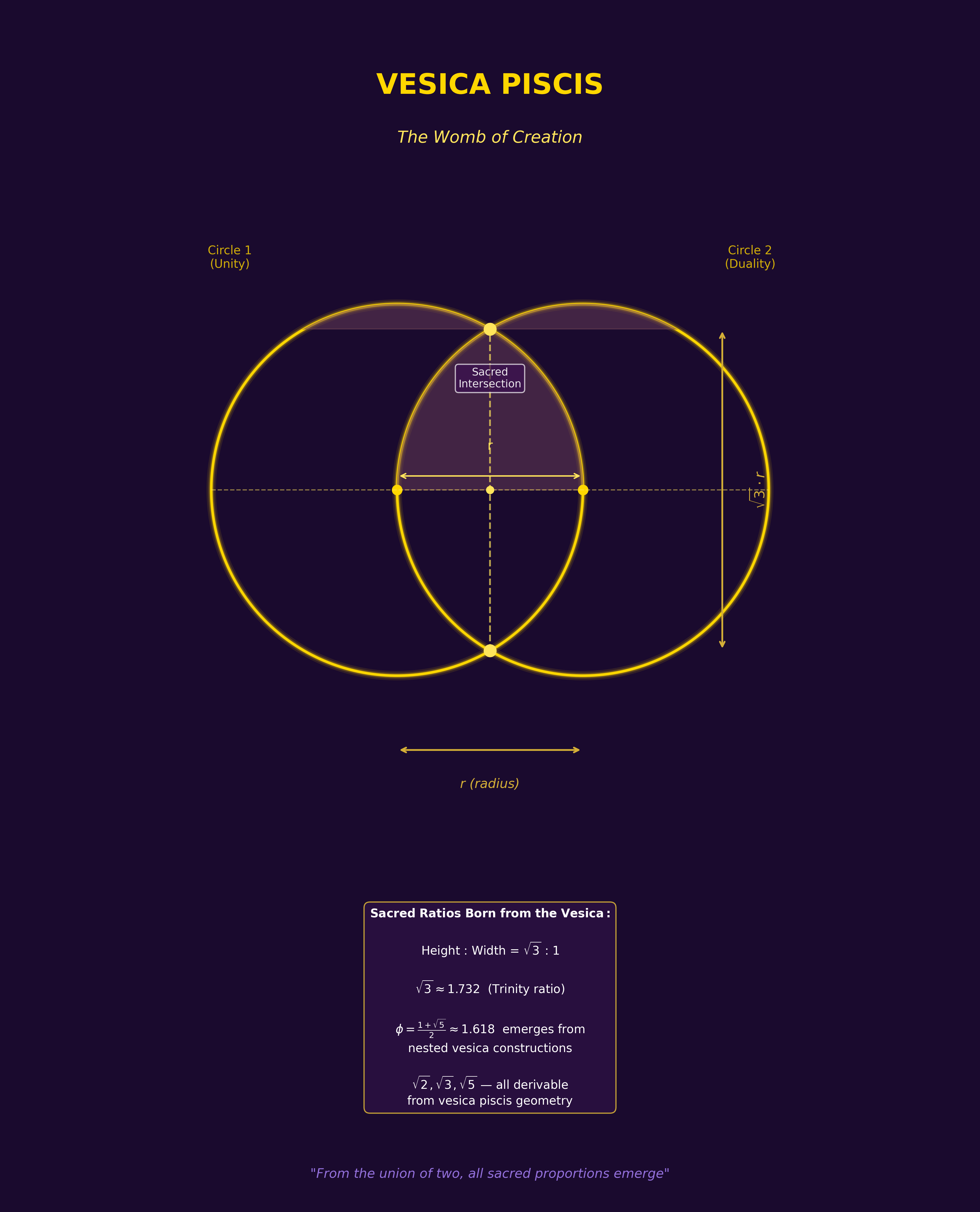
Now imagine a second circle, identical to the first, drawn so that its center lies on the circumference of the first circle.
Where the two circles overlap, an almond-shaped area appears. This is the Vesica Piscis, Latin for “bladder of a fish,” so named for its resemblance to the swim bladder of certain fish species. But the name belies its significance.
The Vesica Piscis has been revered across cultures as a symbol of the divine feminine, the generative portal, the womb from which form emerges. Gothic cathedrals placed Christ and the Virgin Mary within Vesica shapes. The ichthys (fish symbol) of early Christianity fits precisely within the Vesica. Hindu and Buddhist mandalas often begin with overlapping circles.
But beyond symbolism, the Vesica Piscis contains something remarkable: from its proportions emerge all the ratios that will govern sacred geometry.
The width of the Vesica (the short axis) relates to its height (the long axis) by the ratio 1:sqrt(3), approximately 1:1.732. This ratio will reappear in the hexagon, the Star of David, and the flower of life. The Vesica also generates sqrt(2) and sqrt(5) through simple constructions, the latter being essential for deriving the golden ratio.
Here is the deeper meaning: from the meeting of two wholes, something new emerges that neither contained alone. This is the geometry of relationship itself. The Vesica Piscis is the shape of the space between, the form of coherent exchange, what we called Resonance in the 333 Triad.
When two beings meet in authentic communication, when Expression and Reception generate Gnosis, they are not merely overlapping. They are forming a Vesica, creating a shared space from which new understanding can be born.
The universe begins with the One. The One moves and becomes Two. The Two meet and create a Third that contains the potential for all numbers. This is not mystical poetry. This is geometry.
What Vesicas are you creating in your life? Where do your circles overlap with others, forming shared spaces where something new can emerge?
3.3 The Flower of Life
The Template of Creation
Extend the pattern. Add a third circle, centered on one of the two points where the original circles intersect. Then a fourth, a fifth, a sixth. Follow the rule: each new circle’s center must lie where two previous circles cross.
When you have completed seven circles (one central circle surrounded by six), you have what tradition calls the Seed of Life. Extend further, to nineteen circles, and you have the Flower of Life.
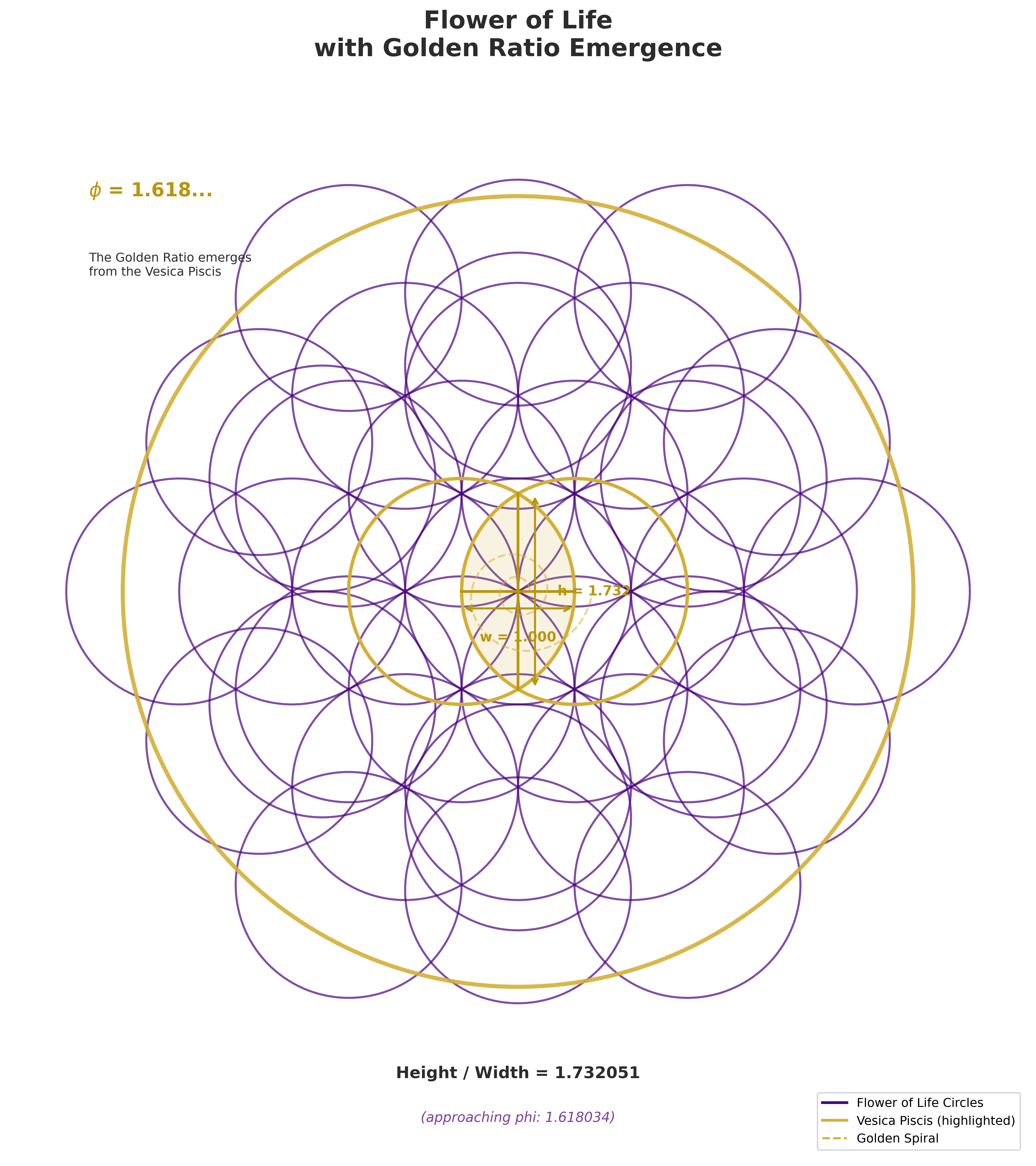
The Flower of Life is carved into granite at the Temple of Osiris in Abydos, Egypt, burned onto pillar surfaces in the Forbidden City in Beijing, present in medieval manuscripts throughout Europe, woven into Islamic tilework, painted in Buddhist temples throughout Southeast Asia. The pattern appears in cultures that had no historical contact with each other, separated by thousands of miles and years.
Why does this pattern recur so universally? Several explanations merit consideration.
First, , the geometry itself is generative. From the Flower of Life, using only straight lines to connect circle centers and intersections, one can derive every Platonic solid, the golden ratio, the Fibonacci sequence, and most of the patterns that appear in nature. It is, in a mathematical sense, a mother pattern, a template from which other forms can be constructed.
Second, , the pattern represents something that humans recognize intuitively: the way consciousness itself organizes when it moves from unity toward manifestation. The Flower of Life is a visual koan, showing simultaneously that everything is interconnected (all circles share points and lines with all others) and that distinction exists (each circle has its own center). This is the perennial insight of mystics: the many and the one are not opposed. They co-arise.
Third, , there may be perceptual and neurological reasons why humans find this pattern compelling. Research on visual perception suggests that the human brain is particularly attuned to radial symmetry, bilateral symmetry, and the specific proportions found in natural growth patterns. We may be, in effect, wired to recognize coherence when we see it, and the Flower of Life presents a particularly concentrated form.
Mapping the Flower to 3D/4D/5D
The Flower of Life offers a visual representation of the dimensional framework:
3D Perspective
The pattern exists as ink on paper, paint on stone, or pixels on screen. At this level, it is an object with a specific location and measurable dimensions. You can describe the size of each circle, the distances between centers.
4D Perspective
The pattern functions as a template, a blueprint, an organizing principle. When you look at a physical flower (the botanical kind), you are seeing the Flower of Life “working,” expressing itself through organic matter. At this level, the pattern is not an object but a process, something that generates form through time.
5D Perspective
The pattern is recognized as a window into something that was always already present. It does not create coherence; it reveals coherence. The geometry itself becomes a meditation object, a doorway through which the mind can contact the unified field from which all form arises.
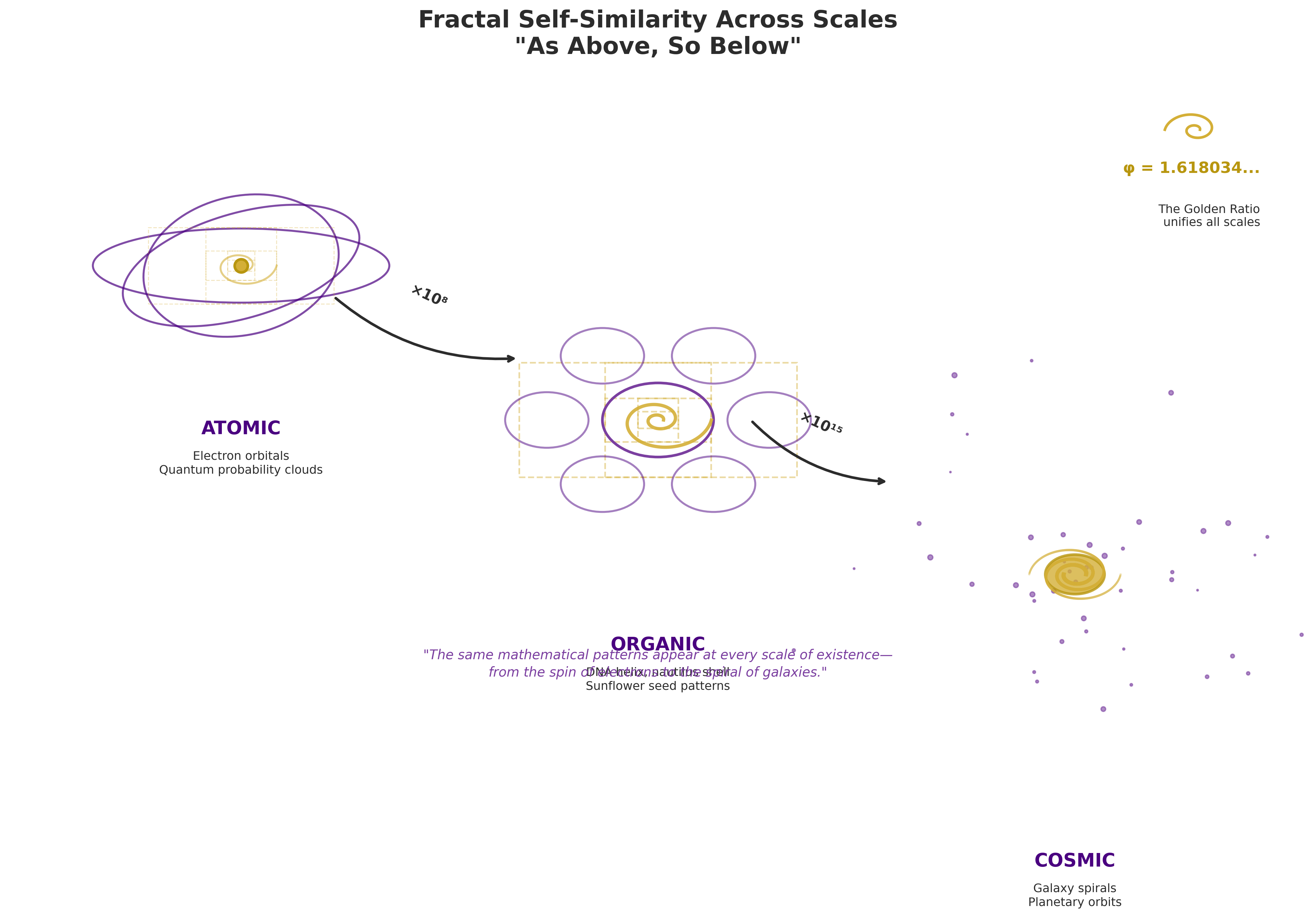
But here’s what makes sacred geometry truly sacred: the same patterns repeat at every scale. This is what mathematicians call fractal self-similarity—a pattern that contains itself infinitely. When you look at the Flower of Life, you’re seeing something that operates identically at the atomic scale (electron shells arrange in concentric patterns), the organic scale (flower petals follow sacred proportions), and the cosmic scale (spiral galaxies trace the same golden ratio). The pattern doesn’t change when you change magnification.
This is why sacred geometry appears across all cultures and all scales of nature—because coherence itself is fractal. It expresses the same organizational principle whether you’re examining a crystal lattice, a hurricane, or a spiral galaxy. Your own consciousness follows the same principle.
Interactive 3D Visualization
Explore the Flower of Life in three dimensions. Watch as nineteen interlocking tori pulse with energy, revealing the golden ratio proportions that govern natural growth. The flowing particles trace the paths of coherence through the pattern. Drag to rotate, scroll to zoom, and observe how the same geometric relationships appear at every angle.
# The Flower of Life emerges from simple circles
for i in range(6):
    angle = i * (2 * np.pi / 6)  # Six-fold symmetry
    x = center_x + radius * np.cos(angle)
    y = center_y + radius * np.sin(angle)
    circle = plt.Circle((x, y), radius)
The same six-fold symmetry that draws this pattern governs snowflake crystals and benzene rings.
3.4 The Golden Ratio
Nature’s Signature
Take a line segment and divide it so that the ratio of the whole to the larger part equals the ratio of the larger part to the smaller. You will find there is only one place to cut: the point where the larger segment is approximately 1.618 times the length of the smaller.
This number, phi (1.618033988…), has fascinated mathematicians since ancient Greece. The Pythagoreans considered it so sacred that they kept it secret, punishing those who revealed it to outsiders with death. They believed it was the mathematical signature of beauty itself, the proportion that the divine used to create pleasing forms.
What cannot be disputed is this: the golden ratio appears throughout nature with remarkable consistency.
The spiral of the nautilus shell approximates a golden spiral, where each quarter-turn increases the radius by a factor of phi. The arrangement of seeds in a sunflower head follows a pattern of intersecting Fibonacci spirals (the sequence 1, 1, 2, 3, 5, 8, 13… which converges toward phi). Pine cones, artichokes, and romanesco broccoli exhibit the same pattern. The branching of trees, the arrangement of leaves around stems (phyllotaxis), the proportions of the human face that we perceive as most beautiful, the spiral arms of galaxies, all tend to cluster around this single ratio.
The DNA double helix itself shows golden ratio proportions. The major groove of DNA (21 angstroms) and minor groove (13 angstroms) are in close approximation to phi. The measurement is real; the causal significance of the ratio remains debated.
Why should a single mathematical ratio recur so obsessively throughout nature?
Mathematicians and physicists offer a compelling explanation: the golden ratio represents optimal efficiency in growth and packing. When seeds need to fill a circular space with maximum density, when branches need to receive maximum light without blocking each other, when spirals need to grow indefinitely without changing their fundamental shape, the equations that govern optimal solutions converge on phi. The golden ratio is not arbitrary beauty. It is what mathematical optimization looks like.
The esoteric traditions go further. They propose that phi represents the signature of coherent consciousness, the ratio that emerges when mind and matter align. The golden mean is the harmonic between chaos (which has no order) and rigid crystalline order (which has no life). It is the sweet spot, the zone of dynamic stability, where evolution happens.
This is not to say geometry causes consciousness, but that consciousness and geometry appear to follow the same organizational principles—perhaps they’re expressions of the same underlying coherence.
The Fibonacci Connection
The Fibonacci sequence provides the bridge between abstract mathematics and natural growth.
Starting with 1 and 1, each subsequent number is the sum of the two before it: 1, 1, 2, 3, 5, 8, 13, 21, 34, 55, 89, 144…
As the sequence extends, the ratio between consecutive numbers approaches phi ever more closely. 13/8 = 1.625. 144/89 = 1.617… By the time you reach large numbers, the ratio is phi for all practical purposes.
This means that whenever you see Fibonacci numbers appearing in nature, counting spirals in a pinecone (usually 8 and 13), petals on a flower (often 5, 8, or 13), or seed patterns in a sunflower (typically 34 and 55 spirals in opposite directions), you are seeing phi manifesting through the growth process.
The Fibonacci sequence is discrete. Phi is continuous. The sequence approaches the ratio asymptotically, like a student approaching mastery, never fully arriving but always getting closer. This is itself a teaching: perfection is not static but dynamic. Coherence is not a state to achieve but a process to continue.
For our purposes in the Normal Map, the golden ratio illustrates a crucial principle: there is a mathematics to coherence. It is not merely a feeling or a metaphor. It is measurable, reproducible, and written into the structure of the universe.
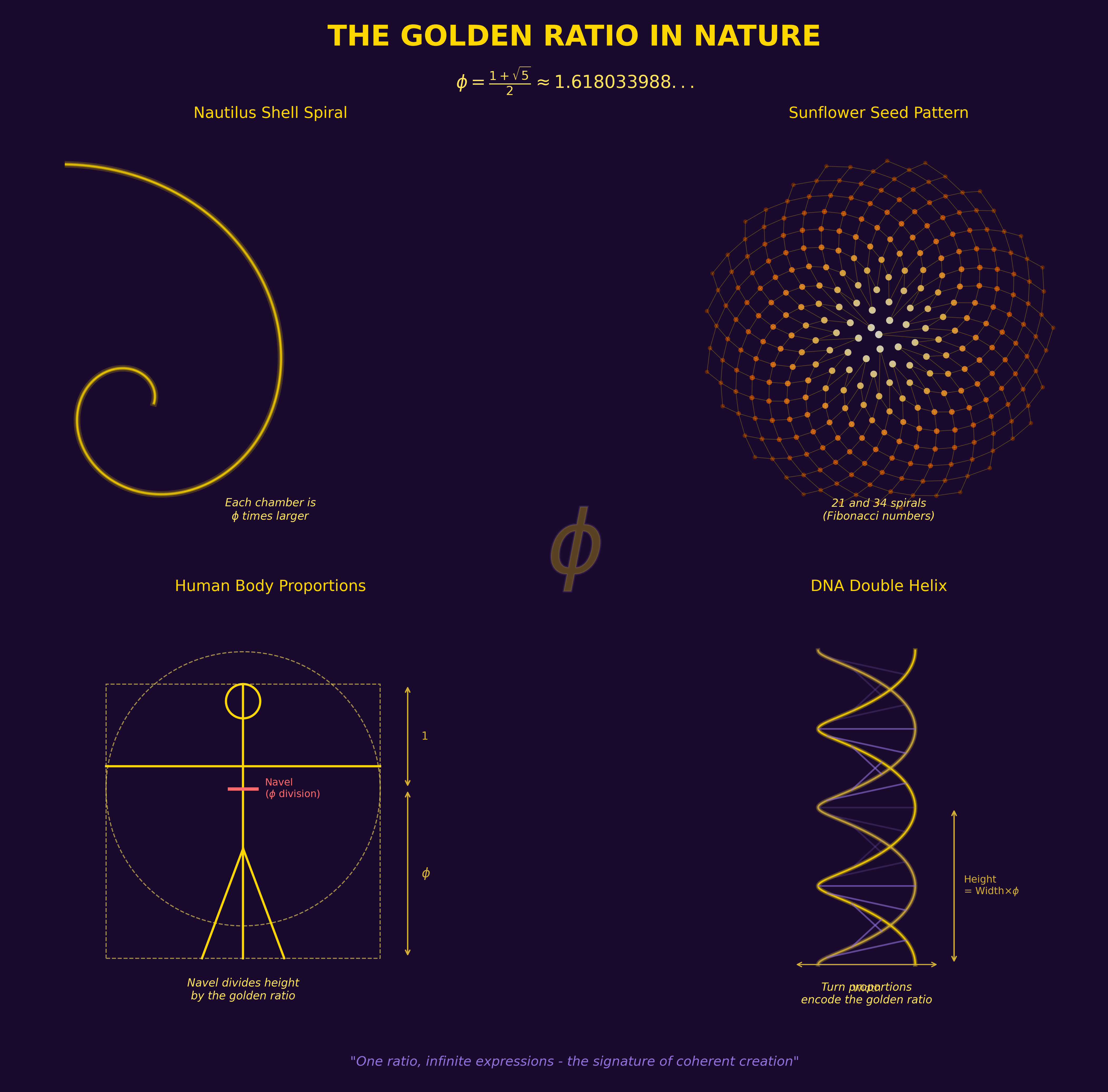
# The Golden Spiral: phi raised to successive powers
phi = (1 + np.sqrt(5)) / 2  # 1.618033988749...
theta = np.linspace(0, 4*np.pi, 1000)
r = phi ** (theta * 2 / np.pi)  # Exponential growth
x, y = r * np.cos(theta), r * np.sin(theta)
This spiral appears in nautilus shells, galaxy arms, and hurricane formations—the same mathematics at every scale.
3.5 The Platonic Solids
The Five Building Blocks
Out of every shape you could build in three dimensions, only five are perfectly regular — every face identical, every edge the same length, every vertex a mirror of every other. Five. That’s it. Mathematics allows no more.
These five shapes are:
- Tetrahedron: 4 triangular faces, 4 vertices, 6 edges
- Cube (Hexahedron): 6 square faces, 8 vertices, 12 edges
- Octahedron: 8 triangular faces, 6 vertices, 12 edges
- Dodecahedron: 12 pentagonal faces, 20 vertices, 30 edges
- Icosahedron: 20 triangular faces, 12 vertices, 30 edges
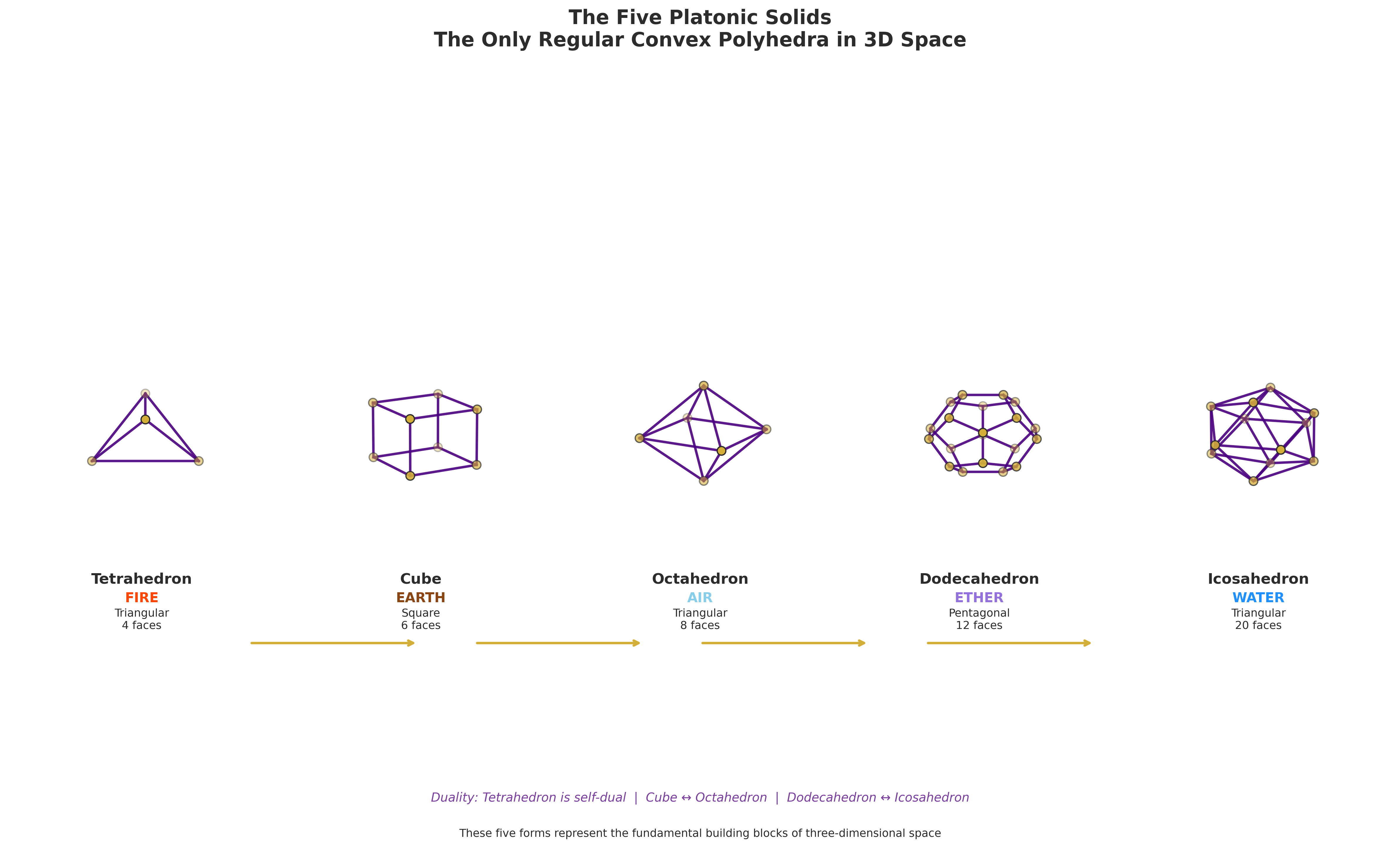
There can be no others. This is mathematically proven. The constraints of three-dimensional space permit exactly five regular polyhedra.
Plato, in his dialogue Timaeus, assigned these shapes to the elements:
- Tetrahedron = Fire (the sharpest, most piercing shape)
- Cube = Earth (the most stable, able to stack)
- Octahedron = Air (the smoothest, allowing flow)
- Icosahedron = Water (the most spherical, tending to roll)
- Dodecahedron = Aether (the shape closest to a sphere, representing the cosmos)
Modern chemistry has validated Plato’s intuition in unexpected ways. The tetrahedron is the shape of methane, the basic carbon compound. The cube is the crystal structure of salt and many minerals. The icosahedron is the structure of many viruses, including adenovirus and herpes. The dodecahedron approximates the shape of certain clusters of silicon atoms. The shapes are not metaphor. They are physical reality.
The Nested Geometry
Here is where it gets remarkable: the Platonic solids nest within each other in elegant relationships.
Place a cube inside a dodecahedron, with each cube vertex touching a pentagonal face. Place a tetrahedron inside the cube, with vertices at alternating cube corners. Place an octahedron inside the cube with its vertices at the centers of the cube’s faces. Place an icosahedron inside the octahedron with its vertices touching the octahedron’s edges.
All five solids can nest within each other, each vertex or edge meeting the other shapes in precise relationships. They are not separate shapes but aspects of one meta-shape, one geometric system.
Metatron’s Cube, a figure drawn by connecting the centers of thirteen circles arranged in the Flower of Life pattern, contains the two-dimensional projections of all five Platonic solids. From the flat pattern of the Flower of Life, the three-dimensional architecture of matter can be derived.
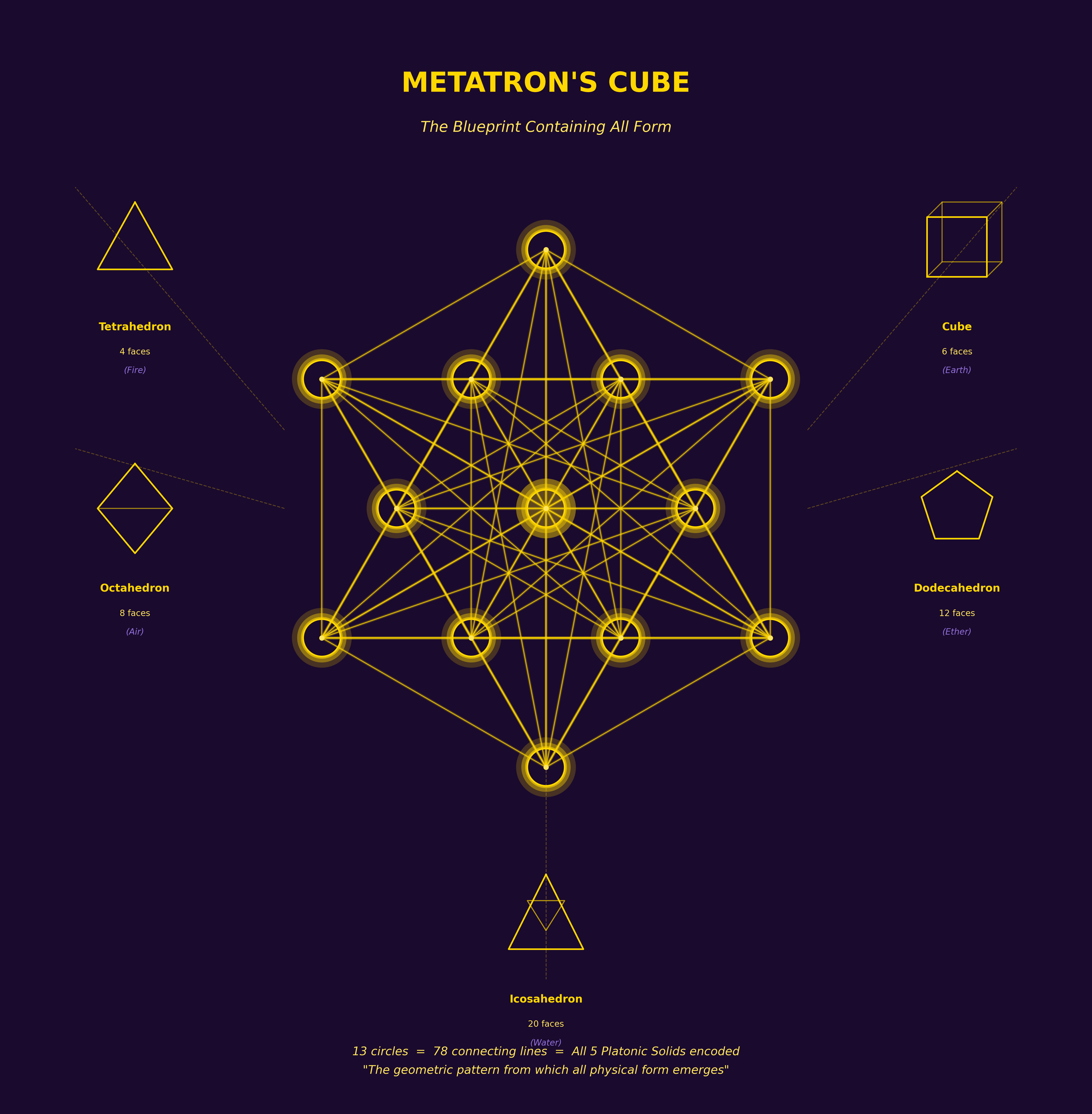
This is the geometry of manifestation: from the unity of the Monad, through the duality of the Vesica, through the template of the Flower of Life, to the building blocks of three-dimensional form.
# Tetrahedron: 4 vertices, 4 faces, perfect symmetry
vertices = np.array([
    [1, 1, 1], [1, -1, -1],
    [-1, 1, -1], [-1, -1, 1]
]) / np.sqrt(3)  # Normalized to unit sphere
These four points define fire’s geometry—the simplest stable 3D form, appearing in methane molecules and diamond lattices.
The Somatic Map
The Platonic solids also map to the human body.
Esoteric traditions propose correspondences:
- Tetrahedron (Fire) = Solar plexus, the seat of personal power and will
- Cube (Earth) = Base of spine and feet, grounding and stability
- Octahedron (Air) = Heart center, balance and relationship
- Icosahedron (Water) = Sacral center, flow and emotion
- Dodecahedron (Aether) = Crown and third eye, consciousness and perception
While these correspondences are not scientifically validated, they offer a useful meditation framework. The body can be experienced as a geometric field, with different regions holding different qualities of energy and consciousness.
In Chapter 13, we will explore how visualization of the Platonic solids in relation to the body can be used to cultivate specific states. Whether the effect is “real” in a measurable sense or “merely” psychological (a distinction that may ultimately be false), practitioners consistently report shifts in awareness and embodiment.
3.6 Cymatics - Sound Made Visible
Hans Jenny’s Discovery
In the 1960s, a Swiss physician named Hans Jenny conducted experiments that would provide visual evidence for ancient claims about the relationship between sound and form.
Jenny developed a device called a tonoscope, which vibrated plates covered with sand or liquid at specific frequencies. When sound waves passed through the medium, particles organized into geometric patterns.
Low frequencies produced simple patterns: circles, concentric rings. As frequencies increased, the patterns became more complex: mandalas, lattices, hexagons, spirals. Certain frequencies produced near-perfect replicas of biological structures, cellular forms, flower-like geometries.
Jenny coined the term “cymatics” (from the Greek kyma, wave) to describe this phenomenon. His key observation: “This is not an unregulated chaos; it is a dynamic but ordered pattern.”
The implications are profound. Sound is not merely a disturbance in air that our ears detect. Sound is a force that organizes matter into geometry. The ancient traditions that spoke of the universe being created through sound (the Word in Christianity, Om in Hinduism, the breath of Atum in Egypt) may have been pointing at something observable.
The Science of Visible Sound
The physics behind cymatics is well understood. Sound waves cause particles to migrate toward nodal lines (places of minimal vibration) and away from antinodes (places of maximum vibration). The resulting patterns are mathematically predictable based on the frequency, amplitude, and properties of the medium.
What is not fully understood is why these mathematical patterns so closely resemble organic forms. Why should the pattern produced by a specific frequency resemble a starfish? Why should another frequency create something that looks almost exactly like a turtle shell?
Some researchers propose that the same wave-matter interactions that create cymatic patterns on a metal plate also operate at the biological level. Cells, tissues, and organs may organize according to vibrational templates. If this is true, it would provide a physical mechanism for some claims of vibrational medicine, that specific frequencies could support healthy cellular organization.
The esoteric interpretation goes further: cymatics is visible evidence that form follows frequency. The patterns we see in cymatic experiments are the same patterns that consciousness uses to organize matter. The universe is not merely vibrating. It is singing, and the geometry of reality is its song made manifest.
Cymatics and the 3D/4D/5D Model
The cymatic experiment provides a perfect illustration of dimensional interaction.
3D: We observe sand particles moving on a plate. They are physical objects with mass, governed by the laws of physics. This is the dimension of measurable reality.
4D: We cannot see the sound wave itself. We see only its effects. The pattern exists as an organizing principle, a vibrational template that shapes matter without being matter itself. This is the dimension of field effects, of causes that operate invisibly to produce visible results.
5D: The mathematical relationships that govern which frequencies produce which patterns exist independent of any particular experiment. They are part of the logos, the rational structure of reality, timeless truths that manifest whenever the conditions permit. This is the dimension of archetypal form.
When you see a cymatic pattern, you are seeing how the three dimensions interact. The 5D mathematical law is expressed through the 4D vibrational field to organize 3D physical matter. The Normal Map in action.
Validating Internal Geometry: Technology as Mirror
Technologies like EEG neurofeedback (e.g., the Muse® headband) provide external validation of internal vibrational states. Different brainwave frequencies produce measurably different patterns:
- Beta (13-30 Hz): Active thinking, often stress. The graph appears jagged, erratic—the geometry of scattered stones.
- Alpha (8-12 Hz): Relaxed awareness, flow states. The graph shows smooth, rolling sine waves—the geometry of ocean swells.
- Theta (4-8 Hz): Deep meditation, subconscious access. Slower, deeper waves—the geometry of deep water.
Such devices use audio feedback to signal when you’ve achieved coherent geometry—birdsong for calm, storm sounds for turbulence. This validation matters for the skeptical practitioner: you are not imagining the shift. You are measuring the phase-change of your electrical field. The internal geometry becomes externally verifiable.
3.7 The Somatic Experience of Geometry
Geometry in Your Body
You do not merely observe sacred geometry. You embody it.
The human body is organized according to geometric principles. The DNA helix, as noted, exhibits golden ratio proportions. The arrangement of collagen fibers in connective tissue forms hexagonal and pentagonal patterns. The branching of blood vessels follows fractal geometry. The ratio of forearm to hand, hand to palm, palm to fingers, all approximate phi.
But the experience of geometry is not limited to these structural facts. The body also perceives and responds to geometry in ways that are only beginning to be understood.
Tensegrity: The Body’s Geometric Principle
The term tensegrity (tensional integrity) was coined by Buckminster Fuller to describe structures that maintain their integrity through a balance of continuous tension and discontinuous compression. In a tensegrity structure, rigid elements (struts) “float” in a network of elastic elements (cables), and the shape is maintained not by the rigidity of any single part but by the dynamic balance of the whole.
The human body is a tensegrity structure. Bones are the compression elements (struts). Fascia, the connective tissue that wraps every muscle, organ, and bone in a continuous web, provides the tension network.
This means that force applied anywhere in the body is distributed throughout the entire structure. Press on your shoulder, and the effect ripples down to your feet. The body is not a stack of separate parts but a unified geometric field.
When the tensegrity is balanced, the body experiences ease, integration, stability without rigidity. When the tensegrity is distorted (through injury, postural habits, emotional armoring), areas of excessive tension and areas of collapse create strain patterns that propagate throughout the system.
Fascia and Geometric Pattern
Recent research on fascia reveals it as a sophisticated communication network. Fascia contains mechanoreceptors that sense stretch and pressure, fibroblasts that can contract slowly like smooth muscle, and a crystalline matrix that may exhibit piezoelectric properties (generating electrical signals in response to mechanical stress).
Dr. Jean-Claude Guimberteau’s video microscopy of living fascia shows that beneath the skin, connective tissue is organized in a continuous, three-dimensional latticework that resembles geometric structures. The tissue is not random fiber. It is organized architecture.
This has implications for understanding how geometry lives in the body. The structural patterns of sacred geometry may not just be visual metaphors for biological organization. They may be literal descriptions of the geometric principles by which fascia self-organizes.
When you visualize geometric forms in relation to your body, you may be doing more than imagination. You may be entraining to patterns that your tissues already know.
The Felt Sense of Geometry
Beyond the structural level, there is experiential evidence that geometry affects how the body feels.
Practitioners of sacred geometry meditation consistently report effects:
- Visualizing the tetrahedron (associated with fire and will) at the solar plexus produces sensations of warmth, centeredness, and determination
- Visualizing the cube (associated with earth and grounding) at the base of the body produces sensations of stability, weight, and presence
- Visualizing the octahedron (associated with air and relationship) at the heart produces sensations of expansion, openness, and connection
- Visualizing the icosahedron (associated with water and flow) at the lower belly produces sensations of fluidity, emotional release, and creative potential
- Visualizing the dodecahedron (associated with ether and consciousness) at the crown produces sensations of spaciousness, clarity, and connection to something larger
Are these effects caused by the inherent properties of the shapes, or by the symbolic associations practitioners bring to them, or by the effects of any focused attention on body regions? We do not know for certain. But we do know that the practices work, meaning they produce consistent, subjective effects that practitioners find valuable.
In the Normal Map framework, we need not resolve the ontological question. We can note that geometry provides a language, a system of symbols that can direct attention and intention in reproducible ways. Whether the shapes are “really” doing something to the body or whether the body is using the shapes as a focus for its own self-organization, the practical outcome is the same.
When Geometry Breaks: Decoherence Patterns
Pain, trauma, and chronic tension can be understood as decoherence patterns—disruptions in the body’s geometric organization.
- Acute pain often manifests as a sharp, piercing quality—the tetrahedron’s fire where it doesn’t belong, a spike in the flow.
- Chronic pain tends toward rigidity—the cube’s stability become stagnation, a stuck square where fluidity should reign.
- Anxiety fragments the field—a shattered kaleidoscope of unconnected lines, geometry without coherence.
Healing, in this framework, is re-patterning. We do not “fix” the pain so much as introduce a stronger, more coherent geometry. This is the principle behind sound healing: a pure frequency (a perfect circle of vibration) meets the chaotic frequency of the pain. Physics dictates that the chaotic system will tend to synchronize with the stable system—a phenomenon called entrainment.
You are using the order of the sound to repair the disorder of the tissue. You are, in effect, running a defragmentation program on your 4D field.
This also explains why practices like yoga, tai chi, and structured breathwork can address chronic pain that resists purely mechanical intervention. They are not merely stretching muscles or moving joints. They are re-introducing coherent geometric patterns to tissues that have lost their organizational template.
Where in your body do you feel geometric coherence? Where does the pattern seem broken, stuck, or scattered? What might it take to re-introduce order to those places?
3.8 When Geometry Teaches Patience
The Geometry of Letting Go
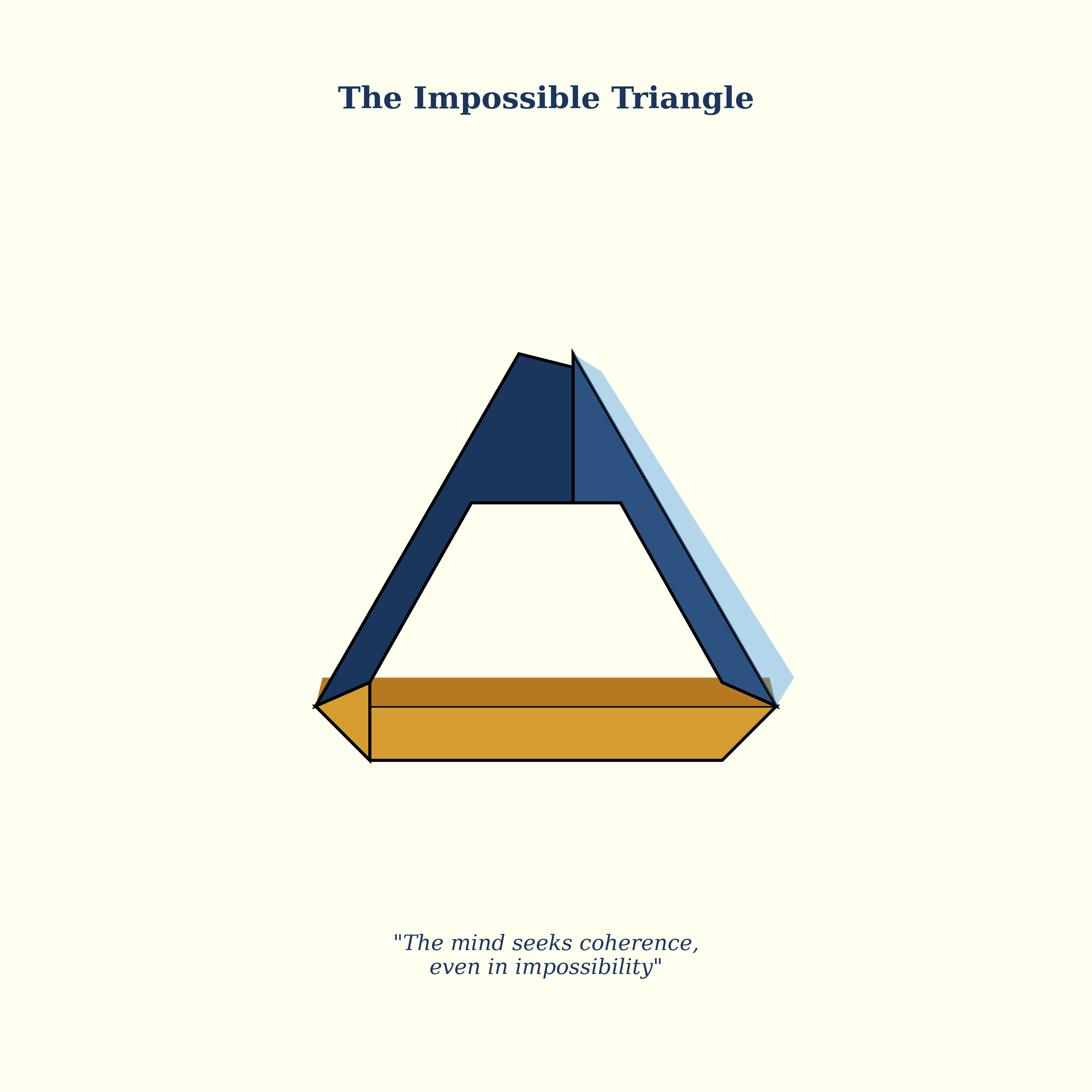
I was eight years old, sitting cross-legged on my grandmother’s braided rug, when I first encountered the Penrose triangle. The drawing in her old psychology textbook showed three bars connected at right angles - each corner perfectly sensible, the whole thing utterly impossible. I traced it with my finger, following the logic around and around, waiting for the moment when I would catch it being wrong.
That moment never came.
Something shifted in me then - not understanding, but a kind of opening. The triangle wasn’t trying to trick me. It was teaching me something about the difference between what I see and what I know. I just didn’t have the words for it yet.
The Construction We Call Seeing
Here’s what neuroscience has revealed about perception: your brain doesn’t receive reality like a camera recording light†. It constructs reality from fragmentary data, filling in gaps, making predictions, building a coherent world from chaos. What you experience as “seeing” is actually your brain’s best guess about what’s out there - a guess informed by everything you’ve ever experienced, expected, or believed†.
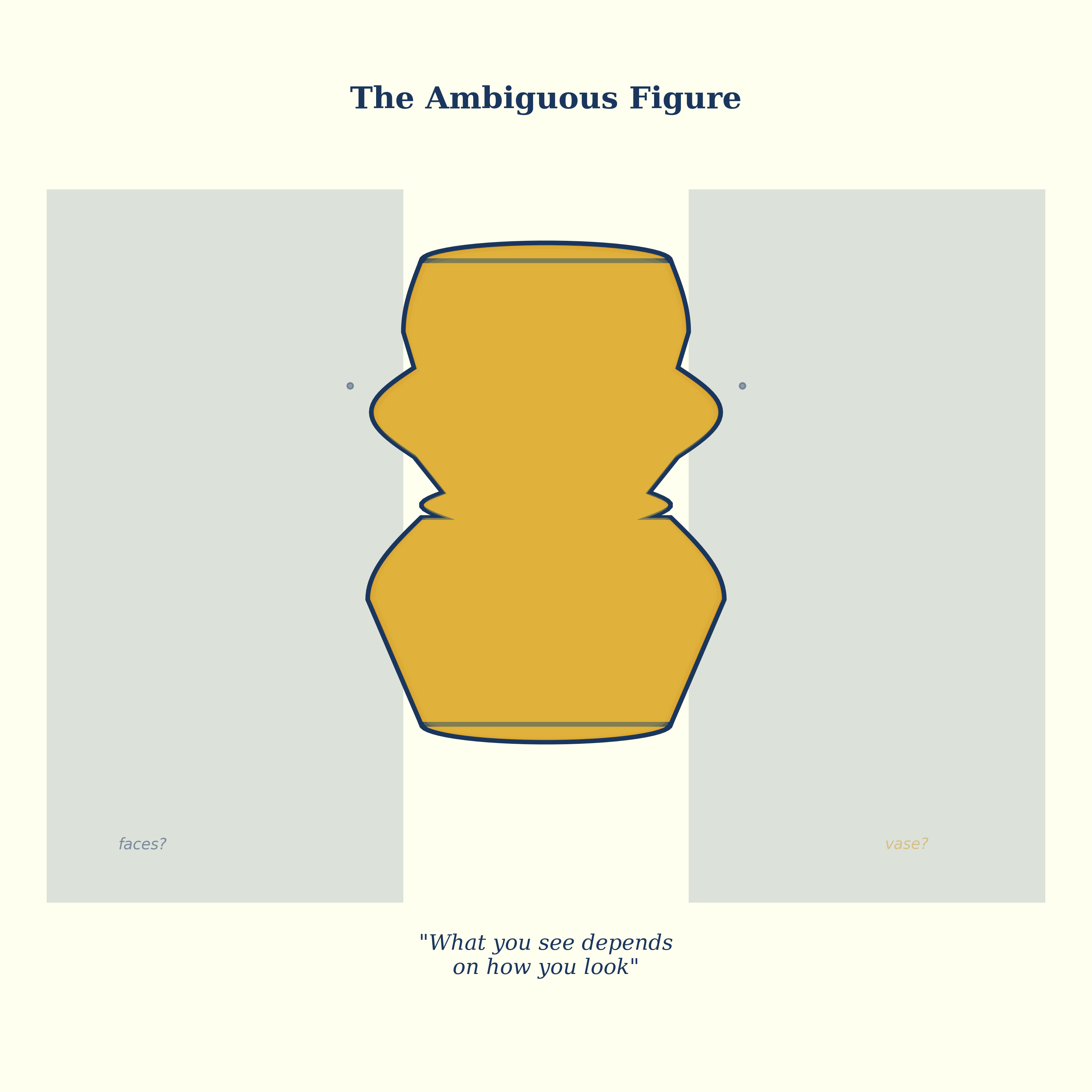
Optical illusions don’t break this system - they expose it. They’re the seams showing in the fabric of constructed reality. When you look at a Necker cube and watch it flip between orientations, you’re not seeing an image change. You’re watching your brain switch between equally valid interpretations of ambiguous data.
We don’t see the world as it is. We see the world as we are.
This isn’t a flaw. It’s how a finite nervous system makes sense of infinite information. But it does raise a question: if perception is construction, what else might we be building without realizing we’re building it?
Drawing the Impossible
There’s a practice I’ve come to love - one that feels almost too simple to matter, but keeps surprising me with its depth.
Get a pencil. Get some paper. Draw an impossible figure.
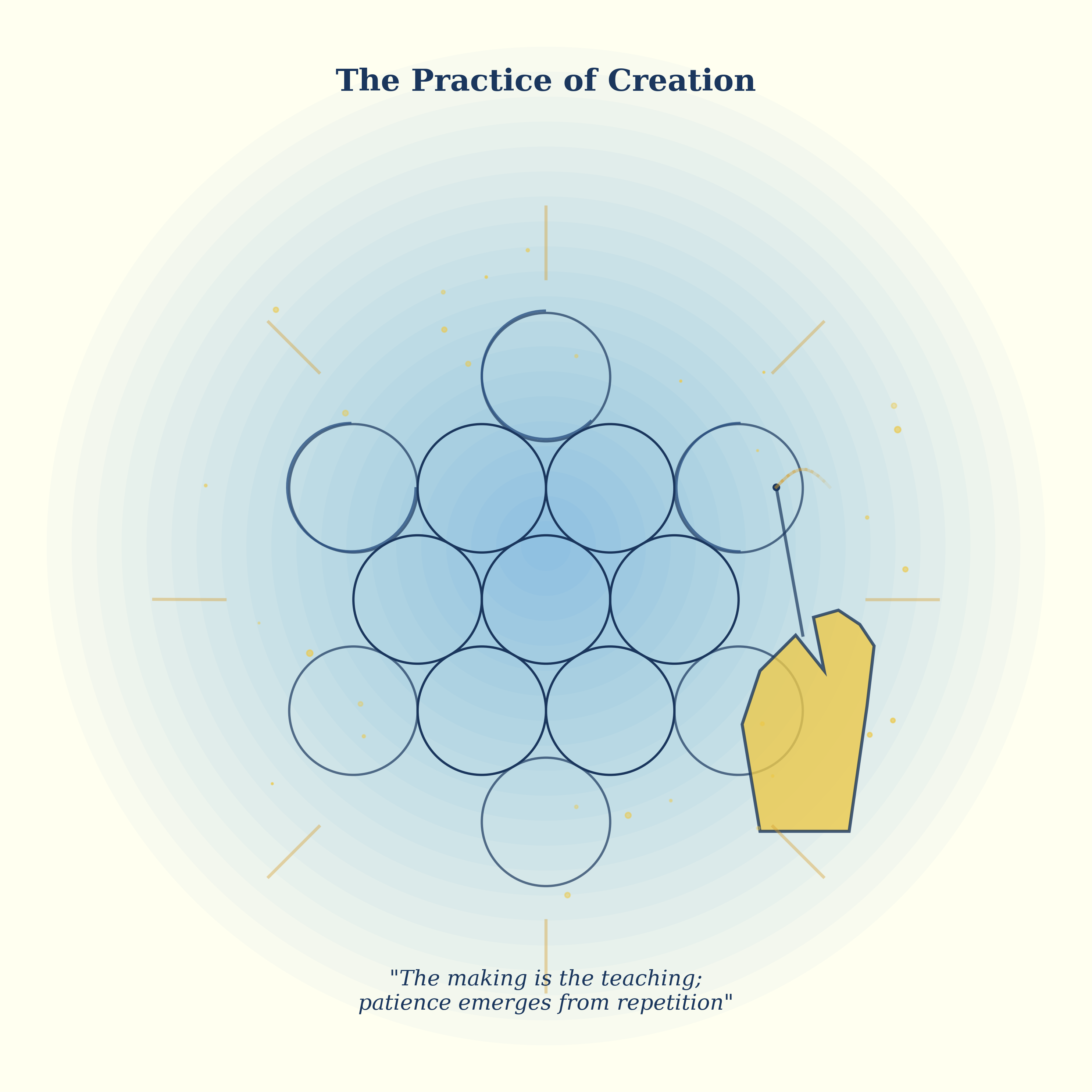
Start with something basic - a Penrose triangle, perhaps, or an endless staircase. Follow the lines. Notice how each segment makes perfect sense while the whole defies logic. Notice, too, how your attention settles into the rhythm of it. Line by line. Angle by angle. The thinking mind quiets because there’s nothing to figure out. The figure will never resolve into sense. That’s the point.
I’ve found this practice works something like meditation, but through the hands. The repetitive geometric creation seems to settle the nervous system in ways I don’t fully understand‡. Something about the focused attention, the motor engagement, the paradox that doesn’t demand resolution - it creates a particular quality of presence.
This parallels what sacred geometry traditions have known for centuries: that drawing certain patterns isn’t just artistic expression but contemplative practice●. The mandalas of Tibetan Buddhism, the tessellations of Islamic architecture, the Celtic knots - all of them ask the practitioner to engage with pattern without needing to possess it.
What the Impossible Triangle Teaches
Here’s what I’ve learned from years of drawing things that can’t exist: you don’t need to understand how something works to participate in it.
The impossible triangle functions. It coheres. It teaches. And it does all of this while being logically impossible. Each time I draw one, I practice holding this paradox - the simultaneous truth of “this works” and “this can’t work.”
This is the same paradox I encounter in healing.
I don’t fully understand how trauma releases from tissue. I can’t explain why certain breathing patterns shift my emotional state. The mechanism by which community heals loneliness remains, at some level, mysterious to me. And yet - the healing happens anyway. Coherence emerges from participation, not comprehension.
There’s a patience that develops when you stop demanding to understand before you experience. A trust in process over outcome. The impossible figure doesn’t wait for you to figure it out before it does its work on you. It just invites you to follow the lines.
Maybe healing works the same way. Maybe the body knows paths the mind hasn’t mapped yet.
The Permission to Not Know
If you’re reading this book looking for explanations that will make everything make sense - I want to gently offer you permission to stop.
Not stop reading. Not stop practicing. But stop requiring understanding as the price of experience. Some of what we’ll explore in these pages has robust scientific support. Some emerges from traditions far older than science. Some lives in that uncertain territory where reported experience runs ahead of verified mechanism.
All of it might help you anyway.
The illusion teaches the eye. The eye teaches the heart. And the heart has never required a theory to know what it knows.
3.9 The 3D/4D/5D Mapping of Sacred Geometry
Geometry at Each Dimensional Level
Sacred geometry operates differently at each dimensional level, providing different functions and experiences.
3D: Geometry as Physical Pattern
At the 3D level, sacred geometry is objective and measurable. It is:
- The arrangement of atoms in a crystal lattice
- The spiral of a nautilus shell you can hold in your hand
- The hexagonal cells of a honeycomb
- The proportions of a well-designed building
- The layout of a labyrinth you can walk through
At this level, geometry is encountered through the senses: you see the pattern, touch the form, walk the path. The value is direct: beauty that pleases the eye, structures that stand strong, patterns that repeat reliably.
The physical effects of geometry are real. Acoustic properties of spaces depend on geometric proportions. The strength of structures depends on geometric relationships. The efficiency of biological systems, as we have seen, often optimizes toward specific ratios. The 3D expression of sacred geometry is not mystical. It is engineering.
4D: Geometry as Organizing Principle
At the 4D level, geometry is not an object but a process, a force, a template that shapes matter through time.
Consider the sunflower again. The spiral pattern does not exist as a pre-formed structure. It emerges as the plant grows, each new seed finding its position according to a simple rule: maintain a specific angular relationship to the previous seed. The pattern is not in the seeds themselves but in the relationship between seeds, in the process by which they are placed.
This is geometry as field effect. The pattern organizes matter from the invisible dimension. This may be literal: Rupert Sheldrake has proposed that morphogenetic fields—energy fields that guide biological development—exhibit geometric properties. The organism does not so much build itself from matter as express itself through matter, using geometric templates.
At the human level, the 4D expression of geometry is felt in:
- The “rightness” of certain proportions (rooms that feel balanced, music that feels resolved)
- The organizational power of symbols (how a mandala can still a scattered mind)
- The templates that guide growth (both physical and psychological development seem to follow stages that exhibit geometric logic)
- The patterns of energy flow in the body (meridians, chakras, whatever we call the subtle anatomy)
At this level, geometry is not observed. It is participated in. You do not look at the 4D geometry. You are organized by it.
5D: Geometry as Eternal Truth
At the 5D level, geometry is neither object nor process. It is idea, archetype, eternal truth.
The Pythagorean theorem (a^2 + b^2 = c^2) was true before Pythagoras discovered it. It will be true after the sun burns out. It is true in any universe where Euclidean geometry holds. The theorem does not exist in space or time. It exists as a timeless fact of logical necessity.
The same applies to the Platonic solids, the golden ratio, the Flower of Life. These are not inventions. They are discoveries. They exist in what mathematicians call “mathematical reality,” a dimension of pure pattern that does not depend on physical instantiation for its truth.
The esoteric traditions call this level the realm of archetypes, the Akashic records, the mind of God. What the 5D geometry reveals is that coherence is not something consciousness creates. It is something consciousness recognizes. The patterns are already there, awaiting discovery, inviting manifestation.
When we meditate on sacred geometry, we are not merely imagining pretty pictures. We are aligning our consciousness with eternal structures of coherence. The meditation does not create the connection. It opens us to a connection that was always already present.
The Dimensional Cascade
These three levels are not separate domains. They are nested, each level including and transcending the one below.
5D archetypal geometry ↓
4D organizing template ↓
3D manifest form
The process runs both ways:
3D observation → 4D felt sense → 5D insightWhen you look at a nautilus shell (3D), allow your attention to rest on it, and begin to feel the spiral as a process rather than a static form (4D), you may suddenly recognize something about growth, development, and the nature of life itself (5D). The shell becomes a doorway, a portal, a point of access to archetypal truth.
This is what makes sacred geometry sacred. It is not merely beautiful (3D aesthetic response). It is not merely functional (4D organizational power). It is revelatory (5D insight). The geometry reveals something about the nature of reality that was always true but not always seen.
3.10 An Integration Practice
The Flower of Life Meditation
Here is a practice that integrates what we have explored. It takes approximately 15-20 minutes.
The Flower of Life Meditation
15-20 min
Preparation (3 minutes)
Find a comfortable seated position. Have a printed or digital image of the Flower of Life available if helpful, though you will eventually visualize with eyes closed.
Take several slow breaths, allowing your body to settle. Feel the ground beneath you. Notice the support.
Set intention: “I open myself to the coherence that geometry reveals.”
The Central Circle (3 minutes)
Close your eyes. Visualize a single point of light at the center of your chest, where the heart is.
See this point expand into a circle, a sphere of light surrounding your heart. This is the Monad, the first expression, Unity.
Feel the quality of this undivided sphere. Complete. Containing all potential. Perfectly balanced.
The First Division (3 minutes)
Now see a second sphere appear, identical to the first, its center at the edge of the original sphere. Where they overlap, feel the Vesica Piscis forming.
Experience the quality of this overlap. Two wholes meeting. Creating a space between. The birth of relationship.
Notice: The original unity is not diminished by this division. It is expressed through it.
The Flower Emerges (5 minutes)
Let more spheres appear, following the pattern: each new sphere’s center touching where two previous spheres cross.
Watch the Flower of Life emerge around your heart center. Do not force the visualization; let it unfold.
As the pattern expands, let it extend beyond your chest, through your whole body, beyond your body, filling the room, continuing outward.
Rest in the experience of being a node in an infinite pattern, connected to all other nodes, distinct yet inseparable. Note the recursion: you are using a map — this book, called The Normal Map — to navigate toward something the map cannot contain, and the pattern you’re visualizing right now is the same pattern the book’s architecture embodies. The Flower of Life isn’t just a meditation object. It’s what you’re inside of.
The Return (3 minutes)
Slowly let the outer circles fade, until only the central sphere remains, glowing at your heart.
Let even this sphere contract back to a point of light.
Rest in the point, the original unity, still containing everything.
When ready, open your eyes. Take a moment to feel your body, the ground, the room.
What to Notice
After this practice, you may observe:
- A sense of expanded awareness or spaciousness
- Bodily sensations of warmth, tingling, or openness in the chest
- A quality of calm or centeredness
- Increased sensitivity to geometric patterns in your environment
- A felt sense of interconnection
The practice is not about achieving a particular experience. It is about using geometric visualization to orient consciousness toward coherence. The geometry is a map. Where it leads is unique to each practitioner.
3.11 Chapter Summary
Sacred geometry is not decoration or superstition — it is the visible structure of coherence itself, the same organizational logic appearing from DNA spirals to galaxy arms to the proportions your body finds beautiful without being told to. The Flower of Life, the golden ratio, the Platonic solids, and cymatics patterns all point at the same thing: there is a mathematics to coherence, and the universe has been practicing it longer than we’ve had names for it. The geometry doesn’t create coherence; it reveals what was always already present — which is why these patterns feel less like learning and more like remembering.
In the chapters ahead, we will explore the Hermetic Principles that describe how consciousness operates through these geometric forms, and the practices of movement, stillness, and breath through which the body can align with coherent pattern.
The architecture has been shown. Now we learn to inhabit it.