15 The Hermetic Principles
16 The Hermetic Principles
5.1 Opening: The Night the Code Revealed Itself
Elena had studied biochemistry for twelve years. She could name every enzyme in the Krebs cycle, map the cascade of neurotransmitters in a panic response, explain in precise molecular detail why certain drugs worked and others failed. What she could not explain was what happened to her mother.
Her mother was dying. Stage four pancreatic cancer. The doctors gave her six weeks. They were kind, clinical, certain.
Then Elena’s mother started meditating. Not the app-guided, productivity-enhancing kind. Something older. Something a strange woman at the hospice had taught her, involving breath patterns and visualizations and words Elena didn’t recognize. Hermetic something-or-other.
Elena watched, skeptical but desperate, as her mother sat each morning in stillness, moving her hands in slow geometric patterns, breathing in counts of seven, murmuring about “as above, so below.”
Six weeks passed. Then eight. Then twelve.
The tumors didn’t disappear. But they stopped growing. Her mother’s pain, which had required escalating opioids, became manageable with half the dose. Her energy returned. She laughed again. The doctors used words like “spontaneous stabilization” and “unexplained remission.” They had no framework for what they were witnessing.
Elena did what any good scientist would do: she researched.
What she found disturbed her. Not because it was nonsense—she could have dismissed nonsense. What disturbed her was that it made a terrible kind of sense. Ancient principles about mind and matter. Modern research on belief and biology. Quantum observations about consciousness and probability. Nervous system studies showing how mental states restructure tissue.
The pieces fit together in a way her training had never suggested was possible.
“What did that woman teach you?” Elena finally asked her mother.
Her mother smiled. “The operating system,” she said. “The software that runs on the hardware of reality. Seven principles. Once you see them, you see them everywhere.”
This chapter is about those seven principles.
Lateralus by Tool. The Fibonacci Sequence is embedded not just in the lyrics, but in the time signatures. It is Hermetic consciousness made audible—music that knows the code.
5.2 Introduction to Hermeticism - The Philosophy Behind the Principles
A Necessary Honesty
Before we explore these principles, we must be transparent about their origins.
When most people encounter the “Seven Hermetic Principles,” they assume these are ancient Egyptian teachings, passed down from the mythical Hermes Trismegistus in the mists of antiquity. The reality is more nuanced—and arguably more interesting.
The specific formulation of these seven principles comes from a book called The Kybalion, published in 1908 by “Three Initiates”—widely believed to be William Walker Atkinson, a prominent figure in the New Thought movement. The Kybalion synthesized genuinely ancient Hermetic concepts with ideas from 19th-century philosophy, psychology, and the emerging sciences of its era.
This doesn’t make the principles less valuable. It makes them a fascinating example of perennial wisdom being reformulated for new generations—exactly what every living tradition does.
What Is Genuinely Ancient
The Hermetic tradition does trace to ancient sources:
The Emerald Tablet first appears in Arabic texts from the 8th-9th century CE. Its famous phrase—“That which is above is like to that which is below, and that which is below is like to that which is above”—has influenced Western esotericism for over a thousand years.
The Corpus Hermeticum, a collection of Greek-Egyptian philosophical texts from the 2nd-3rd centuries CE, presents teachings attributed to Hermes Trismegistus on the nature of reality, consciousness, and spiritual transformation.
Hermes Trismegistus himself is a syncretic figure combining:
- Thoth (Egyptian god of writing, magic, wisdom, and the moon)
- Hermes (Greek god of communication, boundaries, and guidance between realms)
- The human tradition of priest-philosophers who wrote in their names
The ancients genuinely believed that consciousness and matter were intimately connected, that patterns repeated across scales, and that humans could work with natural laws rather than merely being subject to them.
What The Kybalion Added
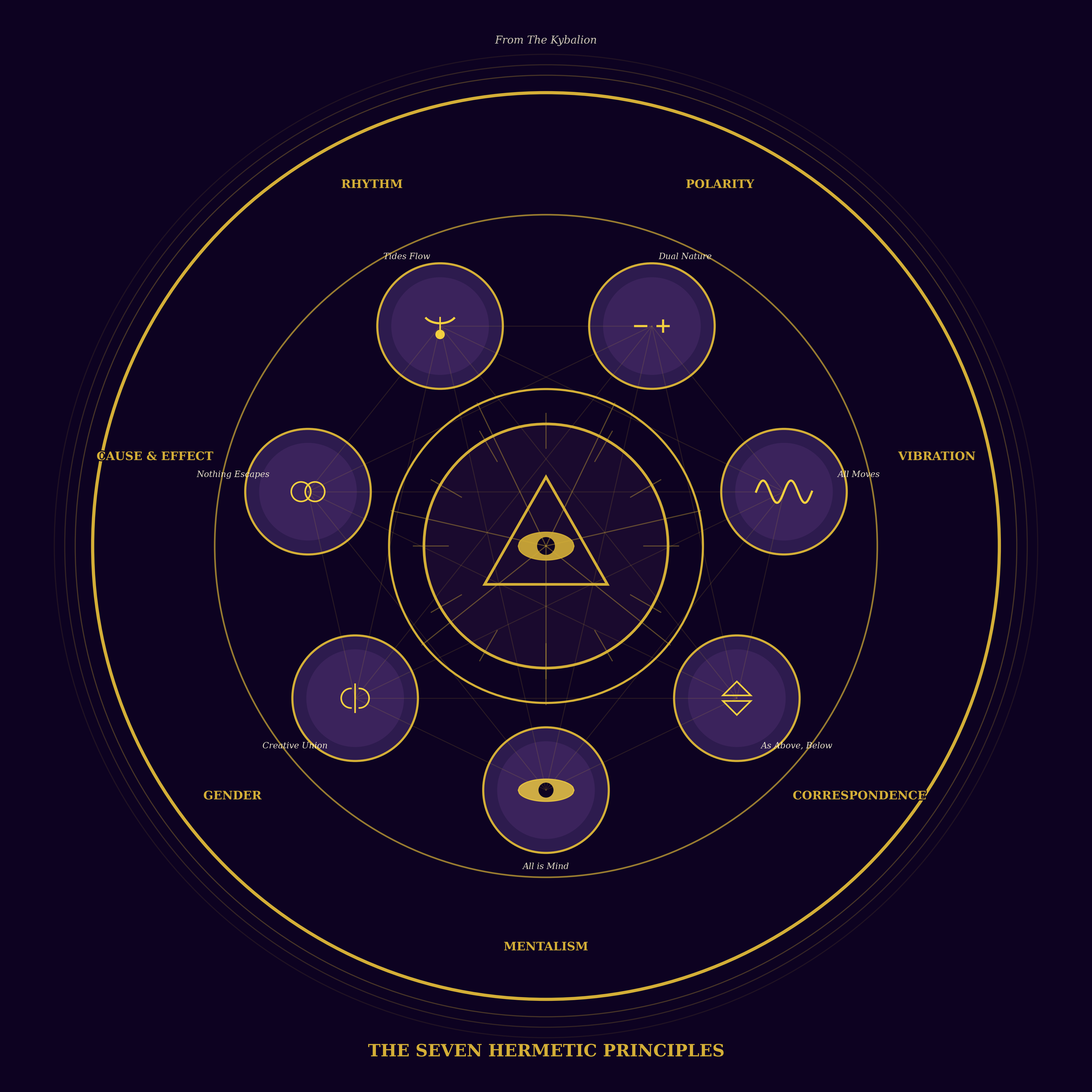
The 1908 Kybalion organized these diffuse teachings into seven clean principles and added concepts reflecting the intellectual climate of its time:1
- The Principle of Vibration, while having ancient roots, was elaborated using 18th-19th century physics concepts
- The psychological framing reflects the emergence of modern psychology
- The systematic organization mirrors the period’s love of classification
None of this makes the principles false. Many profound truths have been articulated differently across eras. The question isn’t whether the Kybalion is “really ancient”—it’s whether these principles describe something real about how reality works.
Why This Matters for The Normal Map
In our framework, we’ve established:
- Chapter 8 (3D/4D/5D): The vertical dimension—your relationship with yourself across dimensions of Mind, Field, and Soul
- Chapter 10 (333 Triad): The horizontal dimension—how consciousness communicates through Expression, Reception, and Resonance
- Chapter 12: The hardware—the structural patterns that shape reality’s form
Now we need the software—the operating principles that run on that geometric hardware. The Hermetic Principles provide exactly this: a description of how reality behaves, the logic underlying manifestation.
Think of it this way: Sacred Geometry is the architecture of a computer. The Hermetic Principles are the operating system that makes the architecture functional.
Tyler Moment: When the Principles Found Me
I didn’t find the Hermetic principles through study. They found me through failure.
I was 28, convinced I had life figured out, when everything I’d built collapsed in the span of six months. Relationship. Career. Health. The identity I’d constructed so carefully revealed itself as construction, and I was left with the uncomfortable question: if that wasn’t who I am, then who am I?
A friend gave me a copy of the Kybalion. I almost didn’t read it—the language felt archaic, the claims grandiose. But I was desperate enough to try anything.
What I found wasn’t comfort. It was something stranger: recognition. The principle of Mentalism—that consciousness is fundamental—reframed my collapse. I hadn’t lost myself; I’d lost a mental construction of myself. The principle of Correspondence—as above, so below—helped me see patterns connecting my inner chaos to the external chaos I’d created. The principle of Rhythm explained why fighting the low period only extended it.
I’m not saying these principles are scientifically true. I’m saying they gave me a framework to navigate experience when nothing else worked. That’s worth something, even if I can’t prove it in a lab.
What I’ve learned since: the Hermetic principles work best not as beliefs to adopt but as lenses to try on. Look through them at your own experience. See what becomes visible that wasn’t before. Then decide if they’re useful for your map.
5.3 The Principle of Mentalism
“THE ALL is MIND; The Universe is Mental.”
Everything you have ever experienced has occurred within consciousness. Every sunset, every heartbreak, every moment of wonder—all of it happened in awareness. You have never perceived a single thing “outside” of mind because the very act of perception is mental.
This isn’t solipsism (the belief that only your individual mind exists). It’s the recognition that consciousness is the medium in which all experience arises. Like fish who cannot see the water they swim in, we rarely notice the mind we exist within.
Hermeticism holds that THE ALL—the ultimate reality, whatever we call it—is not a being separate from creation. THE ALL is Mind Itself. The universe doesn’t exist in space and time; space and time exist within the Mind of THE ALL. You are a thought in the Mind of the Infinite, thinking itself.1
Modern Scientific Parallel
The observer effect in quantum mechanics demonstrates that particles exist in probability states until measured. Measurement or interaction—not consciousness specifically—collapses the wave function into definite states. While the leap from quantum particles to everyday reality is debated, the finding itself is remarkable.
Placebo research shows that belief alone can produce measurable physiological changes:
- Placebo surgeries for knee osteoarthritis show improvement rates comparable to actual surgery in some studies
- Placebo treatments can release endogenous opioids, dopamine, and other neurochemicals
- The nocebo effect (negative expectations causing harm) is equally documented
Neuroplasticity research confirms that repeated mental patterns physically restructure brain tissue. Neurons that fire together wire together. Your thoughts are not merely ephemeral—they are sculptors of your neural architecture.
Research on meditation and intention suggests that sustained mental states can influence physiology beyond what simple relaxation would predict. While mechanisms remain under investigation, the data accumulates.
Interactive 3D Visualization
Explore quantum dynamics interactively. Watch wave functions, probability clouds, and entangled particles demonstrate the principles of correspondence. Drag to rotate, scroll to zoom.
3D/4D/5D Mapping
- 3D Application: Your conscious thoughts (what you deliberately think) represent the surface layer. This is the “user interface” of mind.
- 4D Application: Your subconscious mind—beliefs, memories, patterns operating below awareness—is where the real programming runs. This is the 4D Plasma Field of habitual thought-forms (see Chapter 14).
- 5D Application: Pure awareness itself—the “I AM” that witnesses thoughts without being the thoughts. The screen on which the movie plays. Accessing 5D consciousness means recognizing yourself as awareness, not as the content of awareness.
| Element | Mentalism Application |
|---|---|
| Stillness | Primary domain. Meditation reveals thoughts as objects in awareness, not as awareness. You discover that you are not your thoughts—you are the witness of thoughts. |
| Breath | The bridge between conscious and unconscious mind. Rapid breathing creates chaotic thought; slow breathing creates calm. You can program mental states through breath patterns. |
| Movement | Embodied cognition research confirms that posture affects mental state. Depression creates collapsed posture; collapsed posture reinforces depression. Change the body, change the mind. |
Daily Application
If everything you experience occurs within consciousness, and if your mental patterns shape your neural architecture (and possibly influence broader reality), then thought hygiene becomes as important as physical hygiene.
Morning Mental Reset: Upon waking, before any external input, spend two minutes in silence before reaching for your phone. Notice whatever thought arrives first. Don’t follow it — just notice it arrived.
Throughout the Day: When you catch yourself in repetitive negative thinking, pause. Ask: “Who is aware of this thought?” That question is the whole practice. It shifts you from being in the thought to being the witness of the thought — the doorway from 3D to 5D.
Ponder This: If everything you’ve ever experienced has occurred within consciousness, then what exactly is “outside” of you? And if your beliefs shape your neurobiology and potentially influence quantum probability… what is the logical conclusion about the power you hold?
If Mentalism tells you what everything is made of, the next principle shows you how the pieces relate to each other.
5.4 The Principle of Correspondence
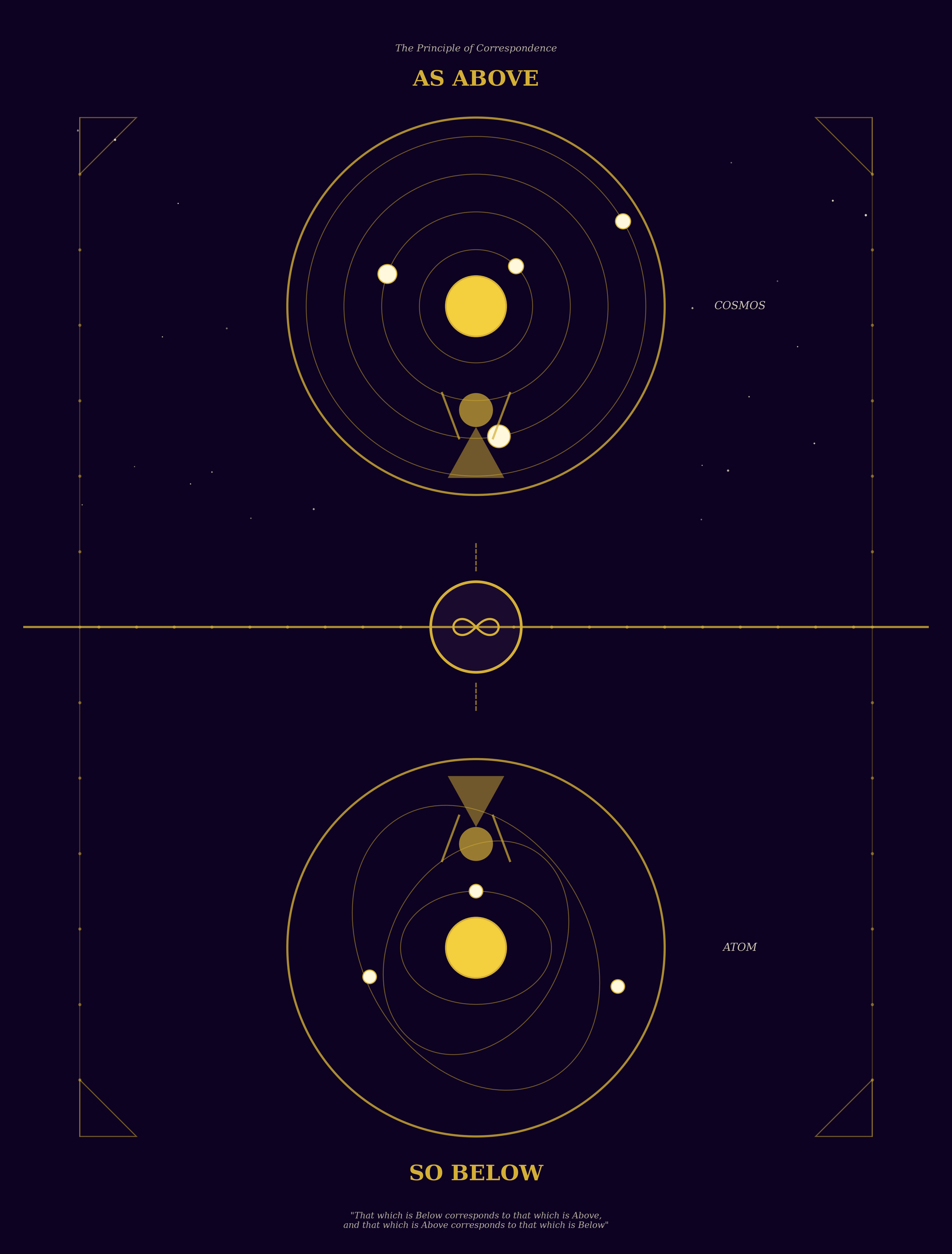
“As above, so below; as below, so above.”
This is the most famous phrase in Hermeticism, and it contains a radical claim: reality is fractal. The patterns that govern the cosmos govern the atom. The dynamics of your inner world mirror the dynamics of your outer circumstances. Nothing exists in isolation; everything reflects everything else.
The Emerald Tablet continues: “…to accomplish the miracles of the One Thing.” Correspondence is not merely observation—it’s technology. If you can affect one level, you affect all levels. Change the “below” (your body, your habits), and you shift the “above” (your mind, your connection to larger patterns). Change the “above” (your beliefs, your intentions), and you transform the “below” (your health, your circumstances).
This is the Hermetic basis for what traditions call “magic”—not supernatural intervention, but leveraging the fractal nature of reality to create change across scales.
You may have noticed this chapter repeats a pattern. Principle, explanation, parallel, mapping, practice. Seven times. That’s Correspondence. You’re not just reading about self-similarity — you’re inside one.
Modern Scientific Parallel
Holographic principles: In a hologram, each part contains information about the whole. Cut a hologram in half, and you get two complete (though fuzzier) images, not two halves.
Fractal mathematics describes patterns that self-repeat across scales:
- Coastlines look jagged whether viewed from satellites or from ankle height
- Blood vessel branching patterns mirror river delta patterns mirror lightning patterns mirror tree branches
- The ratio relationships in your hand bones echo the ratio relationships in spiral galaxies
Systems biology reveals that patterns at cellular level correspond to patterns at organ level correspond to patterns at organism level. Your cells’ communication patterns predict your social communication patterns.
Research on heart rate variability shows that your inner coherence state corresponds to measurable changes in how others respond to you. Internal states create external effects through mechanisms we’re only beginning to map.2
3D/4D/5D Mapping
The Correspondence principle IS the mechanism of the 3D/4D/5D model:
- 5D (Soul) broadcasts a signal of essential truth
- 4D (Field) receives, filters, and translates according to stored patterns
- 3D (Body/Mind) experiences the translated signal as thought, emotion, sensation
If your 4D filter is coherent, the 5D signal arrives clearly. You feel aligned, guided, in flow. If your 4D filter is decoherent (trauma, limiting beliefs), the 5D signal arrives distorted. You feel lost, anxious, disconnected.
The Practical Implication: Your outer circumstances are not happening to you. They are corresponding with something inside you. Every external problem is also an internal mirror. This is not blame—it’s power. If you are the cause at some level, you can be the cure.
| Element | Correspondence Application |
|---|---|
| Movement | Your outer movement reflects your inner state. Watch someone grieving: shoulders forward, head down, contracted. Watch someone joyful: chest open, head lifted, expansive. You can read the soul in the gait—and write to the soul through the gait. |
| Stillness | In stillness, correspondence between thought and body sensation becomes obvious. “Where do you feel that emotion?” is literal, not rhetorical. Anger in the jaw. Fear in the belly. Grief in the chest. |
| Breath | The ultimate correspondence bridge—both voluntary AND involuntary. It sits at the exact threshold of conscious and unconscious. Breath is the Vesica Piscis of your physiology—the portal between worlds. |
Daily Application
The Mirror Practice: When you encounter an external challenge, before strategizing about how to change the outer situation, ask:
- “What inside me might this be reflecting?”
- “What belief or pattern could be corresponding to this circumstance?”
- “If I shift something within, might the without also shift?”
This isn’t about self-blame. It’s about recognizing leverage points. Sometimes the most efficient way to change your circumstances is to change your correspondence with them.
Ponder This: The world is not only happening to you. Part of it is reflecting something within you. This is not blame — systemic forces, other people’s choices, and genuine bad luck are all real. But where you have a mirror, you have a lever. That’s power.
5.5 The Principle of Vibration
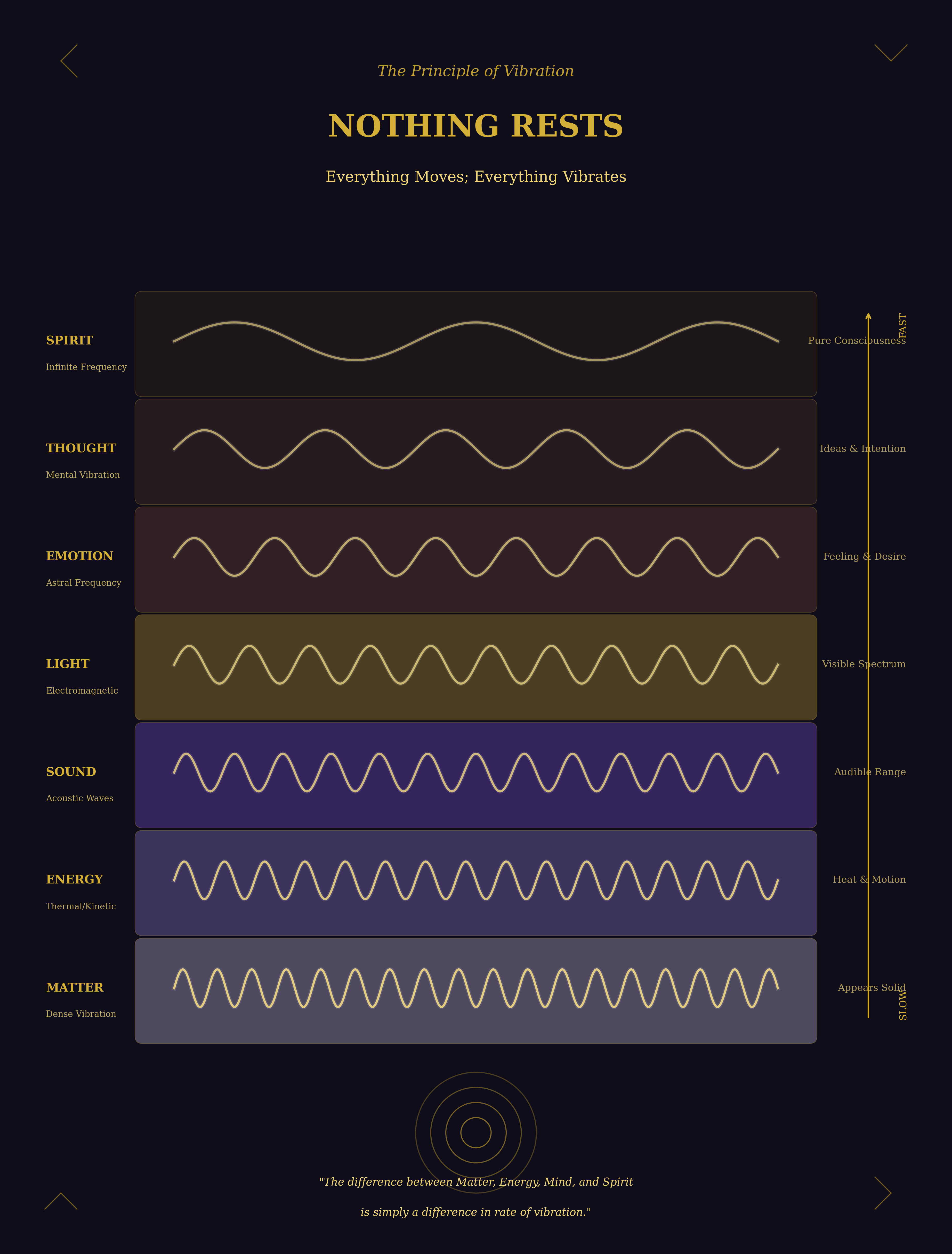
“Nothing rests; everything moves; everything vibrates.”
Reality is not still. Not for a nanosecond. The chair you sit on, the wall you lean against—at the quantum level, they are seething oceans of probability waves and vibrational patterns. “Solid” is an interpretation your nervous system creates, not an objective feature of matter.
Hermeticism teaches that the difference between matter, energy, mind, and spirit is simply a difference in rate of vibration. Matter vibrates slowly (dense, tangible). Thought vibrates faster (fluid, invisible). Spirit vibrates so rapidly it appears still—like a fan blade at full speed looking like a solid disc.1
While the concept of universal vibration has ancient roots, the specific scientific framing in The Kybalion reflects 18th-19th century physics. This doesn’t invalidate the principle—modern physics confirms that all matter is indeed vibrational at the quantum level—but we should be honest about the historical layers.
Modern Scientific Parallel
Quantum field theory describes all matter as vibrating energy fields. What we experience as particles are actually patterns of vibration in underlying fields.
Cymatics (Chapter 12) demonstrates that sound frequencies create geometric patterns in matter. Your body is 70% water. Your cells contain fluid. Your emotional states are vibrational patterns that may influence your cellular structure.
Brainwave research shows consciousness operates at different frequencies—from Beta’s active thinking through Alpha, Theta, Delta, and Gamma’s peak integration (see the brainwave frequency table in Chapter 8 for the full spectrum). HeartMath research suggests the heart generates electromagnetic frequencies that extend beyond the body and may influence others’ physiological states.3
3D/4D/5D Mapping
- 3D Vibration: Physical sound, light, molecular motion—measurable with instruments
- 4D Vibration: Emotional frequency, “mood,” energetic quality—felt but harder to measure (though HRV and EEG are beginning to quantify it)
- 5D Vibration: Love as the frequency that harmonizes all other frequencies—the “Omniphotonic” coherence (see Section 14.9)
Clarification: It’s not quite accurate to say “raise your vibration” as if it’s a simple ladder. More precise: harmonize your vibration. A perfectly coherent low tone can be more powerful than a chaotic high one. Coherence, not mere speed, is the goal.
| Element | Vibration Application |
|---|---|
| Stillness | Primary domain. Sound healing, binaural beats, chanting—these are Stillness practices that directly entrain vibrational states. The “OM” sound literally vibrates the vagus nerve. |
| Breath | Breath creates vibration. Every exhale can become a hum. Controlled breath rate shifts brainwave frequency (slow breath = lower Hz = Alpha/Theta access). |
| Movement | Movement IS vibration made visible. Dancing, walking rhythms, even therapeutic shaking (TRE)—all use vibration to shift states and release stored patterns. |
Daily Application
The Vibrational Inventory: Several times daily, pause and ask: “What frequency am I broadcasting right now?” Not judging, just noticing.
You are a tuning fork walking through the world. Whatever frequency you vibrate, you will resonate with matching frequencies in your environment. This is the mechanism of “attraction”—not magical thinking, but resonance physics applied to consciousness.
Ponder This: Who are you attracting? What are the people and events in your life showing you about your frequency?
From vibration — the texture of what is — we turn to its structure: not one pole but two, always two, always the same.
5.6 The Principle of Polarity
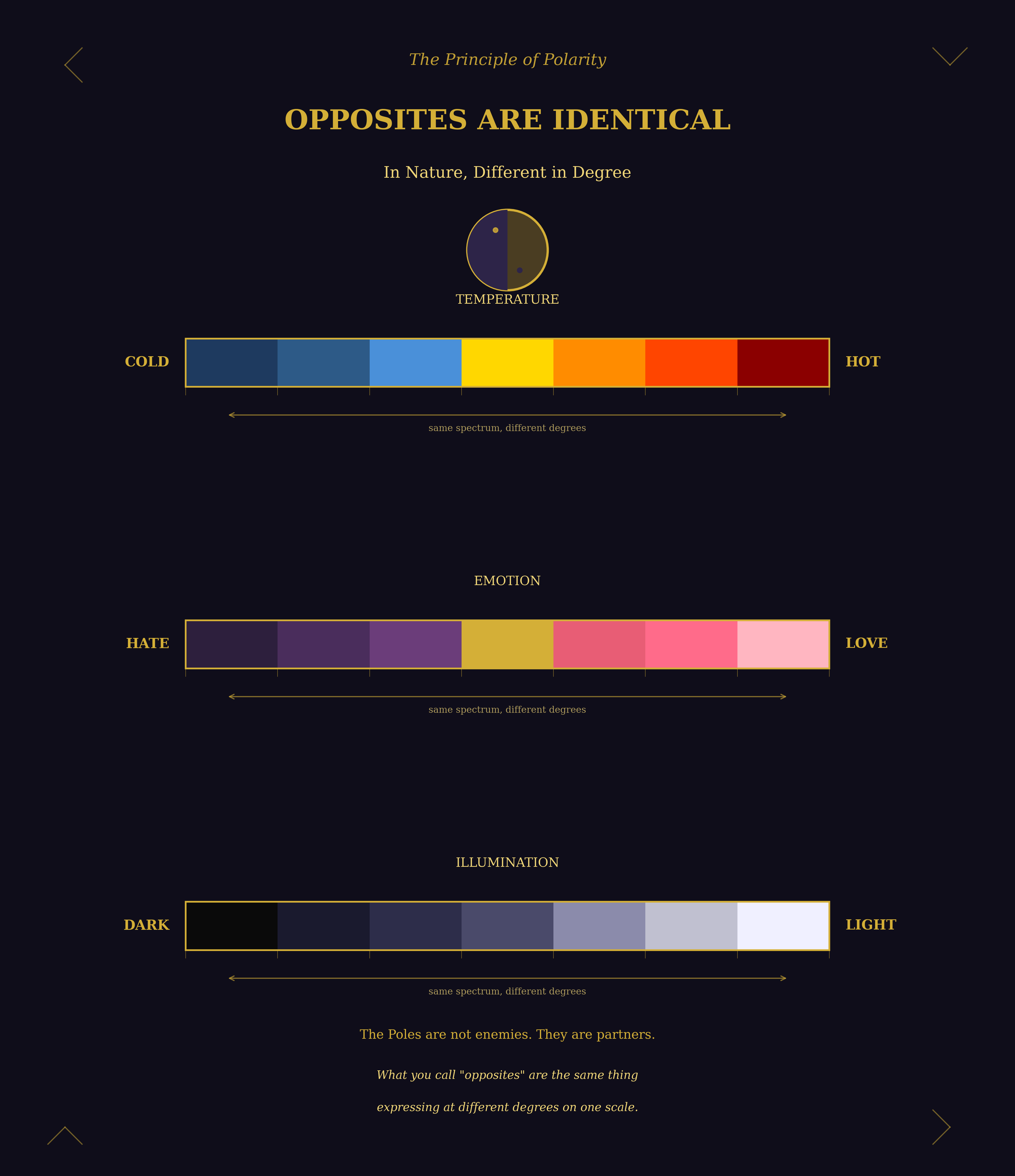
“Everything is Dual; everything has poles; everything has its pair of opposites… opposites are identical in nature, but different in degree.”
Most people think in binaries: good versus evil, light versus dark, love versus hate—separate things at war.
Hermeticism says: No. Opposites are the same thing at different degrees. Heat and cold are both temperature. Love and hate are both intense emotional bond. Courage and fear are both awareness of danger. The difference is not type—the difference is position on a single spectrum.
The practical implication is radical: You can slide along the spectrum. If you feel fear, you don’t need to destroy fear and manufacture a separate thing called courage. You transmute fear into courage by moving along the spectrum. You’re already on the line; you just need to shift your position.1
This is the basis of alchemical transmutation. Turn lead (dense, dull) into gold (luminous, valuable). Turn despair into hope. Turn rage into focused power. The material isn’t replaced—it’s elevated.
Modern Scientific Parallel
Dialectical Behavior Therapy (DBT), developed by Marsha Linehan, is built on the recognition that opposites can both be true. Acceptance AND change. Validation AND challenge. The therapeutic breakthrough comes not from choosing one pole but from holding both.
The autonomic nervous system operates on polarity:
- Sympathetic (activation, mobilization, fight/flight)
- Parasympathetic (relaxation, restoration, rest/digest)
Health requires not eliminating one pole but balancing between them. Pure sympathetic = anxiety and burnout. Pure parasympathetic = collapse and depression. The healthy organism oscillates.
Neurotransmitter balance: Excitatory and inhibitory neurotransmitters must balance. Too much of either creates pathology. The brain needs both poles.
3D/4D/5D Mapping
- 3D Polarity: Physical opposites—hot/cold, light/dark, up/down. These feel absolute from within 3D.
- 4D Polarity: Emotional spectrums—love/hate, fear/courage, grief/joy. Here you can feel that these are the same energy at different degrees.
- 5D Perspective: From 5D, polarities are seen as complementary expressions of unified reality. Not opposites at war but dance partners in a cosmic rhythm.
| Element | Polarity Application |
|---|---|
| Movement | Movement oscillates between effort and ease, tension and release, expansion and contraction. Understanding movement polarity allows conscious shifting between states. Yang (vigorous) and Yin (restorative) movement are complements, not competitors. |
| Stillness | Stillness is the center point of the pendulum. In meditation, you observe the play of opposites without identifying with either pole. Stillness reveals the unity beneath polarity. |
| Breath | Inhale and exhale are the primordial polarity. Alternate nostril breathing (Nadi Shodhana) specifically balances left/right, solar/lunar polarity. Breath teaches that opposites are one rhythmic whole. |
Daily Application
Polarity Transmutation: When caught in a negative emotional state:
- Name the emotion clearly (fear, anger, sadness)
- Identify its polar opposite (courage, peace, joy)
- Recognize: both exist on the same spectrum—you already contain the opposite
- Ask: “What thought or action would shift me toward the other pole?”
You’re not creating something new. You’re moving along a spectrum you’re already on.
Ponder This: Name the quality you judge most fiercely in others. Now sit with this: Polarity says that’s not your enemy. That’s your disowned twin.
5.7 The Principle of Rhythm
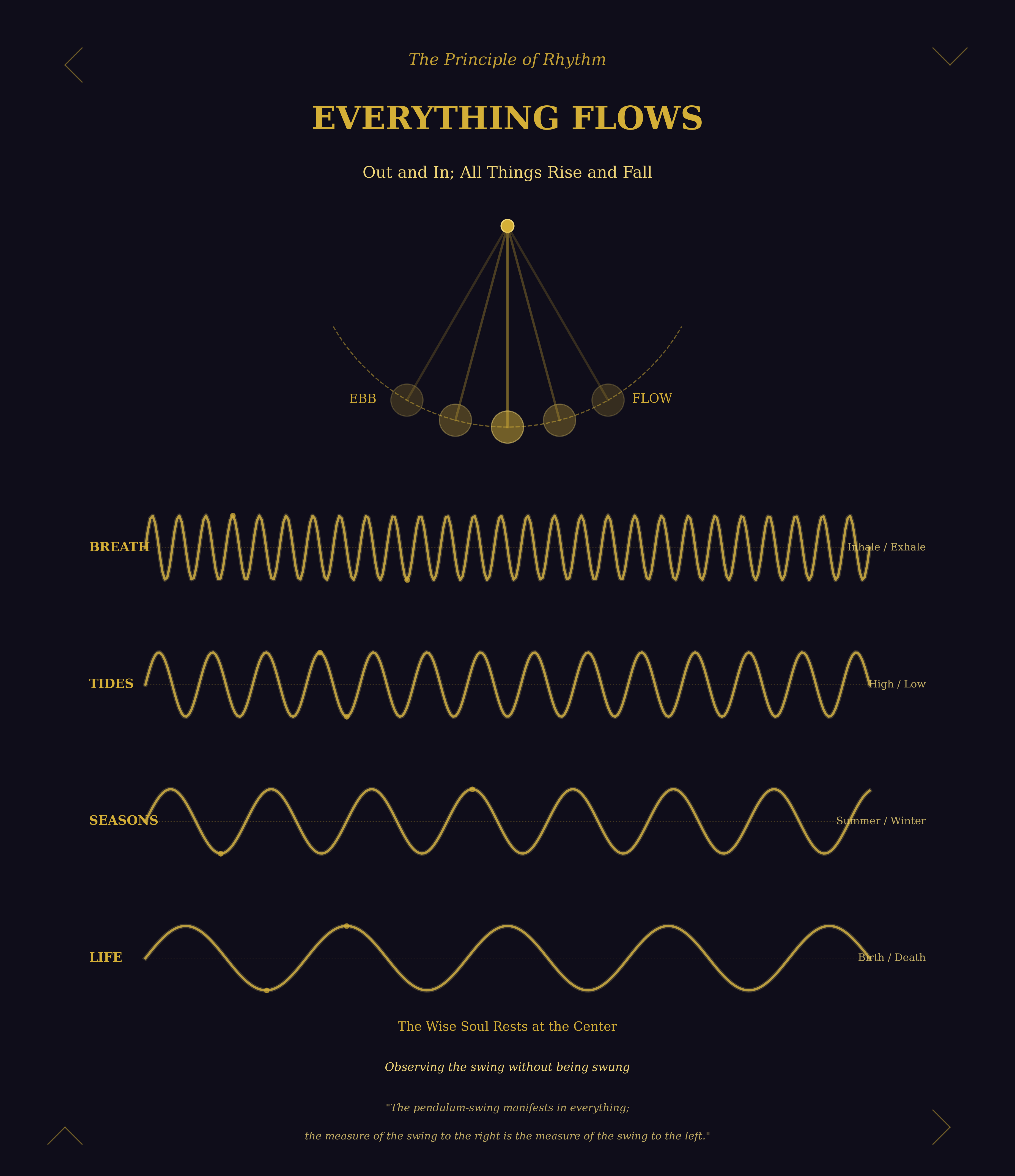
“Everything flows, out and in; everything has its tides; all things rise and fall.”
The pendulum swings. Always. There is no permanent high, no eternal low. The moon waxes and wanes. Tides ebb and flow. Economies boom and bust. Your energy rises in the morning and falls at night. Enthusiasm builds and recedes. This is not failure—this is rhythm.
The Kybalion teaches that masters don’t fight rhythm—they work with it. They “polarize themselves at the point at which they desire to rest, and then neutralize the rhythmic swing of the pendulum which would tend to carry them to the other pole.”1
In other words: you can’t stop the pendulum, but you can choose where on the arc you stabilize.
Modern Scientific Parallel
Circadian rhythms govern nearly every biological process:
- Cortisol peaks in morning (energy, alertness)
- Melatonin rises at night (sleep, restoration)
- Body temperature fluctuates predictably
- Cognitive function peaks and troughs at consistent times
Fighting circadian rhythm creates disease. Aligning with it creates health.
Ultradian rhythms (90-120 minute cycles) govern attention and performance throughout the day. Your body naturally wants to pulse between focus and rest. Ignoring this creates burnout; honoring it creates sustainable high performance.
Heart Rate Variability (HRV) is itself a rhythm measure. Higher HRV (more rhythmic flexibility) correlates with better health, emotional regulation, and cognitive function.2
Sleep cycles run approximately 90 minutes through stages of light, deep, and REM sleep. Waking mid-cycle creates grogginess; waking between cycles creates alertness.
3D/4D/5D Mapping
- 3D Rhythm: Mechanical cycles—heartbeat, breath, circadian. Measurable, predictable.
- 4D Rhythm: Emotional and energetic cycles—mood fluctuations, creative rhythms, relational patterns. Less predictable but still rhythmic.
- 5D Rhythm: The rhythm of consciousness itself—expansion and contraction of awareness, the pulse of presence.
| Element | Rhythm Application |
|---|---|
| Breath | Primary domain. Breath IS rhythm—the master oscillation of the body. Coherent breathing (5:5 ratio) synchronizes heart, brain, and nervous system rhythms. |
| Movement | All movement involves rhythm—gait, exercise cadence, dance. Rhythmic movement (walking, running, swimming) can induce meditative states. |
| Stillness | In stillness, you become aware of the body’s subtle rhythms—heartbeat, breath, even cerebrospinal fluid pulse. Stillness isn’t absence of rhythm but conscious witnessing of it. |
Daily Application
Trust the Low Points: When energy ebbs, rest rather than resist. The upswing is coming. Pushing through troughs depletes resources; resting through them allows restoration.
Ponder This: Where are you in your current life rhythm? Are you in a waxing phase (growth, expansion, energy rising) or a waning phase (consolidation, rest, energy retreating)? Are you honoring the phase you’re in? The wise farmer plants in spring, harvests in autumn, and rests in winter. They don’t scream at the sky for failing to produce fruit in December. What season is your soul in right now?
5.8 The Principle of Cause and Effect
“Every Cause has its Effect; every Effect has its Cause.”
Nothing happens by chance. What appears as luck or accident is simply a cause not yet recognized. Every circumstance in your life is the effect of prior causes—beliefs, choices, actions, patterns. And every action you take now is a cause creating future effects.
The Kybalion teaches that masters “rise to the plane above”—they operate on the level of mental and spiritual causation rather than being merely reactive at the physical level. Instead of being pushed around by effects, they work consciously with causes.1
This is the Hermetic understanding of karma: not cosmic punishment, but simply the law that every cause produces an effect. What you sow, you reap. Not because someone is watching and judging, but because that’s how reality works.
Modern Scientific Parallel
Cognitive behavioral models are built on cause and effect:
- Situations trigger thoughts
- Thoughts create emotions
- Emotions drive behaviors
- Behaviors create outcomes
Each link is a cause-effect relationship. Change any link, change the chain.
Trauma research shows how early experiences (causes) create lifelong patterns (effects) that persist until consciously addressed. The body keeps the score—effects remain until causes are processed.4
Neuroplasticity: Every thought you think strengthens certain neural pathways and weakens others. Today’s thoughts are causes; tomorrow’s brain structure is the effect.
Epigenetics: Lifestyle choices cause changes in gene expression that affect future generations. Your choices today are causes with effects extending beyond your own life.
3D/4D/5D Mapping
- 3D Causation: Physical cause and effect. Dominoes falling. Billiard balls striking each other. The level most people recognize.
- 4D Causation: Emotional and mental cause and effect. Beliefs creating perceptual filters. Expectations shaping experience. Patterns recurring until resolved.
- 5D Causation: Consciousness itself as causal. Intention as creative force. The level where masters operate—causing from awareness rather than being caused by circumstances.
| Element | Cause and Effect Application |
|---|---|
| Movement | Every movement pattern has causes (beliefs, habits, trauma) and creates effects (posture, pain, capability). Changing movement patterns plants new causal seeds. |
| Stillness | Meditation reveals causal chains in thought. You see how one thought leads to another leads to emotion leads to action. In stillness, you can intervene between stimulus and response. |
| Breath | Breath is both effect (reflecting emotional state) and cause (creating nervous system states). Conscious breath is deliberate causation—choosing the breath pattern to create desired effects. |
Daily Application
The Cause Chain Exercise: When facing a recurring problem:
- Name the unwanted effect (the problem)
- Ask: “What might be the immediate cause of this?”
- Then: “What caused that?”
- Continue tracing back 5-7 levels
- You’ll likely arrive at a core belief or pattern
- Identify one point in the chain where you have leverage
- Take action there—plant a new cause
Radical Responsibility: This isn’t about blame. It’s about power. If your current circumstances are effects of prior causes, and if you can work with causes, then you have agency. You’re not a victim of random chance—you’re a creator who may not have been creating consciously.
Ponder This: What patterns keep repeating in your life? The same type of relationship? The same financial struggle? The same health issue? These are effects. What is the cause? And what is the cause of that cause? Trace the chain backward. Often, you will find a core belief, a foundational trauma, a family pattern you absorbed as a child. Finding the cause is half the battle. Change the cause, change the effect.
5.9 The Principle of Gender
“Gender is in everything; everything has its Masculine and Feminine Principles.”
This principle requires careful framing because it’s easily misunderstood. It has nothing to do with biological sex or social gender roles. It describes complementary energies present in ALL things—in nature, in creativity, in consciousness itself.
The Kybalion explicitly states that “Mental Gender” should not be confused with physical sex. The masculine principle is generative, directive, projecting. The feminine principle is receptive, creative, nurturing. Neither is complete without the other. All creation requires both.1
Think of electricity: positive and negative charges. Neither is better; both are necessary. Or think of creation itself: generating an idea (masculine) and developing that idea into full form (feminine).
Modern Scientific Parallel
Carl Jung’s Anima/Animus: Every individual psyche contains both masculine and feminine elements. Psychological wholeness requires integrating both, regardless of biological sex.5
Creative process research shows creation requires both phases:
- Generating options, brainstorming, initiating (more “masculine”)
- Incubating, selecting, developing, nurturing to completion (more “feminine”)
Skip either phase and creation fails.
The autonomic nervous system has gender-like polarity:
- Sympathetic (mobilizing, active, “masculine”)
- Parasympathetic (restoring, receptive, “feminine”)
Health requires balance, not dominance of either.
Hemispheric collaboration:
- Left hemisphere (sequential, logical, analytical—more “masculine”)
- Right hemisphere (holistic, intuitive, relational—more “feminine”)
Optimal cognition integrates both.
3D/4D/5D Mapping
- 3D Gender: Physical polarity—electrical charges, atomic structures, magnetic poles
- 4D Gender: Creative and emotional polarity—action and receptivity, giving and receiving, expression and listening
- 5D Gender: The unified field containing both principles—consciousness prior to the split into masculine and feminine expressions
| Element | Gender Application |
|---|---|
| Movement | Masculine movement: vigorous, directed, effortful (strength training, running, martial arts). Feminine movement: flowing, surrendered, effortless (yin yoga, flowing dance). Balance requires both. |
| Stillness | Stillness itself is primarily feminine—receptive, allowing, witnessing. Yet the discipline to sit and focus is masculine. True meditation balances focused effort with surrendered awareness. |
| Breath | Inhale has feminine quality (receiving, filling, absorbing). Exhale has masculine quality (giving, emptying, releasing). Full breath integrates both polarities. |
Daily Application
Gender Balance Check:
- Signs of masculine excess: Burnout, over-controlling, inability to receive, constant doing
- Signs of feminine excess: Passivity, inability to assert, avoidance of action, stagnation
Integration Practice: Notice which polarity you tend to over-emphasize. If you’re always doing, practice receiving. If you’re always waiting, practice initiating. Wholeness requires access to both poles.
Ponder This: Where are you imbalanced in the gender principle? The goal is not to be 50/50 at all times—it is to have access to both poles and to appropriately deploy them moment by moment.
5.10 The Somatic Experience - How the Principles Live in Your Body
The Hermetic Principles are not abstractions to understand—they are realities to embody. Your body is already demonstrating every principle; the question is whether you’re conscious of it.
The Body as Laboratory
Mentalism in the Body: Notice how your thoughts change your physical state. Think of something stressful—feel your shoulders rise, your breath shorten, your jaw clench. Think of something beautiful—feel your chest soften, your breath deepen, your face relax. The body proves that mind affects matter.
Correspondence in the Body: Where you hold tension corresponds to what you’re holding psychologically. Jaw tension corresponds to suppressed expression. Belly tension corresponds to anxiety about survival. Heart tension corresponds to grief or guarding. The body maps the psyche.
Vibration in the Body: Hum for thirty seconds and feel the resonance through your tissues. Your body is a vibrational instrument. Different emotional states create different cellular vibrations. You can feel this directly.
Polarity in the Body: Notice the constant oscillation—heart beating, breath flowing, nervous system pulsing between activation and rest. Your body lives in polarity every moment.
Rhythm in the Body: Notice your natural energy rhythms through the day. Notice how forcing action during low points depletes you while flowing with high points energizes you. Your body knows rhythm.
Cause and Effect in the Body: Every posture you hold creates effects—structural, emotional, energetic. Your current body is the effect of a lifetime of postural causes. Change your patterns, change your body.
Gender in the Body: Notice your breath—the feminine receptivity of inhale, the masculine release of exhale. Feel how movement requires both effort (masculine) and surrender (feminine). Your body integrates these polarities with every gesture.
The Somatic Triad as Hermetic Practice
| Principle | Movement Practice | Stillness Practice | Breath Practice |
|---|---|---|---|
| Mentalism | Move with intention, noticing how thought directs body | Witness thoughts arising and passing | Notice how breath follows and leads thought |
| Correspondence | Let outer movement reflect inner state | Notice where emotions live in the body | Use breath as bridge between inner and outer |
| Vibration | Feel movement as vibration made visible | Enter vibrational states through stillness | Create vibration through humming, toning |
| Polarity | Balance effort and ease, tension and release | Witness polarities without identifying | Balance inhale and exhale, active and receptive |
| Rhythm | Move in rhythm, find natural cadence | Rest in stillness, trust the cycle | Establish rhythmic breath patterns |
| Cause and Effect | Notice how movement patterns create body effects | See causal chains of thought | Use breath as conscious cause |
| Gender | Balance yang and yin movement | Balance focus and surrender | Balance receiving inhale, giving exhale |
5.11 The 3D/4D/5D Integration
How the Principles Operate Across Dimensions
The seven principles are not separate laws but facets of one truth. They interconnect systematically:
- Mentalism establishes that all is consciousness
- Correspondence shows that consciousness operates the same at all scales
- Vibration reveals that consciousness moves at various frequencies
- Polarity demonstrates that vibration creates complementary opposites
- Rhythm shows that polarity swings between extremes
- Cause and Effect explains how rhythm creates sequential manifestation
- Gender reveals the creative mechanism through which causes produce effects
The Dimensional View
| Principle | 3D Expression | 4D Expression | 5D Expression |
|---|---|---|---|
| Mentalism | Thoughts affect body | Subconscious programs reality | Pure awareness witnesses all |
| Correspondence | Physical patterns repeat | Psyche mirrors circumstance | All reflects One |
| Vibration | Matter as frequency | Emotions as vibration | Love as ultimate coherence |
| Polarity | Physical opposites | Emotional spectrums | Unity containing all poles |
| Rhythm | Circadian cycles | Emotional tides | Expansion/contraction of consciousness |
| Cause and Effect | Physical causation | Mental/emotional causation | Intentional creation |
| Gender | Physical polarity | Creative dynamics | Unified field prior to polarity |
The Operating System Metaphor
If Sacred Geometry is the hardware—the structural architecture of reality—then the Hermetic Principles are the operating system—the logic that makes the hardware functional.
- BIOS: Mentalism—consciousness is the foundation
- Kernel: Correspondence—the fractal self-similarity that allows communication between levels
- Drivers: Vibration, Polarity, Rhythm—the operational dynamics
- User Interface: Cause and Effect, Gender—how the user (you) interacts with the system
Understanding the operating system doesn’t let you break the rules. It lets you work with them skillfully rather than fighting them unconsciously.
5.12 Integration Practice - One Principle, One Week
Deepening Through Focus
Rather than trying to apply all seven principles at once, the most effective approach is focused exploration of one principle at a time.
Week 1 - Mentalism: Focus entirely on the relationship between thought and experience. Notice how mental patterns create emotional and physical states. Practice thought-watching. Ask repeatedly: “Who is aware of this thought?”
Week 2 - Correspondence: Focus on mirrors and reflections. What is your outer life reflecting about your inner life? Where do you see the same pattern repeating at different scales?
Week 3 - Vibration: Focus on frequency. What is your dominant vibration? What raises it? What lowers it? Experiment with sound, movement, emotional cultivation.
Week 4 - Polarity: Focus on spectrums. When caught in a negative state, practice recognizing it as one pole of a spectrum you’re already on. Practice moving along the spectrum.
Week 5 - Rhythm: Focus on cycles. Map your energy rhythms. Notice where you fight natural rhythms versus flow with them. Practice trusting low points.
Week 6 - Cause and Effect: Focus on causation. Trace recurring problems back to their causes. Notice what causes you’re planting with today’s thoughts and actions.
Week 7 - Gender: Focus on creative balance. Notice where you over-emphasize one polarity. Practice developing the less-developed pole. Balance action with receptivity.
For detailed practices corresponding to each principle, see Chapter 17.
5.13 Chapter Summary
The Hermetic Principles are the operating system running on the hardware of Sacred Geometry — seven principles formalized in The Kybalion (1908) that synthesize genuinely ancient ideas into a working description of how reality behaves. Each principle maps across 3D, 4D, and 5D, and each lives not just as concept but as direct somatic experience — your breath, your posture, your nervous system are already running this code. The question is whether you’re a user or a sysadmin.
For Your Journey
Which principle resonates most strongly with you? Which feels most foreign or challenging? Often, the principle that feels most difficult is the one most needed.
Consider: If you were to pick just one principle to work with this week, which would it be? What would it look like to truly embody that principle—not just understand it, but live from it?
The practices in Chapter 17 offer systematic ways to engage each principle through the Somatic Triad. But even without formal practice, you can begin by simply noticing—watching for each principle’s expression in your daily life.
Bridge to Chapter 6
We’ve now established the complete foundational framework of The Normal Map:
- Chapter 1: The vertical dimension (3D/4D/5D)—who you are across dimensions
- Chapter 2: The horizontal dimension (333 Triad)—how you communicate with others
- Chapter 3: The hardware (Sacred Geometry)—the structural patterns of reality
- Chapter 4: The substrate (Plasma Consciousness)—what fills the geometric forms
- Chapter 5: The software (Hermetic Principles)—the operating logic of reality
These principles are universal, which is another way of saying they’re nowhere until you put them somewhere. The next three chapters are about the somewhere: your body in motion, in stillness, and in breath.
Now we’re ready to put this framework into motion—literally. In Chapter 6: Movement as Medicine, we’ll explore how conscious movement becomes the practice that integrates everything we’ve learned. The body in motion is where theory becomes transformation.
The map is complete. Now we walk it.