17 Movement Medicine
18 Movement Medicine
6.1 Opening: The Man Who Stopped Running
“The body is your temple. Keep it pure and clean for the soul to reside in.” — B.K.S. Iyengar
Daniel ran marathons. Thirty-two of them in fifteen years. He was the guy at the office everyone called “crazy dedicated,” the one who logged his miles religiously, who had completed an Ironman triathlon at forty-three. He measured his worth in splits and finish times and the number on the bathroom scale.
Then his knee gave out.
Not dramatically—no heroic injury, no war story to tell. Just the accumulated grinding of cartilage over a decade and a half of pounding the same patterns into pavement. The surgeon said he’d need a replacement eventually. Until then: no running.
Daniel didn’t know who he was without running. He spiraled. Not into obvious depression—that would have been too simple—but into a numbing disconnection from his body. Why care for something that had betrayed him? Why listen to a vessel that had failed its primary function?
It was a somatic therapist, recommended by his frustrated wife, who asked the question that changed everything: “Daniel, when did you start running? Not jogging for exercise—when did you start running?”
And suddenly he was twelve years old again, the night his father came home drunk and violent for the last time, when Daniel had fled out his bedroom window and run through the dark streets until his lungs burned and his legs screamed and the terror dissolved into something like numbness. Running had saved him. Running had been his only power in a powerless childhood. Running had become the way he processed everything—until his body, in its wisdom, said no more.
The healing that followed looked nothing like running. It was slower. Stranger. It involved standing still and feeling what he’d been running from for thirty years. It involved learning that his body wasn’t a machine to optimize but a partner to collaborate with. It involved discovering that stillness could be powerful rather than terrifying.
Daniel now practices tai chi. He walks. He does yoga occasionally. He hasn’t run a marathon in five years, and he’s never felt more alive.
His body, it turned out, had never betrayed him. It had finally gotten his attention.
In Rainbows by Radiohead. An album about bodies in space, about the strange experience of inhabiting physical form, about the way rhythm and movement can become prayer.
6.2 The Case for Movement - Why Your Body Needs to Move
The Sitting Crisis
The average American sits 9.5 hours a day.1 Our ancestors walked, carried, climbed, and ran to survive. Our bodies still expect that. What they get instead is a chair.
The health costs are well-documented:
- Cardiovascular disease increases dramatically with prolonged sitting
- Metabolic dysfunction is directly correlated with sedentary behavior
- Mental health conditions are significantly more common in sedentary populations
- Mortality risk increases independent of exercise with high sitting time
But here’s what’s often missed: exercise doesn’t fully compensate for sitting. A 2019 meta-analysis found that even people who exercise regularly face increased health risks if they spend most of their remaining time sitting. The body needs movement throughout the day, not just concentrated bursts.
Movement as Medicine
The framework I’m about to share owes a significant debt to Julian Ho and Bekin Health, whose movement diagnostics work showed me that the body isn’t just a vehicle for consciousness—it’s a diagnostic instrument. Julian’s approach to movement as a window into longevity, nervous system coherence, and biological age gave this chapter its spine. The science here is broadly sourced, but the lens through which I’m presenting it—movement as medicine, not just exercise—comes from watching Julian work.
Regular physical activity:1
- Reduces all-cause mortality by approximately 30%
- Prevents and treats depression as effectively as antidepressants for mild-to-moderate cases
- Improves cognitive function including memory, attention, and processing speed
- Enhances sleep quality and helps regulate circadian rhythms
- Reduces chronic inflammation, a factor in most modern diseases
- Supports healthy aging, maintaining function into later decades
You already know exercise is good for you. Everyone does. But knowing it hasn’t changed anything, has it? What most people don’t understand is why movement works — and why the right kind of movement, at the right time, can reach places that medication and therapy cannot.
The Somatic Perspective
The body is not your mind’s Uber. It is:
- A processor of experience—emotions and memories are stored in tissue
- A communication system—posture, movement, and breath communicate internal states
- An intelligence—containing wisdom beyond conscious awareness
- A bridge—connecting 3D physical reality to 4D emotional and 5D spiritual dimensions
Movement, from this view, isn’t just exercise. It’s a way of processing life, releasing the past, and opening to the present.
Ponder This: Consider how your body feels right now as you read this. Are you sitting? How are you sitting? What does your body’s current position tell you about your state of mind? Our bodies are always speaking.
6.3 The Somatic Triad Introduction
Movement, Stillness, Breath
Throughout Parts III of this book, we’ll explore what we call the Somatic Triad—three fundamental practices that, together, form a complete system for embodied transformation:
- Movement (this chapter): The body’s language for processing experience
- Stillness (Chapter 20): The technology for integrating experience
- Breath (Chapter 22): The bridge between voluntary and involuntary, between body and spirit
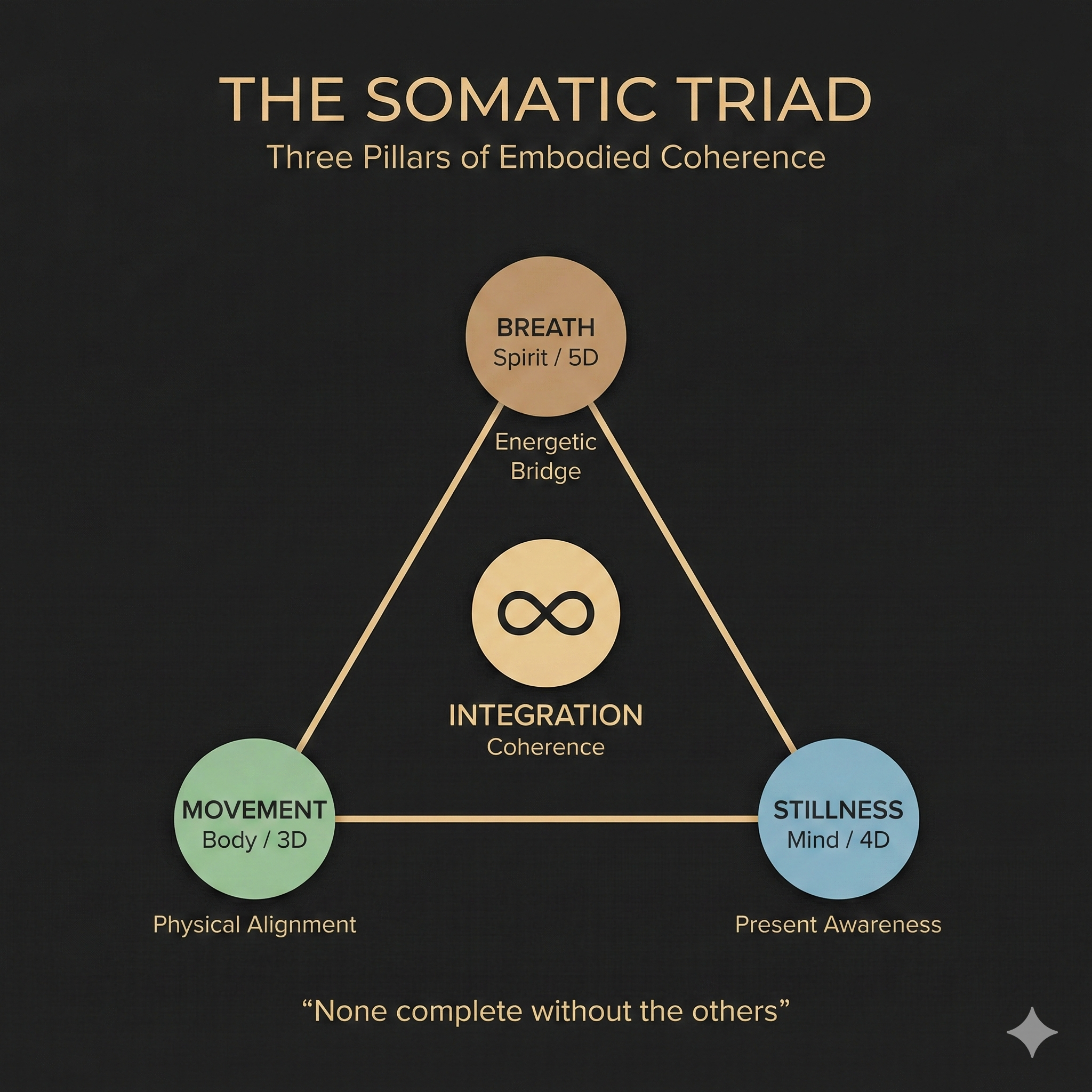
The Somatic Triad: Interactive 3D Visualization
Explore the relationship between Movement, Stillness, and Breath. This chapter focuses on Movement (the red/orange vertex at the top)—the body’s language for processing experience. Click near any vertex to emphasize that element. Drag to rotate, scroll to zoom.
Each element of the triad serves a distinct function:
| Element | Primary Function | Dimensional Focus | Practice Example |
|---|---|---|---|
| Movement | Processing trauma, building resilience | 3D physical, 4D emotional | Joint mobility, dance, strength training |
| Stillness | Integration, nervous system regulation | 4D emotional, 5D spiritual | Meditation, rest, receptive awareness |
| Breath | Bridge and anchor | All dimensions | Conscious breathing during movement |
The triad is not hierarchical. Different situations call for different emphases. Someone who is dissociated may need movement before stillness. Someone who is perpetually busy may need stillness before more movement. The art is in recognizing what’s needed in each moment.
6.4 Exercise and Mental Health - The Evidence
Exercise as Antidepressant
A landmark 2023 systematic review published in the British Journal of Sports Medicine analyzed 97 studies involving 128,119 participants.2 The findings were remarkable:
- Physical activity reduced symptoms of depression, anxiety, and psychological distress
- Effects were significant even at low doses of activity
- Higher intensity activities showed somewhat larger effects
- Benefits appeared across all populations studied
For depression specifically, exercise has been shown to be as effective as antidepressant medication for mild-to-moderate cases, and enhances outcomes when combined with medication for severe cases.
The Mechanisms
Depression has a posture. You know it when you see it — the collapsed chest, the limbs that seem to cost something to lift, the stillness that isn’t peace but weight. Movement changes the shape the body is holding, and the mind follows.
How does movement improve mental health? Several pathways:
Neurobiological:
- Increases BDNF (Brain-Derived Neurotrophic Factor), which supports brain plasticity
- Elevates endorphins and endocannabinoids, creating natural mood enhancement
- Regulates cortisol and other stress hormones
- Improves neurotransmitter balance (serotonin, dopamine, norepinephrine)
Psychological:
- Builds self-efficacy—the belief in your ability to affect outcomes
- Creates mastery experiences—success breeds confidence
- Provides behavioral activation—counters the withdrawal of depression
- Offers distraction and rumination interruption
Social:
- Group activities create connection and belonging
- Shared challenge builds community
- Regular practice creates structure and routine
Types of Exercise and Their Effects
| Type | Mental Health Benefits | Best For |
|---|---|---|
| Aerobic (running, swimming, cycling) | Depression, anxiety, cognitive function | Mood regulation, energy |
| Resistance (weightlifting, bodyweight) | Self-efficacy, depression, body image | Confidence, strength |
| Mind-Body (yoga, tai chi, qigong) | Anxiety, stress, embodiment | Integration, awareness |
| High-Intensity Interval Training | Depression, mood, cognitive function | Time-efficiency, intensity tolerance |
| Group/Team Sports | Social connection, belonging, mood | Community, fun |
Ponder This: Which forms of movement have you gravitated toward in your life? Which have you avoided? Your movement history might reveal something about your emotional patterns—the body’s preferences often mirror the psyche’s needs and defenses.
6.5 Movement and Trauma - The Body Keeps the Score
The Somatic Storage of Trauma
Trauma researcher Bessel van der Kolk famously titled his groundbreaking book The Body Keeps the Score.3 His central thesis, supported by decades of research: trauma is stored not just in memory but in the body itself.
When we experience overwhelming events, especially early in life or repeatedly, several things happen:
- The nervous system develops hypervigilance or freeze patterns
- Muscles chronically tense or collapse in characteristic patterns
- Fascia (connective tissue) becomes restricted and bound
- Posture shifts to protect vulnerable areas
- Movement patterns become limited and defensive
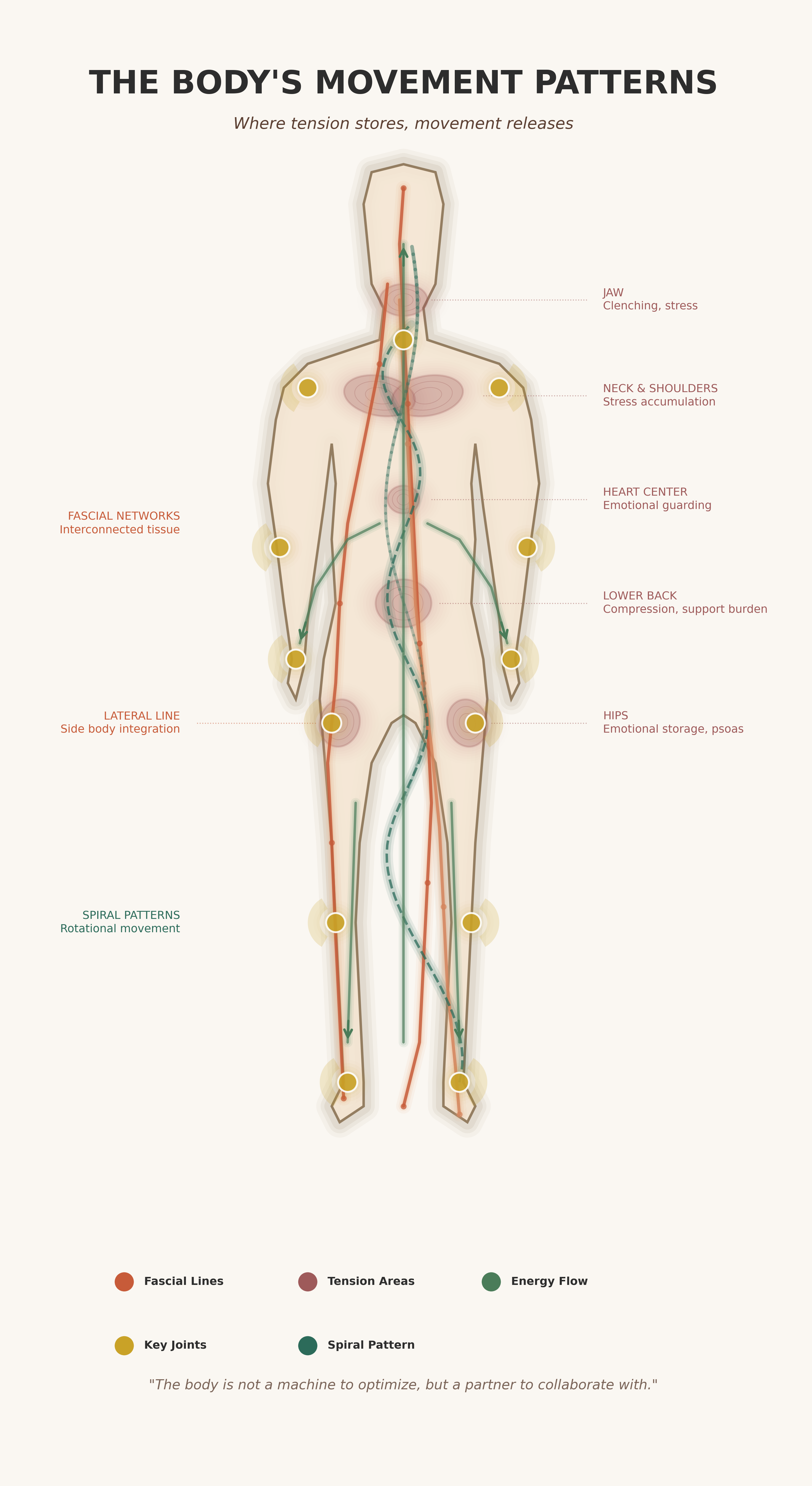
This isn’t metaphorical. Brain imaging shows that trauma affects the areas that process bodily sensation (the insula, somatosensory cortex) as much or more than the areas that process narrative memory.
Why Talk Therapy Isn’t Enough
Traditional talk therapy works primarily through the prefrontal cortex3—the reasoning, narrative-making part of the brain. But trauma often lives “beneath” this level, in the brainstem and limbic system, in the body’s automatic responses.
You can understand intellectually that a situation is safe while your body continues to react as if it’s dangerous. This is why trauma survivors often say, “I know I shouldn’t feel this way, but…”
Bottom-up approaches work differently. Instead of trying to change the body through changing the mind, they change the mind through changing the body. Movement is one of the most powerful bottom-up approaches.
Movement as Trauma Release
When movement is used therapeutically for trauma, several processes occur:
Completion of thwarted survival responses:
During traumatic events, the body often initiates defensive movements that can’t be completed—the arm that wanted to push away, the legs that wanted to run, the voice that wanted to scream. These incomplete actions remain “frozen” in the nervous system.
Certain movement practices allow these responses to finally complete:
- Shaking and tremoring releases fight-or-flight energy
- Pushing and reaching completes defensive impulses
- Vocalizing during movement releases trapped expression
- Running or fast walking completes flight responses
Expansion of the window of tolerance:
The “window of tolerance” is the zone where we can experience stress without becoming overwhelmed (hyperarousal) or shutting down (hypoarousal). Movement, especially when practiced with awareness, gradually expands this window.
Building new body memories:
Trauma creates body memories of danger and helplessness. Movement creates new body memories—of strength, pleasure, capability, safety. Over time, these new memories can become more dominant than the old traumatic ones.
Somatic Triad Connection
| Somatic Triad | Trauma Application | Practice Example |
|---|---|---|
| Movement | Complete survival responses, build new body memories | Shaking, pushing, dancing, sports |
| Stillness | Integrate and witness without overwhelm | Graded exposure to stillness, supported rest |
| Breath | Regulate activation, stay in window of tolerance | Slow exhales, coherent breathing during movement |
6.6 Types of Movement Practices
Movement Categories
Most people do one type of movement and wonder why they’re stuck — the runner who can’t touch their toes, the yogi who feels fragile, the gym regular who can’t dance in their own kitchen. The body needs range, not just repetition.
Not all movement serves the same purpose. Here’s a framework for understanding different movement practices:
1. Cardiovascular/Aerobic
Examples: Running, swimming, cycling, dancing, hiking
Benefits:1 - Heart health and endurance - Mood regulation through endorphin release - Processing and integration through rhythmic movement - Connection to primal movement patterns
Somatic insight: Rhythmic, repetitive movement can induce mild trance states that allow unconscious processing—this is why many people get insights while running or walking.
2. Strength/Resistance
Examples: Weight training, bodyweight exercises, climbing
Benefits:1 - Builds bone density and metabolic health - Creates literal strength and resilience - Addresses power and agency issues (especially relevant for trauma) - Anti-aging effects through muscle preservation
Somatic insight: The ability to exert force—to push, pull, lift—is deeply connected to psychological empowerment. Strength training can shift a felt sense of helplessness.
3. Flexibility/Mobility
Examples: Stretching, yoga, mobility work
Benefits:1 - Maintains range of motion - Releases muscular tension and fascial restriction - Opens stuck areas in the body - Increases body awareness
Somatic insight: Tight muscles often correspond to emotional holding. Releasing physical tension can release emotional tension—sometimes dramatically.
4. Mind-Body Integration
Examples: Yoga, tai chi, qigong, Feldenkrais
Benefits: - Integrates movement with awareness - Develops proprioception and interoception - Bridges physical and subtle dimensions - Regulates the nervous system
Somatic insight: These practices explicitly work with the 3D/4D interface, using physical movement to access and influence energetic and emotional states.
5. Play and Sport
Examples: Team sports, martial arts, dance, play
Benefits:1 - Social connection and belonging - Joy and pleasure (often missing in exercise discourse) - Unpredictable challenges that build adaptability - Flow states through immersive engagement
Somatic insight: Play is movement without agenda. It reconnects us with the body’s natural intelligence and desire to move for its own sake.
Ponder This: Consider your current movement practice (or lack thereof). Which dimension does it primarily engage? What might you be missing? A person who only does structured 3D training might be avoiding emotional expression. A person who only does 4D free movement might be avoiding discipline and structure. Balance across dimensions creates wholeness. For a complete mapping of how each movement type connects to the 3D, 4D, and 5D—including warning signs of dimensional imbalance—see Section 18.10 below.
6.7 Joint Mobility - The Foundation
Why Joints Matter
Joint mobility is the foundation of all movement capability.1 Without it:
- Range of motion decreases progressively
- Compensation patterns develop
- Injury risk increases
- Daily function declines
- The body’s “map” of itself becomes distorted
The good news: joint mobility responds remarkably well to practice, even after years of neglect.
The Use-It-Or-Lose-It Principle
Joints are not passive hinges.1 They respond to the range of motion you actually use. Take a joint through its full range regularly and it stays available. Ignore the edges of that range for years and the body concludes those positions aren’t needed — and begins quietly reducing access to them. You don’t notice until you reach for something on a high shelf and feel the shoulder pull back, or try to squat below parallel and find the hip won’t cooperate.
The practical implication: joint health isn’t something you build once and keep. It’s a daily maintenance practice, like brushing teeth. Small, consistent exposure to full range matters more than occasional deep stretching.
The Controlled Articular Rotations (CARs) protocol, developed through Functional Range Conditioning, offers a systematic way to move each joint through its full available range under active control. The specific technique for neck, shoulder, thoracic, hip, and ankle CARs is detailed in the practices companion to this chapter.
Ponder This: As you practice joint mobility, notice which areas feel free and which feel stuck. The body’s mobility patterns often mirror psychological patterns—where are you flexible, and where are you holding?
6.8 Strength Training - Building Capacity
The Case for Strength
Strength training is associated with:1
- Reduced all-cause mortality (independent of aerobic exercise)
- Improved metabolic health (insulin sensitivity, body composition)
- Better bone density (crucial for aging)
- Enhanced functional independence in later life
- Mental health benefits including reduced anxiety and depression
Yet only about 24% of American adults meet the CDC’s guidelines for muscle-strengthening activities (2 or more days per week).
Strength as Psychological Resource
Beyond the physical benefits, strength training offers psychological gifts:
Self-efficacy: The experience of getting stronger—of lifting today what was impossible six months ago—builds belief in your capacity to change and grow.
Agency: The ability to exert force is connected to the ability to affect the world. Many people, especially those with histories of powerlessness, find that building physical strength transfers to psychological empowerment.
Resilience: Strength training is inherently uncomfortable. Learning to work through discomfort builds tolerance for the inevitable discomforts of life.
Embodiment: Weight training requires attention to the body. You cannot lift effectively while dissociated. The practice pulls awareness into flesh.
Basic Movement Patterns
There’s a moment, when someone new to strength discovers they can actually lift something heavy, where you can watch the reorganization happen in real time — the shoulders come back, the voice drops a register, the eyes settle. It’s not vanity. It’s a person discovering they have force in them.
Rather than isolated exercises, strength training is most effective when organized around fundamental movement patterns:
| Pattern | Description | Example Exercises |
|---|---|---|
| Squat | Knee-dominant lower body push | Goblet squat, back squat, leg press |
| Hinge | Hip-dominant lower body pull | Deadlift, Romanian deadlift, kettlebell swing |
| Push | Upper body pressing | Push-up, bench press, overhead press |
| Pull | Upper body pulling | Row, pull-up, lat pulldown |
| Carry | Loaded locomotion | Farmer’s walk, suitcase carry |
| Rotation | Rotational power | Cable chops, medicine ball throws |
Getting Started
The specifics — how many days per week, which exercises, how to progress — are available in the practices companion to this chapter, where they can live alongside the other protocols without breaking the flow here. What matters conceptually: start simple, train the patterns (not the muscles in isolation), and show up consistently. Progress in strength is less about any single session and more about the accumulated signal you send to the body over months.
6.9 Mind-Body Practices - The Integrative Arts
Yoga: Union of Body and Spirit
Yoga is 5,000 years of technology for uniting body, mind, and spirit. What we practice in gyms — the postures, the stretches — is one limb of an eight-limbed system. Imagine learning a language by studying only its alphabet.
Research on yoga shows:1 - Reduced anxiety and depression - Improved stress resilience and HRV - Decreased inflammation - Enhanced body awareness (interoception) - Better sleep quality
Possible mechanisms: - Vagal tone improvement through breathing and postures - Regulation of the hypothalamic-pituitary-adrenal (HPA) axis - Increased GABA (the calming neurotransmitter) - Enhanced mind-body connection
Tai Chi and Qigong: Moving Meditation
Originating in Chinese martial and medical traditions, these practices emphasize: - Slow, deliberate movement - Breath coordination - Cultivating and directing qi (life energy) - Integration of intention, energy, and physical form
Research confirms:1 - Improved balance and fall prevention in older adults - Reduced chronic pain - Better sleep quality - Lower blood pressure - Improved immune function - Mental health benefits
Somatics: The Western Integration
Modern somatic practices have developed from various Western lineages:
Feldenkrais Method: Developed by Moshé Feldenkrais, focuses on awareness through movement, using small, unusual movements to reorganize the nervous system.
Alexander Technique: Founded by F.M. Alexander, addresses habitual patterns of tension and malalignment, especially relating to head-neck-spine relationship.
Somatic Experiencing: Created by Peter Levine, specifically addresses trauma through body awareness and completion of survival responses.
Continuum Movement: Developed by Emilie Conrad, explores the fluid nature of the body through wavelike movements and breath.
Finding Your Practice
There’s no universally “best” mind-body practice. The best practice is: - One you’ll actually do consistently - One that addresses your particular needs - One taught by a qualified teacher - One that feels both challenging and appropriate
Ponder This: Have you ever experienced a moment in movement practice where thinking stopped and you were simply moving—fully absorbed, time forgotten, self-consciousness dissolved? That’s a glimpse of what these practices offer at their deepest. It’s also a hint of the 5D accessed through the body.
6.10 The 3D/4D/5D Mapping of Movement
Movement Across Dimensions
Movement can engage different dimensions depending on how it’s practiced:
| Dimension | Movement Quality | Experience | Examples |
|---|---|---|---|
| 3D | Structured, goal-oriented, measurable | Following a program, tracking metrics, improving performance | Weight training with a log, running with a watch, exercise classes |
| 4D | Expressive, emotional, intuitive | Moving from feeling, processing emotions, following body’s wisdom | Ecstatic dance, cathartic movement, intuitive flow |
| 5D | Transcendent, timeless, unified | Loss of self-consciousness, flow states, movement as meditation | “In the zone” experiences, deep practice states, moving prayer |
The Progression Through Dimensions
Most people enter movement practice at the 3D level—following instructions, learning forms, building physical capacity. This is appropriate and necessary; it creates the foundation.
With practice, the 4D opens. Movement becomes a way to process emotions, to express what words cannot say, to release what has been held. This is where movement becomes medicine rather than just exercise.
Tyler Moment: What Julian Saw
I was in a session with Julian Ho, watching him work with someone I’ll call Marcus. Marcus walked in the way a lot of high-functioning men walk in — upright, deliberate, the kind of posture that reads as confidence. Julian watched him cross the room. That was it. Just watched him walk.
Then Julian asked Marcus to sit down and stand back up from a chair. No special instructions. Just: sit, stand.
“There,” Julian said quietly, to me. “Did you see that?”
I hadn’t seen anything. I said so.
Julian pointed to the way Marcus’s left hip had dropped and compensated on the way up — a half-second of bracing, like something inside was guarding. He traced it forward: that pattern probably showed up when Marcus reached for things on his left side too, maybe a subtle flinch he’d stopped noticing years ago. He asked Marcus about it. Marcus paused. Said his father had come at him from the left. That he’d spent years sitting to the right of doorways.
I felt the floor shift under me a little.
Not because of the trauma — I’d read about somatic storage. But because Julian had read it from a chair transition. The body had been saying it the whole time. The whole time. And Marcus, and everyone around him, had been looking at the man and not the movement.
That was the moment movement stopped being exercise for me and became diagnostic. The body isn’t just carrying you through the day. It’s carrying everything.
At times, perhaps in peak moments, the 5D becomes accessible. Self and movement merge. The doer disappears into the doing. Time stops or transforms. These moments can’t be forced, but they become more available as practice deepens.
Warning Signs of Dimensional Imbalance
Too much 3D focus: - Movement becomes compulsive, rigid - Emotional life is compartmentalized away from physical practice - Injuries from overriding body’s signals - Exercise addiction without integration
Too much 4D focus: - Lack of structure or discipline - Processing without integration or completion - Emotional volatility without grounding - Difficulty with consistent practice
Grasping for 5D: - Using movement to escape rather than integrate - Spiritual bypassing through practice - Derealization or dissociation during movement - Inability to be present in ordinary movement
Integration Practice
A balanced movement practice engages all three dimensions:
3D component: A structured practice you do consistently. Follow a program. Track something. Show up regularly.
4D component: Time for intuitive, expressive movement. Put on music and move without agenda. Let the body lead. Allow emotions to arise.
5D component: Practice with such depth that thinking stops. Pursue mastery not for ego but for what opens when doing and doer merge.
6.11 Integration Practice - The Movement Medicine Sequence
A Complete Movement Practice
Here is an integrated practice that moves through all elements: joint mobility, strength, mind-body integration, and expressive movement. Allow 30-45 minutes.
Preparation (2-3 minutes)
Stand in a comfortable position. Close your eyes briefly. Take three conscious breaths—inhaling fully, exhaling completely.
Set an intention: What do you want to release? What do you want to build? Hold this intention lightly.
Phase 1: Joint Awakening (5-7 minutes)
Move systematically through your joints:
- Neck: Slow circles, both directions. 5 each way.
- Shoulders: Large arm circles, then CARs. 3-5 each direction.
- Spine: Cat-cow movements, then thoracic rotations.
- Hips: Hip circles, then CARs. 3-5 each direction.
- Knees and Ankles: Circles, flexion, extension.
Move slowly. Notice where there’s freedom and where there’s restriction. No forcing—just exploring.
Phase 2: Activation (8-10 minutes)
Build heat and strength through fundamental movements:
- Squats: 10-15 bodyweight squats. Find full range.
- Hinges: 10-15 hip hinges (hands sliding down thighs). Feel hamstrings stretch.
- Push-ups: 5-15 reps (modify as needed—wall, knees, full).
- Rows: If you have a band or can find something to pull, 10-15 rows. Otherwise, prone I-Y-T lifts.
- Carry: Walk 30 seconds holding something moderate weight, or just walk with engagement.
Focus on quality over quantity. Feel the muscles working.
Phase 3: Flow and Expression (8-10 minutes)
Put on music that moves you. Set a timer so you don’t have to think about it.
Now move without agenda. Let the body lead. You might: - Dance - Stretch - Flow through yoga-like movements - Shake and tremor - Be still, then move again
The only rule: follow what feels true. Notice what emotions arise. Let them move through without needing to understand them.
Phase 4: Integration (5-7 minutes)
Slow down. Find a comfortable position on the floor—lying down or seated.
Let the breath deepen naturally. Don’t control it, but notice it.
Scan the body from feet to head. Notice what has shifted. What feels different? What has released? What has awakened?
Stay here until you feel complete. There’s no rush.
Return
When ready, begin to move gently. Stretch if needed. Come slowly to standing.
Take a moment to notice how you feel. Different? The same? More present? More alive?
Whatever you notice is information. All of it is valid.
Expected Outcomes
During practice: - Increased body awareness - Emotional release (possibly) - Sense of being in the body rather than just “having” a body - Calm alertness after intensity
With consistent practice: - Improved mobility and strength - Better emotional regulation - Enhanced stress resilience - Deeper embodiment - The body becomes an ally rather than an obstacle
6.12 Chapter Summary
Movement is the first pillar of the Somatic Triad — medicine, not just exercise. The body stores what the mind can’t process, and movement is one of the most reliable ways to complete what got frozen. A consistent practice that includes structure (3D), expression (4D), and integration earns its keep.
6.13 For Your Journey
This week, experiment with treating movement as medicine rather than just exercise:
Notice your current relationship with movement. Do you move from joy or obligation? Do you avoid certain types of movement? What does your movement history reveal about your psychological patterns?
Try the Integration Practice once, even if abbreviated. Notice what happens when movement includes structure (3D), expression (4D), and integration (stillness).
Add joint mobility to your morning. Even 5 minutes of joint circles changes how the body moves through the day.
The body is not a burden to transcend. It is an instrument to play, a partner to collaborate with, a home to inhabit fully. Notice that this chapter was itself a movement sequence. Daniel’s story was the warm-up. The science sections were the exertion. This closing is the cool-down. You’ve been taken through a movement pattern on the page — and your body, if you pay attention right now, may feel slightly different than when you opened this chapter.
How might your life change if you moved not to fix what’s wrong, but to express what’s alive?
Movement is the 3D expression of the Somatic Triad—and it’s only one pillar. In the next chapter, we’ll explore its complement: Stillness, where different kinds of knowing become available.
6.14 Bridge to Next Chapter
We’ve explored Movement as the first pillar of the Somatic Triad—the body’s language for processing experience.
Now we turn to its complement: Stillness. Chapter 7, Silent Vibrations, explores the paradox of meditation—how doing nothing accomplishes everything, how stopping reveals movement at subtler levels, and how stillness opens doors that action cannot.
If Movement is the exhale, Stillness is the inhale.