19 Silent Vibrations
20 Silent Vibrations
“Be still, and know that I am God.” — Psalm 46:10
7.1 Opening: The Brain That Rebuilt Itself
In 2005, neuroscientist Sara Lazar was stretching in a yoga class when a thought occurred to her that would change the trajectory of brain research.
She had started yoga to recover from a running injury. What she noticed, beyond the physical benefits, was that she felt calmer, more present, better able to handle stress. The scientist in her wanted to know: was this real, or was she just imagining it?
So she put meditators in brain scanners.
What she found at Harvard’s Massachusetts General Hospital stunned the neuroscience community. Long-term meditators showed increased gray matter in key brain regions: the prefrontal cortex (involved in decision-making and emotional regulation), the insula (body awareness and empathy), and the hippocampus (learning and memory).1 Even more remarkably, the prefrontal cortex of 50-year-old meditators looked like that of 25-year-olds. The brain region that typically thins with age had somehow been preserved.
But Lazar’s most significant finding came in a follow-up study. She took people who had never meditated before, taught them a simple mindfulness practice, and had them practice for just eight weeks, averaging 27 minutes per day. Then she scanned their brains again.
In eight weeks, their brains had physically changed.
The gray matter increased in the hippocampus, posterior cingulate cortex, temporo-parietal junction, and cerebellum. The amygdala, the brain’s fear and stress center, actually shrank. These weren’t long-term meditators who had logged thousands of hours. These were ordinary people who had practiced stillness for less than 30 minutes a day for two months.
Stillness, it turns out, is not passive. It’s not the absence of doing. Stillness is one of the most powerful actions a human being can take.
In the previous chapter, we explored movement as medicine, how the body processes experience through motion, how trauma releases through shake and flow. Now we turn to movement’s complement: the profound technology of stillness. And we’ll discover that stillness isn’t just about sitting quietly. It’s about vibration, about frequency, about the way sound and silence shape consciousness itself.
Because sometimes the most powerful thing you can do is stop.
The Somatic Triad: Interactive 3D Visualization
Explore the relationship between Movement, Stillness, and Breath. This chapter focuses on Stillness (the teal vertex at bottom-left) - the profound technology of stopping, settling, and allowing consciousness to reveal itself. Click near any vertex to emphasize that element. Drag to rotate, scroll to zoom.
Ambient 1: Music for Airports by Brian Eno. The album that invented “ambient music”—designed to create space without demanding attention. Let it dissolve the foreground and reveal the background.
7.2 The Neuroscience of Stillness
What Happens When We Stop
We wake to alarms. Reach for phones before our eyes focus. The attention that evolved to track predators now tracks notifications. Most of us live in a low-grade state of activation we’ve been in so long we call it normal. We don’t know what baseline feels like because we’ve never been there.
When we enter stillness, when we consciously stop the motion of body and mind, something remarkable begins to happen in the nervous system.
Within minutes of beginning meditation, brainwave patterns begin to shift. Beta waves (12-30 Hz), associated with active thinking and external focus, start to decrease. Alpha waves (8-12 Hz), associated with relaxed alertness, increase. With deeper practice, theta waves (4-8 Hz) emerge, the frequencies associated with creativity, intuition, and access to subconscious material.1
But this is just the beginning.
A 2014 systematic review and meta-analysis by Fox and colleagues examined morphometric neuroimaging studies of meditation practitioners and found consistent structural effects across multiple brain regions:2
Decreased activity in the default mode network (DMN): The DMN is active during mind-wandering, self-referential thinking, and rumination. When it quiets, the inner narrator that constantly comments on experience becomes less dominant.
Increased connectivity in the salience network: This network helps us determine what’s important in our environment. Meditation strengthens its function, improving attention and focus.
Enhanced prefrontal-limbic integration: The thinking brain (prefrontal cortex) becomes better connected to the emotional brain (limbic system), improving emotional regulation.
Structural changes in gray matter: Long-term meditators show increased cortical thickness in regions associated with attention, interoception, and sensory processing.3
Perhaps most striking is the research on the amygdala. This almond-shaped cluster of neurons is the brain’s alarm system, triggering the stress response when it perceives threat. Studies consistently show that meditation practice reduces amygdala reactivity and size. The fear center literally shrinks.3
The Brainwave Spectrum of Consciousness
To understand stillness practices, we need to understand brainwaves. These electrical oscillations, measurable through EEG, provide a window into different states of consciousness.
See the brainwave frequency table in Chapter 8 for the full spectrum of states and their characteristics.4
Mapping Brainwaves to Dimensions
In the 3D/4D/5D framework we introduced in Chapter 8, these brainwave states correlate to dimensional access:
Beta (12-30 Hz) = 3D consciousness: Active thinking, external world, linear time. The workhorse of daily functioning.
Alpha (8-12 Hz) = 3D-4D bridge: Relaxed awareness creates the conditions for 4D access. The doorway opens.
Theta (4-8 Hz) = 4D access: Deep meditation, intuitive insight, subconscious material surfaces. The emotional body becomes visible.
Delta (0.5-4 Hz) = 4D-5D bridge: In advanced meditation and dreamless sleep, the boundary between dimensions becomes permeable.
Gamma (30+ Hz) = 5D access: Peak awareness, unity consciousness, transcendent insight. The soul’s dimension becomes experientially available.
The Muse Mirror: Technology as Training Wheels
EEG technology (like the Muse® headband) allows real-time observation of brainwave states. This provides the skeptical practitioner with objective data—a mirror for the internal experience:4
- When you’re in Beta (busy mind), you hear storms.
- When you’re in Alpha (calm awareness), you hear birds.
- When you’re in Theta (deep stillness), the soundscape becomes serene.
The Practice: Use technology to calibrate your internal experience. Learn what Alpha feels like in your body—the specific quality of relaxed alertness, the texture of thoughts becoming spacious. Then practice accessing it without the device.
The goal is not to become dependent on technology but to use it as training wheels until you can recognize the states internally. The Muse doesn’t create the stillness; it reflects what’s already happening in your nervous system. Eventually, you become your own biofeedback device—able to sense the shift from Beta to Alpha as clearly as you sense the difference between tension and relaxation in a muscle.
Here’s what’s fascinating: stillness practices are essentially brainwave training. When we sit in meditation, we’re learning to shift our dominant frequency, to move from beta-dominated consciousness into alpha, theta, and beyond.
And the body changes to match. As brainwaves slow, heart rate decreases, blood pressure drops, cortisol levels fall, and the immune system strengthens. The mind shapes the body; the body shapes the mind.
Ponder This: When you sit in stillness, what happens in your body? Does it settle or does it fight? Your body’s response to stillness tells you something about your nervous system’s baseline state—and reveals where your practice needs to go.
When the Eyes Lead the Way
Here’s something nobody tells you when you start meditating: your eyes are going to do something weird.
Not immediately. Not on day one, when you’re still wondering if you’re “doing it right” or whether this whole thing is a waste of time. But somewhere in the deepening—somewhere in the transition from scattered to settled—your eyes will, without asking your permission, begin to roll upward. Not dramatically. Not like a horror movie. Just… up. Softly. Like they’re looking for something behind your forehead.
The first time it happened to me, I thought I’d broken something.
I was maybe three months into a daily practice. Sitting in what I imagined was dignified stillness. And then I noticed my eyes—behind closed lids—had quietly drifted upward on their own. I did what any reasonable person does when their body does something unexpected: I panicked slightly, jerked them back down, and spent the next five minutes wondering if I’d had a tiny seizure. I hadn’t. My body had just started doing something it apparently already knew how to do.
Turns out, the eyes know things the conscious mind doesn’t.
The body already had a head start. There’s a reflex called Bell’s phenomenon—named after the Scottish surgeon Charles Bell, who described it in the 19th century—where your eyes naturally rotate upward when you close your eyelids. Around 75% of humans have this. Before any meditation practice even begins, the hardware is biased toward up. The body already associates “eyes closed” with “eyes up.” You’re not doing something strange. You’re following the factory settings.
It gets better. In 1972, psychiatrist Herbert Spiegel tested over 2,000 people and found that how far your eyes can roll upward correlates directly with your capacity to enter trance states—a 73.9% correlation. The higher the roll, the deeper you can go. Your eyes aren’t just following factory settings. They’re advertising your hardware specifications.
Eyes up, brain shifts. Research by James Hardt at the Biocybernaut Institute and Les Fehmi at Princeton’s neuroscience program found that upward eye position correlates with increased production of alpha and theta waves. Downward gaze pushes toward beta—the analytical, task-oriented frequency. Upward gaze opens the door to alpha and theta—the receptive, intuitive, creative frequencies. This isn’t mystical speculation. It’s a measurable shift you can see on an EEG.
Remember the alpha-theta spectrum we just mapped? The 3D-to-4D bridge? Your eyes are part of that shift. They’re not just along for the ride—they’re helping drive the transition.
The nerve that connects your eyes to your nervous system. Here’s where it gets genuinely fascinating. There’s a reflex called the trigeminovagal reflex—sometimes called the oculocardiac reflex—that connects extraocular muscle tension directly to the vagus nerve. When the muscles that rotate your eyes upward stretch and activate, the vagus nerve responds: heart rate slows, parasympathetic tone deepens, the whole system shifts toward rest-and-digest. Your eyes rolling upward during meditation may literally be deepening the meditative state through a direct nerve pathway.
The feedback loop writes itself: deeper state → eyes roll up → vagal activation → even deeper state. The body is optimizing itself. You just have to not interfere.
Five traditions. Five continents. One phenomenon. What makes this particularly hard to dismiss is how many completely independent contemplative traditions noticed and then deliberately cultivated the exact same eye position:
- In Hatha Yoga, Shambhavi Mudra directs the gaze toward the eyebrow center—one of the most closely guarded practices in the tradition. The Hatha Yoga Pradipika calls it the most secret of all mudras.
- Tibetan Tögal practice uses specific upward gazing at open sky and light to catalyze visionary states.
- St. Teresa of Ávila documented involuntary upward eye rolling during mystical rapture in the 16th century. Bernini sculpted it. El Greco painted it across dozens of canvases.
- Sufi Muraqaba directs contemplative attention toward the latifa of the forehead, with gaze oriented upward.
- In Kundalini traditions, eyes rolling upward is classified as a kriya—an involuntary purificatory movement that occurs when energy reaches the Ajna center, the third eye.
Five traditions. Five continents. Five completely independent discoveries of the same phenomenon. The eyes go up when consciousness goes deep. That’s not coincidence. That’s convergent evolution of contemplative technology—different cultures, same map. And when your eyes drift up on their own during practice, you’re not having a personal quirk. You’re corroborating five thousand years of field notes.
You might notice, reading this, that your own eyes have shifted. That’s the phenomenon, happening to you, right now, on the page.
The pineal whisper. Here’s where the map gets interesting in a different way—less certain, more suggestive. The pineal gland sits almost exactly where the upward gaze converges anatomically—deep in the center of the skull, at the geometric heart of the brain. It contains photoreceptor cells. Rick Strassman’s research hypothesized it may produce endogenous DMT under certain conditions, including perhaps deep meditative states. And in 2025, Plini and colleagues published MRI evidence that long-term meditators show physically brighter pineal glands on brain scans—with signal intensity increasing proportionally to lifetime hours of meditation. The pineal isn’t just anatomically located where the gaze converges. It appears to be structurally changed by the practice of converging there. Whether upward eye position “activates” the pineal in any meaningful way is genuinely unknown. But the convergence of anatomy, tradition, subjective report, and now structural imaging is striking enough to hold loosely—not as a conclusion, but as an interesting question the body seems to keep asking.
Next time you close your eyes to sit, notice where your gaze goes. Don’t direct it—just observe. Where do your eyes want to be? What happens to the quality of your attention when you let them drift toward wherever they seem to want to go? The answer won’t be in your head. It’ll be in the texture of what follows.
The Flow Cycle as Meditation Map
Here’s something the mindfulness tradition rarely says out loud: meditation and flow share the same neurological signature.
Both involve what Arne Dietrich termed transient hypofrontality—the temporary quieting of the prefrontal cortex that opens access to non-ordinary states. Both show reduced activity in the default mode network (the inner narrator, the self-referential loop). Both produce the same neurochemical signature: dopamine, norepinephrine, anandamide, endorphins—the body’s most powerful cocktail of focus, pleasure, and pattern recognition. Flow research didn’t discover a new state. It rediscovered what contemplatives have mapped for millennia and gave it a scientific name.
The practical implication: the four-stage flow cycle that Steven Kotler describes—Struggle → Release → Flow → Recovery—is a map you can read inside every meditation session.
Struggle is the opening minutes. The mind races. The body itches. Attention skips between the grocery list, the email you forgot to send, the noise outside. This isn’t failure—this is the loading phase. The prefrontal cortex is still running at full beta power, processing its remaining queue before it can release. You cannot skip this phase. Trying to force calm here is like trying to force sleep by squeezing your eyes shut harder.
Release is the hinge. Somewhere between five and twenty minutes in—if you stay—the grip loosens. The exhale deepens without being instructed to. The shoulders drop. Something in the body says oh…okay. This is the prefrontal cortex stepping back. This is the gateway. Most people who “can’t meditate” are stopping at the struggle phase, just before release arrives.
Flow is absorption. The boundary between you-who-is-meditating and the meditation itself softens. The traditions call this states: samadhi, jhana, rigpa—depending on depth and method. In flow research terms, action and awareness have merged. You’re not watching your breath anymore. You’re not anywhere in particular. There is just this.
Recovery is the return—and it is not optional. The brain needs time to consolidate what happened in the flow phase. This is why ending a meditation abruptly and immediately opening a screen is a bad idea. The transition matters. The quiet after the sit is part of the sit.
The 4% Principle Applied to Attention
Flow research points to a sweet spot: challenge must stretch just beyond current skill level—roughly 4%, as a practical guideline rather than an exact threshold. Below that threshold: boredom, autopilot, the default mode network taking over. Above it: anxiety, fragmentation, the system in protection mode.
Meditation is the practice of applying that principle to attention itself.
A slightly longer sit than yesterday. Holding the anchor one extra breath before the mind wanders. Returning to the present moment five seconds after you notice you’ve drifted, rather than two. These micro-stretches keep the practice in flow’s sweet spot—engaging enough to preclude boredom, manageable enough to prevent overwhelm.
This means the most productive meditation isn’t always the most dramatic one. Sometimes it’s the sit where nothing seemed to happen except that you quietly extended your window of tolerance by a few degrees. The edge doesn’t always announce itself. But it’s where the growth is.
Ultradian Rhythms and Natural Flow Windows
The body doesn’t wait for you to schedule a meditation session to move toward altered states. Every 90 to 120 minutes, the nervous system cycles through a natural rest phase—the ultradian rhythm—where the dominant hemisphere alternates and the system enters a brief, spontaneous restorative state.
You know this as the involuntary daydream at the board meeting. The moment your eyes go soft and your attention drifts to nothing in particular. Western productivity culture reads this as a lapse. The contemplative traditions understood it as a gift.
If you can learn to recognize your ultradian rest phases and honor them—a few minutes of stillness rather than fighting the drift with caffeine and willpower—you’re working with the body’s natural flow rhythm rather than against it. Practice doesn’t have to mean formal sessions. It can mean recognizing the body’s own invitations.
Think of the last time you were deeply absorbed in something—a conversation, a project, a creative problem. Where did the time go? What released in you to allow that kind of presence? You were in flow. You crossed the 3D→4D threshold. You’ve always known how to do this. The question meditation asks is: can you learn to do it on purpose?
7.3 Three Faces of Stillness
Not All Stillness Is the Same
The word “meditation” covers a vast territory. A Zen monk counting breaths, a loving-kindness practitioner sending compassion to all beings, a yogi sitting in samadhi, and an executive doing a mindfulness app are all “meditating.” But they’re doing very different things, accessing very different dimensions.
We can map the major stillness practices to three fundamental types, each corresponding to a different dimensional focus.
3D Stillness: Concentration (Samatha)
What it is: Focused attention on a single object. The object might be the breath, a mantra, a visual image, a candle flame, or any chosen anchor. When attention wanders, you bring it back. Again and again.
Dimensional mapping: 3D stillness works primarily in the 3D dimension. It trains the mind, develops willpower, and strengthens the prefrontal cortex. It’s the foundation that makes deeper practices possible.
Brainwave signature: Concentration practices increase alpha waves initially, then with sustained focus, beta can actually increase in specific regions associated with attention. Advanced concentrative states show highly coherent, focused activity.
What it feels like: Like holding a beach ball underwater. The mind is buoyant, always rising toward the next thought. You press it down, it pops up. Press again, it pops up. The practice isn’t holding — it’s the willingness to keep pressing.
Traditional names: Samatha (Pali), dhyana (Sanskrit), one-pointed meditation
Research shows that concentration practices improve attention span, working memory, and cognitive control. A 2018 study found that just 10 minutes of focused attention meditation improved performance on attention tasks compared to a control group.2
When to use it: When you need to strengthen your capacity for focus. When the mind is scattered and wild. As the foundation for all other practices.
Somatic signature: Stillness in the body, narrowed focus, possible tension from effort (which softens with practice), sense of being “zoomed in.”
4D Stillness: Mindfulness (Vipassana)
What it is: Open awareness of whatever arises. Instead of focusing on one object, you observe the flow of experience itself: sensations, emotions, thoughts. You don’t grasp or push away; you simply notice.
Dimensional mapping: 4D stillness opens the door to the 4D dimension. By observing the contents of consciousness without attachment, you become aware of the emotional body, the patterns of the subconscious, the 4D interface that usually operates invisibly.
Brainwave signature: Mindfulness practices show increased alpha and theta, decreased beta, and notably increased activity in the insula (body awareness) and anterior cingulate cortex (conflict monitoring).
What it feels like: Like sitting by a river, watching the water flow. Thoughts and feelings pass like leaves on the current. You’re aware of them, but you’re not them. There’s space between experience and the observer of experience.
Traditional names: Vipassana (Pali, meaning “clear seeing”), mindfulness, choiceless awareness
The research on mindfulness is extensive. The Lazar studies mentioned in the opening used a mindfulness protocol. Consistent findings include reduced stress, decreased anxiety and depression, improved emotion regulation, and enhanced meta-awareness (awareness of your own mental processes).[1]3
When to use it: When you need to understand what’s actually happening in your inner world. When you want to develop equanimity with difficult experiences. For processing and integrating emotional material.
Somatic signature: Body awareness heightened, breath observed rather than controlled, feelings noticed without reactivity, sense of being “expanded” or “receptive.”
5D Stillness: Non-Dual Awareness
What it is: The recognition that there is no separate self doing the observing. In concentration, there’s a meditator focusing on an object. In mindfulness, there’s an observer watching experience. In non-dual awareness, the distinction between observer and observed collapses. There is just this: awareness being aware of itself.
Dimensional mapping: 5D stillness is direct access to the 5D dimension, to what traditions call the soul, the higher self, pure consciousness. Subject and object merge. Time stops. What remains is presence without location.
Brainwave signature: Research on advanced meditators in non-dual states shows dramatic increases in gamma wave activity (30-100+ Hz), particularly in the prefrontal and parietal regions. Some studies show gamma synchrony across the entire brain, a phenomenon rare in ordinary consciousness.2
What it feels like: Language fails here. “I” is the wrong word because there’s no separate I. “Experience” is the wrong word because there’s no one having an experience. There’s just… this. Aware. Complete. Home.
Traditional names: Samadhi (Sanskrit), rigpa (Tibetan), kensho/satori (Japanese), turiya (Sanskrit, “the fourth state”), non-dual awareness
This is what mystics across traditions have pointed to: the Atman recognizing itself as Brahman, the Buddha-nature seeing its own face, the Christian mystic’s union with God. The pointing words differ; the territory they indicate is remarkably consistent.
When to use it: This isn’t really something you “use.” It’s more something you recognize, allow, or fall into. It arises when conditions are right: when the mind is stable, the nervous system regulated, and grasping has been released.
Somatic signature: Profound stillness that isn’t collapse. The body may feel like it’s disappeared or expanded to include everything. Often accompanied by a sense of warmth in the heart, tears of recognition, or spontaneous gratitude.
The Progression
These aren’t three practices. They’re three depths of the same practice:
- Concentration stabilizes the mind, creating the foundation
- Mindfulness opens awareness to the 4D, clearing the interface
- Non-dual awareness reveals the 5D that was always present
You can’t force the progression. Trying to skip to non-dual awareness without developing stability first is like trying to see clearly through a dirty, shaking window. The concentration practices clean and stabilize the window. The mindfulness practices open the window. And then… you realize there was never a window at all.
Ponder This: Which type of stillness have you practiced most? Which have you avoided? The practices we resist often point to the dimensions we need most—and the ones where our growth potential is highest.
7.4 Polyvagal Stillness
Why Regulation Must Come Before Meditation
Here’s something most meditation instruction doesn’t acknowledge: if your nervous system is dysregulated, traditional meditation might not work, and could even make things worse.
Polyvagal theory, developed by Stephen Porges, describes three primary states of the autonomic nervous system:5
Ventral vagal (social engagement): Safe, connected, present. Heart rate steady, breath easy, social cues readable. This is the state from which meditation is most effective.
Sympathetic (fight/flight): Mobilized for defense. Heart racing, breath rapid, hypervigilant. In this state, telling someone to “just relax” is useless, their nervous system is convinced danger is present.
Dorsal vagal (freeze/collapse): Shutdown, dissociation, numbness. Very low heart rate, shallow breath, disconnection from the body. This can look like stillness but isn’t, it’s a defense mechanism.
The crucial insight: you can’t meditate your way out of a dysregulated nervous system directly. If someone is in dorsal vagal collapse, asking them to sit and observe their experience might intensify the dissociation. If they’re in sympathetic activation, sitting still might just leave them wrestling with anxiety while pretending to be calm.
The Window of Tolerance
The “window of tolerance,” a concept developed by Dan Siegel, describes the zone of arousal within which we can function effectively:4
- Above the window (hyperarousal): anxiety, panic, anger, hypervigilance
- Within the window: alert, present, capable of both relaxation and engagement
- Below the window (hypoarousal): numbness, depression, disconnection, collapse
Effective meditation happens within the window. If you’re outside the window, the first task is regulation, not meditation.
Research from trauma-informed meditation shows that for people with significant trauma history:4
- Body awareness practices can initially increase distress rather than relieve it
- Emphasis on being “present” can feel destabilizing
- The invitation to “observe thoughts” can strengthen ruminative loops
- Traditional postures (eyes closed, spine straight, immobile) can trigger freeze responses
This doesn’t mean traumatized people shouldn’t meditate. It means they need a different approach.
Regulation Before Realization
The sequence matters:
First, regulate the nervous system. Use the breath, movement, grounding, and co-regulation with safe others to bring the system into the window of tolerance.
Then, begin concentration practices. Build the capacity for stable attention while maintaining regulation.
Then, open to mindfulness. Allow the 4D material to surface in a regulated container.
Then, allow non-dual recognition. Let the 5D reveal itself when conditions are right.
For many people, this means their meditation practice should begin with regulation practices: coherent breathing, gentle movement, grounding in sensory experience. Only when the nervous system has a foundation of safety does deeper stillness become possible.
Practical implication: If you sit down to meditate and find yourself more anxious or dissociated afterward, you’re not failing at meditation. You’re receiving information that your nervous system needs something different first. Honor that information.
Stillness as the Release Phase of Flow
We can read this in two directions: stillness as one phase of the flow cycle, or the flow cycle as a complete map of each meditation session. Both views are useful—like zooming in and out of the same fractal.
Zooming in: stillness practices map directly to the release phase—the crucial transition that most people skip. The release phase—taking your foot off the gas, letting go of the problem—allows the prefrontal cortex to quiet (transient hypofrontality, as described above). This is why stillness isn’t passive. The instructions “let go,” “stop trying,” “allow” aren’t spiritual bypassing—they’re precise directions for inducing that shift.
The implication: movement practitioners who never practice stillness may struggle to access flow. They excel at effort but never learn release. Stillness is the gateway.
7.5 Sound and Vibration
The Universe is Frequency
We’ve been discussing stillness, but this chapter carries another name: “Silent Vibrations.” Because stillness isn’t the absence of vibration. It’s the presence of very particular vibrations.
At the deepest level, everything is frequency. Matter is energy vibrating at specific rates. Light is electromagnetic waves at particular frequencies. Sound is pressure waves moving through air. Your brain produces electrical oscillations we measure as brainwaves. Your heart generates electromagnetic fields. Even your thoughts, from one perspective, are patterns of neural firing, frequencies in flesh.
The ancient traditions knew this. In the beginning was the Word. The Word was with God, and the Word was God. Om, the primordial sound, from which all creation emerged. Nada Brahma: “Sound is God” or “The world is sound.” The universe not as mechanism but as music.
Let’s explore what science has discovered about sound, vibration, and consciousness.
Cymatics: Seeing Sound
In 1967, Swiss physician Hans Jenny published a book called Cymatics: The Study of Wave Phenomena. He had spent years systematically studying what happens when sound frequencies are applied to physical media like sand, water, and powders.6
His tonoscope and oscillators revealed something remarkable: sound creates form. Different frequencies create different geometric patterns, circles, hexagons, spirals, and complex mandalas depending on the frequency and the medium.
Low tones produce simple, clear patterns. Higher frequencies create more complex structures. Jenny noted: “This is not an unregulated chaos; it is a dynamic but ordered pattern.”
The physics behind cymatics is well-understood. Sound waves create standing wave patterns in a medium. The medium accumulates at the nodes (points of minimum vibration) and clears from the antinodes (points of maximum vibration). The geometry emerges from the mathematical relationship between wavelength and the container’s dimensions.6
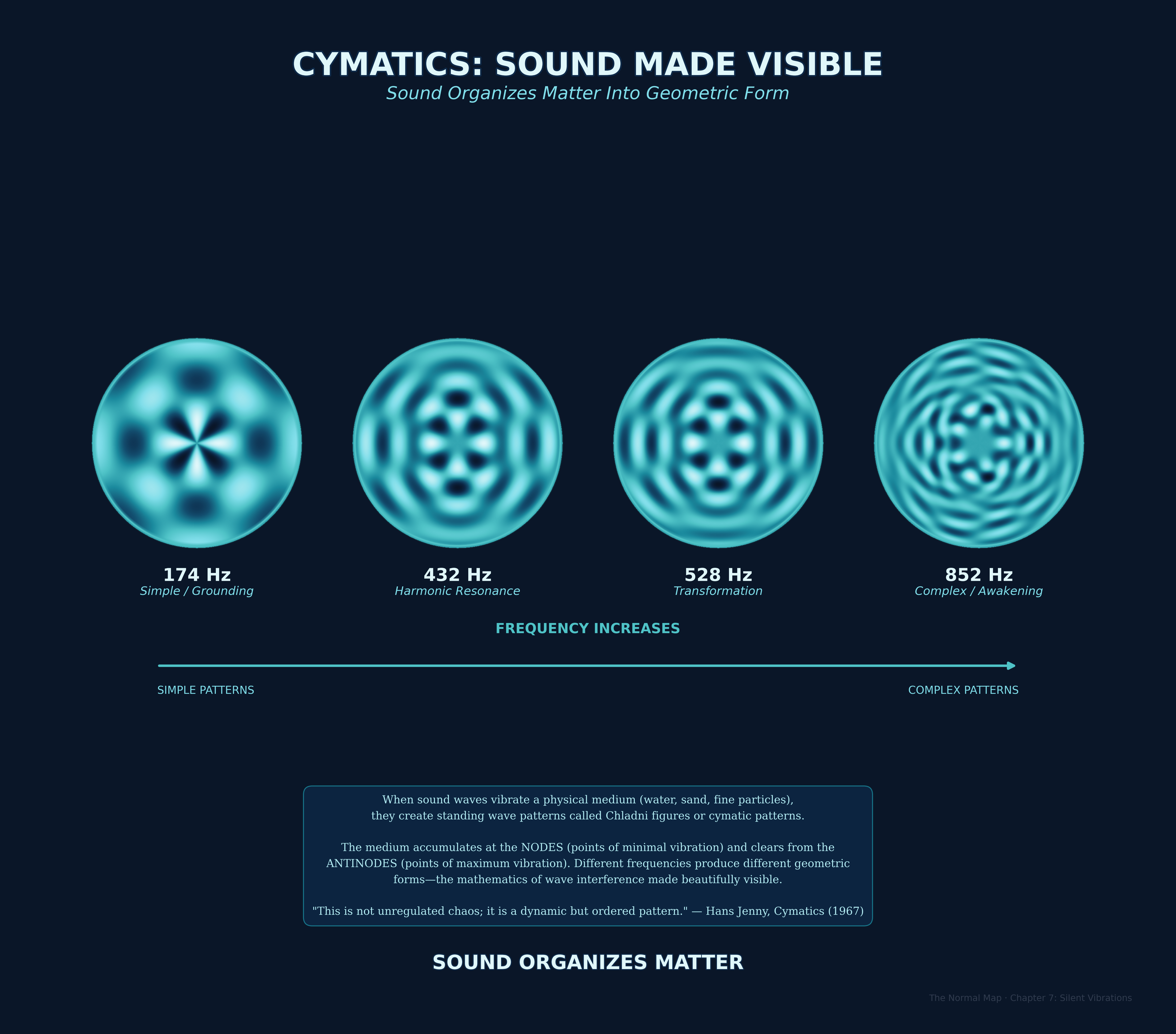
What this suggests: Sound doesn’t just affect matter. Sound organizes matter. Frequency imposes form.
The implications ripple outward. If the universe is fundamentally vibrational, and if sound organizes matter, then sound practices might not be metaphorical when they claim to affect the body. The body is matter. Matter responds to vibration.
The Vagus Nerve and Sound
The vagus nerve, the longest cranial nerve, connects the brain to the heart, lungs, and digestive system. It’s the primary component of the parasympathetic nervous system, our “rest and digest” mode.5
Sound can stimulate the vagus nerve through multiple pathways:
Auricular branches: The vagus has branches in the ear. Sound waves directly stimulate these pathways.
Laryngeal vibration: When you vocalize, when you hum, chant, or sing, the vibrations in your throat directly stimulate vagal pathways.
Vibrotactile stimulation: Deep tones felt in the chest and body activate vagal responses.
Recent research has explored these connections directly:
A 2025 pilot study found that vibrotactile stimulation of the ear at 20 Hz significantly increased coherence in theta and alpha brainwaves.
Studies on OM chanting show significant deactivation of the amygdala and activation of the prefrontal cortex during the practice. The vibrations of the chant seem to directly calm the brain’s fear center.
Research on humming and singing shows increased heart rate variability (HRV), a key marker of vagal tone and stress resilience.
Practical implication: Sound practices aren’t just spiritual traditions. They’re technologies for nervous system regulation with measurable physiological effects.
Solfeggio Frequencies: Tradition and Science
The Solfeggio frequency system, popularized in modern times by Dr. Joseph Puleo, proposes that specific frequencies have specific effects:
- 174 Hz: Pain relief, grounding
- 285 Hz: Cellular healing
- 396 Hz: Liberation from fear and guilt
- 417 Hz: Facilitating change
- 528 Hz: “Miracle frequency,” associated with DNA repair and love
- 639 Hz: Connection and relationships
- 741 Hz: Problem-solving and clarity
- 852 Hz: Spiritual awakening
- 963 Hz: Divine connection
Important caveats: Ancient cultures had sophisticated musical systems, but they could not have precisely measured specific Hz values. Oscilloscopes and frequency analyzers are modern technologies. The “ancient” Solfeggio claims should be understood as modern constructions, not historical fact.
That said, there is some peer-reviewed research on specific frequencies:
528 Hz: A 2018 study by Akimoto et al. found that 528 Hz music significantly reduced stress in the endocrine and autonomic nervous systems after just 5 minutes.7 A study on human astrocyte cells found that 528 Hz sound waves reduced cell death from ethanol exposure, increasing cell viability by approximately 20%. Note: While this research shows reduced oxidative stress (which may indirectly protect cellular health), claims of direct “DNA repair” from any frequency lack peer-reviewed evidence.
432 Hz: Preliminary research suggests that music tuned to A=432 Hz (vs. the standard A=440 Hz) may have calming effects on heart rate and blood pressure, though the differences are subtle.
What we can say honestly: One frequency, 528 Hz, has some promising preliminary research. The other Solfeggio frequencies lack peer-reviewed studies. This doesn’t mean they don’t have effects. It means we don’t have scientific evidence yet.
The balanced position: The specific frequency claims should be held lightly. What is established is that sound affects physiology. Chanting, humming, singing, and listening to calming music all have documented effects on the nervous system. Whether 528 Hz is more healing than 527 Hz or 529 Hz remains unproven.
What Science Does Not Support
It’s important to distinguish legitimate sound research from pseudoscience. Masaru Emoto’s water crystal experiments, claiming that water exposed to different words or intentions forms different crystal structures, have not survived scientific scrutiny:
- Emoto was not a scientist and his studies lacked proper methodology
- Blinded replication attempts have consistently failed
- The James Randi Educational Foundation offered $1 million for controlled demonstration; Emoto did not respond
The appeal of Emoto’s claims is understandable. We want consciousness to directly affect matter. But intellectual honesty requires acknowledging when claims fail scientific testing. Sound healing has legitimate research support. Water memory does not.
Binaural Beats and Brainwave Entrainment
Binaural beats occur when two slightly different frequencies are played into each ear. The brain perceives a “beat” at the difference between them. For example, 250 Hz in the left ear and 256 Hz in the right ear creates a perceived 6 Hz beat, in the theta range.
The theory: this could entrain brainwaves to a desired frequency, allowing technological access to different states of consciousness.
The research is mixed:
- A 2023 systematic review examined 14 studies and found highly inconsistent results. Some studies showed brainwave entrainment; others showed no effect.
- A 2025 study found that gamma frequency binaural beats improved attention performance, with EEG confirming some brain entrainment.
- Other studies have shown binaural beats leading to worse test performance compared to silence.
What we can say: Binaural beats might work for some people, under some conditions. They’re not a reliable shortcut to meditative states. Traditional practices, while slower, have more consistent research support.
Isochronic tones, which use rhythmic pulses of a single tone rather than two interfering tones, may be more effective than binaural beats because the entrainment mechanism is more direct. But research here is also limited.
Ponder This: What sounds settle your nervous system? What sounds activate it? Your body already knows which vibrations support your state—notice what it’s been telling you all along.
7.6 The Somatic Experience of Stillness
What Stillness Feels Like in the Body
Theory maps the territory, but the body knows the terrain. Let’s explore what stillness actually feels like as a lived somatic experience.
The Entry: Meeting Your Restlessness
When you first enter stillness, the body often rebels. You notice itches you want to scratch. Muscles twitch. There’s an urge to shift, to fidget, to move. The mind generates urgent reasons why you need to check your phone, start that task, get up.
This is normal. The body and mind are pattern-recognition systems optimized for motion and stimulation. When you remove the stimulation, they search for it. When you refuse to provide it, they protest.
The instruction: stay.
Not with grim determination, but with gentle firmness. You’re not suppressing the restlessness. You’re creating space for it, staying present while it burns through.
Somatic texture: Twitching, itching, restlessness in the legs or hands, urgency in the chest, mind producing reasons to move. This is the 3D self encountering the absence of its usual distractions.
The Settling: Nervous System Shift
If you stay, something shifts. Usually somewhere between 5 and 20 minutes, the nervous system begins to recognize that there’s no threat, no emergency, no requirement to act. The sympathetic grip begins to loosen.
Somatic texture: Exhale deepens spontaneously. Shoulders drop without you telling them to. Belly softens. Heart rate slows. You might feel a wave of settling, like something in the body saying “oh… okay.”
This is the transition from sympathetic dominance toward ventral vagal engagement. The body is entering the state from which deep stillness becomes possible.
The Deepening: 4D Opens
As settling continues, the 4D begins to reveal itself. With the 3D’s constant motion quieted, you become aware of what was always there underneath.
Somatic texture: Emotions surface without obvious cause. A wave of sadness, a flush of warmth, a tightness in the throat. The body speaks in sensation. You might notice tingling, pressure, temperature changes, in locations that don’t map to obvious physical causes.
This is the body’s way of processing. The 4D is an accumulation of all the experiences that the 3D didn’t have space to fully feel. In stillness, they have room to complete.
The instruction: let it happen. Don’t grasp the pleasant sensations. Don’t push away the difficult ones. Just notice, allow, let the body do what it knows how to do.
The Opening: Spaciousness Emerges
Sometimes, not always, something further opens. The sense of being a someone doing meditation shifts. There’s still awareness, but it’s not located anywhere in particular. Time stops being relevant. The body may feel like it’s disappeared, or expanded to include everything.
Somatic texture: Profound stillness. Not the stillness of suppression but the stillness of presence. Warmth in the heart area. A quality of coming home. Sometimes tears that aren’t sadness, just recognition.
This is 5D access. It can’t be forced. But when conditions are right, it appears, like the sun breaking through clouds.
The Return: Integration
Stillness practices end. You return to movement, to thought, to the business of life. But something has shifted. There’s more space. Colors seem brighter. You respond rather than react.
Somatic texture: The body feels different, more present, more alive, more your own. There’s a quality of settledness that persists beyond the formal practice.
This is integration. The stillness doesn’t stay as a peak experience. It becomes a baseline, a place you can return to, a resource you carry.
7.7 The 3D/4D/5D Mapping of Stillness
Practices for Each Dimension
Let’s map specific stillness practices to the dimensional framework:
3D Stillness Practices
Focus: Training the mind, strengthening attention, building the foundation.
Brainwave target: Coherent beta transitioning to alpha.
Examples:
- Concentration meditation (breath counting, mantra repetition)
- Single-pointed focus (candle gazing, sound focus)
- Attention training apps and exercises
- Visualization practices
Somatic signature: Narrowed attention, sense of effort that softens over time, mental stability.
Best for: Scattered minds, beginners establishing a practice, building focus for creative or professional work.
4D Stillness Practices
Focus: Opening awareness, processing emotional material, clearing the interface.
Brainwave target: Alpha deepening into theta.
Examples:
- Mindfulness meditation (open awareness)
- Body scan practices
- Emotion-focused meditation (RAIN, loving-kindness)
- Yoga Nidra (yogic sleep)
- Shadow work and inner parts work
Somatic signature: Body awareness heightened, emotions surfacing and releasing, sense of spaciousness.
Best for: Emotional processing, healing trauma (with appropriate support), developing equanimity, understanding inner patterns.
5D Stillness Practices
Focus: Recognizing the already-present awareness, dissolving subject/object duality.
Brainwave target: Gamma bursts, delta/gamma integration.
Examples:
- Non-dual pointing-out instructions
- Self-inquiry (“Who am I?”)
- Dzogchen “resting in awareness”
- Advanced samadhi practices
- Contemplative prayer (centering prayer, hesychasm)
Somatic signature: Profound stillness without effort, dissolution of boundaries, heart opening, recognition rather than achievement.
Best for: Recognizing your essential nature, spiritual realization, integration of all dimensions.
Sound Practices Across Dimensions
Sound practices span the dimensions:
3D Sound: Focusing on a sound, using sound as a concentration object. Single frequency or mantra. Mind training through auditory anchor.
4D Sound: Allowing sound to evoke and release emotion. Singing bowl sessions, sound baths. Processing and clearing through vibration.
5D Sound: Merging with sound until there’s no separation between listener and listened. The sound of silence. Nada Brahma, the world as sound, experienced directly.
| Dimension | Stillness Goal | Sound Application | Examples |
|---|---|---|---|
| 3D | Train attention | Concentration anchor | Mantra, single tone, counting |
| 4D | Process emotions | Evoke and release | Sound baths, singing bowls, chanting |
| 5D | Recognize awareness | Merge with vibration | Silence, Nada yoga, primordial sound |
7.8 Integration Practice
A Complete Stillness Sequence
Here is an integrated practice that moves through all three dimensions of stillness. It takes approximately 20-30 minutes. Read through first, then practice.
Preparation (2 minutes)
Find a comfortable seated position. If sitting is uncomfortable, lie down. The body should be supported enough that you can forget about it.
Take three intentional breaths. Longer exhales than inhales. With each exhale, let something release.
Phase 1: Grounding and Regulation (5 minutes)
Place your attention on the physical sensations of your body in space. Feel the weight of your body. The places where your body contacts the surface beneath you. The temperature of the air on your skin.
Now bring attention to your breath without changing it. Simply notice: air moves in, air moves out. The body breathes itself.
If your nervous system feels activated (racing heart, tense muscles, scattered mind), extend your exhale. Breathe in for 4 counts, out for 6 counts. Continue until you feel something settle.
Phase 2: Concentration (5 minutes)
Choose an anchor: the sensation of breath at the nostrils, a mental image, or a repeated word or sound (like “Om” or “peace”).
Place your full attention on this anchor. When attention wanders, notice that it has wandered, and gently return.
No judgment about the wandering. No force in the returning. Just: notice, return. Notice, return.
With each return, you’re building the muscle of attention.
Phase 3: Opening to the 4D (5-7 minutes)
Now release the anchor. Let your attention become spacious.
Instead of focusing on one thing, notice whatever is present. Sensations in the body. Emotions moving through. Thoughts arising and passing.
Don’t grasp pleasant experiences. Don’t push away difficult ones. Just notice. Let everything be as it is.
Pay special attention to sensations at and beyond the skin boundary. Tingling, warmth, coolness, pressure. The energy body revealing itself.
If strong emotions arise, let them. Breathe with them. Don’t try to fix or understand. Just let the body process.
Phase 4: Allowing the 5D (5-7 minutes)
Now, rest. Stop practicing. Stop doing anything.
Let awareness be aware of itself. Not aware of objects, just… aware.
If thoughts arise, let them. They’re not problems. But don’t follow them either. Let them pass like clouds.
If there’s effort, release it. If there’s trying, stop trying. If there’s waiting for something to happen, stop waiting.
Just this. Just now. Just here.
Rest in whatever presence is available.
Phase 5: Sound Integration (3-5 minutes)
Take a deep breath. On the exhale, let sound emerge. It might be a hum, an “Om,” a sigh, whatever wants to come.
Let the sound be whatever it is. No performance. No trying to make it “spiritual.” Just vibration moving through flesh.
Feel where the sound resonates in your body: throat, chest, head. Let the vibration move.
Continue for several breaths, then let the sound fade into silence.
In the silence, notice: is there a subtler sound? A vibration in the stillness itself? What is the sound of awareness?
Return (2 minutes)
Begin to move gently. Fingers, toes. Let movement spread organically.
Take a deeper breath. Open your eyes if they were closed.
Notice how you feel. Notice how the room looks. Notice that you’ve been here all along, but something has shifted.
Carry this shifted quality with you as you return to activity.
7.9 Chapter Summary
Stillness is not the absence of doing. It’s one of the most powerful things you can do.1 The nervous system needs regulation before meditation, and meditation needs to be matched to where you actually are — not where you think you should be. The 5D isn’t something you achieve in stillness. It’s what you stop obscuring.
7.10 For Your Journey
This week, experiment: When you sit still, what happens? Does your body want to move? Does your mind race? Does stillness feel like peace or like torture?
There is no wrong answer—only information about where your nervous system is and where your practice needs to go.
Consider these questions:
- What is your current relationship to stillness? Do you avoid it? Seek it? Fear it?
- Which face of stillness (concentration, mindfulness, non-dual) have you practiced most? Which have you avoided?
- What does your body do when you ask it to be still? This response is information about your nervous system state.
- What sounds settle your system? What sounds activate it?
7.11 Bridge to Next Chapter
In the next chapter, we’ll explore the third pillar of the Somatic Triad: Breath. The one autonomic function we can consciously control. The thread that weaves movement and stillness together. The bridge between dimensions that you carry with you every moment of your life.
For now, practice stillness. Not as an achievement, but as a homecoming. You’re not learning something new. You’re remembering what you’ve always known.
The silence is full.