21 Breath as Bridge
22 Breath as Bridge
“For the breath is life, and if you breathe well you will live long on earth.” — Sanskrit Proverb
8.1 Opening: The Woman Who Learned to Breathe
Elena had tried everything.
Therapy for seven years. Three different antidepressants. Yoga. Meditation apps. Journaling. Affirmations. Nothing touched the tight knot of anxiety that lived permanently in her chest, the nameless dread that woke her at 3 AM, the constant low-level hum of something wrong.
Then a friend dragged her to a breathwork class.
“I thought it was ridiculous,” Elena told me later. “Breathing? I breathe all day. That’s not going to fix anything.”
But twenty minutes into the session, as the facilitator guided the group through a slow, rhythmic pattern—five counts in, five counts out—something happened that seven years of talk therapy had never produced. The knot in her chest loosened. Not through insight or understanding, but through something more direct, more physical, more fundamental.
“It was like my nervous system suddenly remembered what safe felt like,” she said. “Not because I told it to. Because I breathed it there.”
Over the following months, Elena’s transformation was remarkable. Not because she’d achieved enlightenment or transcended her problems. Because she’d discovered something simpler and more powerful: a direct line to her own nervous system that bypassed the thinking mind entirely.
Notice your breathing right now. Not to change it — just to notice that it probably shifted while you read Elena’s story. That’s the mechanism. That’s the bridge. It’s already working.
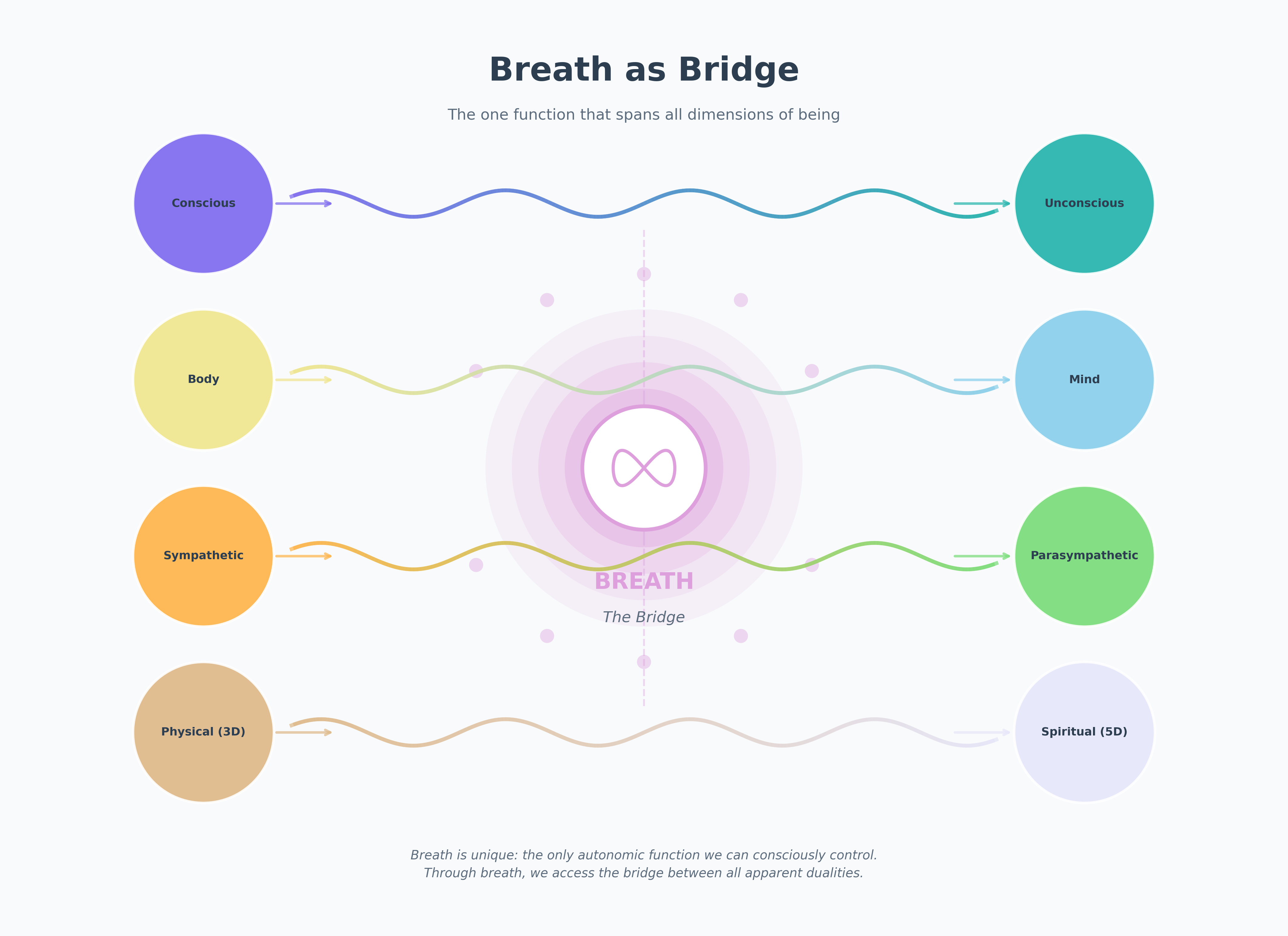
This chapter is about the one lever you always have access to. Breath is not one technique among many. It is the master key to the entire system — the bridge between voluntary and involuntary, between body and consciousness, between the life you’re living and the life your nervous system thinks you’re living.
In the Somatic Triad of Movement, Stillness, and Breath, we’ve already explored Movement (Chapter 18) as the body’s language and Stillness (Chapter 20) as the mind’s technology. Now we come to the third pillar: Breath. And you’ll discover why many traditions place it at the center.
Selected Ambient Works 85-92 by Aphex Twin. Or, for something more traditional, Meditation Music by Deuter. Both create space for breath without demanding attention—the sonic equivalent of a clear channel.
The Somatic Triad: Interactive 3D Visualization
Explore the relationship between Movement, Stillness, and Breath in three-dimensional space. This chapter focuses on Breath (the bottom-right vertex in green)—the bridge that connects body and consciousness, the voluntary gateway to involuntary systems, the master key to state change.
In the visualization below, Movement appears in warm red-orange tones (the body’s language), Stillness in cool teal (the mind’s technology), and Breath in vibrant green (the bridge between dimensions). Notice how Breath occupies the position that connects the physical and the meditative, the active and the receptive. This is not arbitrary—it reflects breath’s unique role as the master key to the entire nervous system.
Click near any vertex to emphasize that element of the triad. Drag to rotate the view. Scroll to zoom. Watch how the relationships shift as you change perspective—just as your relationship with breath shifts when you move from unconscious breathing to conscious practice.
8.2 The Universal Insight
Breath Is Spirit
In at least 97 cultures around the world, the word for breath is the same as the word for spirit, soul, or life force. This isn’t coincidence. This is the most consistent insight in human history.
The linguistic evidence is overwhelming:
| Tradition | Term | Meaning |
|---|---|---|
| Sanskrit | Prana | Breath, life force, vital principle |
| Chinese | Qi/Chi | Vital energy, breath, gas |
| Greek | Pneuma | Breath, spirit, soul |
| Hebrew | Ruach | Breath, wind, spirit |
| Latin | Spiritus | Breath, spirit (root of “respiration” and “inspiration”) |
| Japanese | Ki | Life energy, spirit |
| Polynesian | Mana | Life force, spiritual power |
Look at the English language itself. To inspire literally means to breathe in. To expire means to breathe out—and we use the same word for death. Spirit comes from spiritus, which means breath. We speak of someone being animated (from anima: breath, soul) or inanimate (without breath, without soul).
This linguistic convergence points to a shared human intuition: breath is the interface between the material and the immaterial. It’s where body meets soul. It’s where the voluntary meets the involuntary. It’s where the 3D touches the 4D and opens to the 5D.
Prana: The Sanskrit Understanding
The Sanskrit term prāṇa (from pra “forth” and ana “breathe”) encompasses far more than physical respiration:
- The Absolute (Brahman) as the transcendental source of all life
- Life in general
- The life force or “breath” of life
- Respiration itself
- The life organs
In the yogic tradition, prana permeates all reality, including inanimate objects. It flows through channels called nadis (estimated at 72,000 in classical texts) and concentrates in energy centers called chakras.
Pranayama, the fourth limb of Patanjali’s eight-limbed yoga, means “extension of the life force” or “breath control.” The ancient yogis understood something that modern neuroscience is confirming: by controlling the breath, you can directly influence states of consciousness that are otherwise inaccessible to voluntary control.
Qi: The Chinese Understanding
In Chinese medicine and martial arts, Qi (or Chi) is the vital energy that animates the universe. Its literal translation is “gas” or “air,” revealing the same breath-spirit connection.
Qi flows through specific channels called meridians in the body. When Qi flows freely, health results. When it’s blocked, disease follows. This framework underlies acupuncture, Traditional Chinese Medicine, and the internal martial arts.
Qigong (literally “energy work” or “breath work”) combines three modalities:
- Mindfulness training: Focused attention
- Breathing manipulation: Conscious control of breath
- Body posture: Physical alignment
Research confirms that slow-paced breathing during Qigong practice activates the vagus nerve, reducing inflammation, lowering stress hormones, and increasing resilience. The ancient practitioners understood the mechanism through different language, but the effects are measurable.1
Pneuma: The Greek Understanding
For the Stoic philosophers, pneuma was the “breath of life”—a mixture of air (in motion) and fire (as warmth). It was the active, generative principle that organizes both the individual and the cosmos.
The Greek medical tradition recognized pneuma as essential to health. The term survives in modern medicine: “pneumonia” (lung inflammation), “pneumatic” (relating to air/breath).
In early Christian thought, pneuma became associated with the Holy Spirit—the breath of God that animates creation. “The Spirit of God was hovering over the waters,” says Genesis. The Greek translation uses pneuma. Spirit and breath were one.
Ruach: The Hebrew Understanding
In Hebrew, ruach means breath, wind, and spirit—all the same word. The creation story in Genesis describes God breathing ruach into Adam to make him a living being (nephesh).
This breath of the Creator separated humanity from the rest of creation. Breath wasn’t just biological function; it was the divine-human interface, the point where heaven touched earth.
The Pattern Behind the Pattern
Ninety-seven cultures. Separated by oceans and millennia. All arriving at the same insight: breath is where spirit enters matter.
This convergence suggests not cultural borrowing but independent recognition of the same underlying reality. Ninety-seven separate inquiries, arriving at the same door. When that many traditions point to the same thing — from opposite sides of the planet, across thousands of years of history — we should not explain it away. They were noticing something real about breath that our materialist culture has largely forgotten.
Ponder This: Have you ever noticed how your breath changes with your emotional state? How fear tightens it, how love opens it, how excitement speeds it? Your body already knows that breath and spirit are connected. Every culture in history has known it too. What does it mean that we’ve forgotten?
8.3 The Neuroscience of Breath
The Autonomic Bridge
Your autonomic nervous system controls the involuntary functions of your body: heart rate, digestion, pupil response, hormone release, immune function. You can’t consciously command your heart to beat faster or your stomach to digest. These systems operate below the level of voluntary control.2
There is exactly one exception.
Breath is the only autonomic function you can consciously override.
You breathe automatically while asleep, while talking, while focused on other things. The brainstem handles it without consulting you. But at any moment, you can take over. You can breathe fast or slow, deep or shallow, through the nose or the mouth. You can hold your breath entirely.
This makes breath the control dial on your nervous system’s dashboard.
The autonomic system has two main branches:
- Sympathetic: “Fight or flight” — mobilization, stress response, activation
- Parasympathetic: “Rest and digest” — recovery, relaxation, repair
These branches are in constant dynamic balance. Too much sympathetic activation: anxiety, hypervigilance, exhaustion. Too much parasympathetic: collapse, dissociation, lethargy. Health requires flexibility between them.
The breakthrough insight: Because breath is both automatic AND voluntary, it’s a bidirectional bridge. Your nervous system state affects your breath (anxious = shallow and fast). But the reverse is equally true: your breath affects your nervous system state. Change the breath, change the state.
The Vagus Nerve Connection
The vagus nerve (cranial nerve X) is the main component of the parasympathetic nervous system. It’s the longest cranial nerve, wandering from the brainstem through the neck, heart, lungs, and digestive tract (“vagus” comes from the Latin for “wandering”).2
The vagus nerve:
- Releases acetylcholine, a calming neurotransmitter
- Slows heart rate
- Reduces inflammation
- Supports digestion
- Enables social engagement
Vagal tone—the strength of vagus nerve activity—is one of the most important biomarkers you’ve probably never heard of. High vagal tone predicts:
- Better emotional regulation
- Reduced inflammation
- Improved cardiovascular health
- Greater psychological resilience
- Better cognitive function
- Faster recovery from stress
Here’s how breath affects the vagus nerve: During exhalation, heart rate naturally decreases. This phenomenon, called respiratory sinus arrhythmia (RSA), reflects the heart and breath synchronizing. When you extend your exhale, you directly stimulate the vagus nerve, activating the parasympathetic response.2
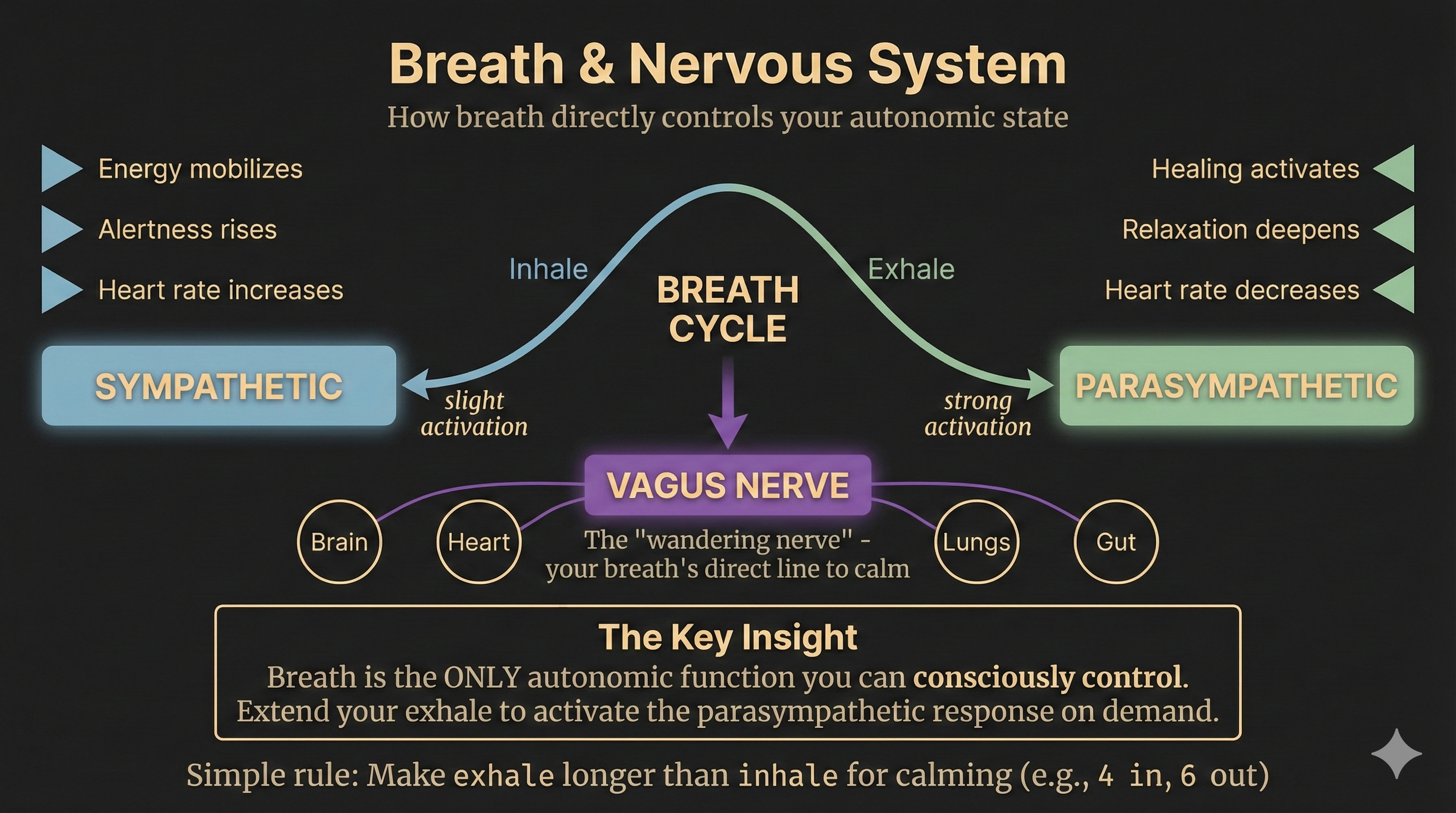
This is why every calming breath technique involves longer exhales. It’s not symbolic. It’s mechanical. You’re directly stimulating the nerve that tells your body it’s safe.
Resonance Frequency: The Magic Number
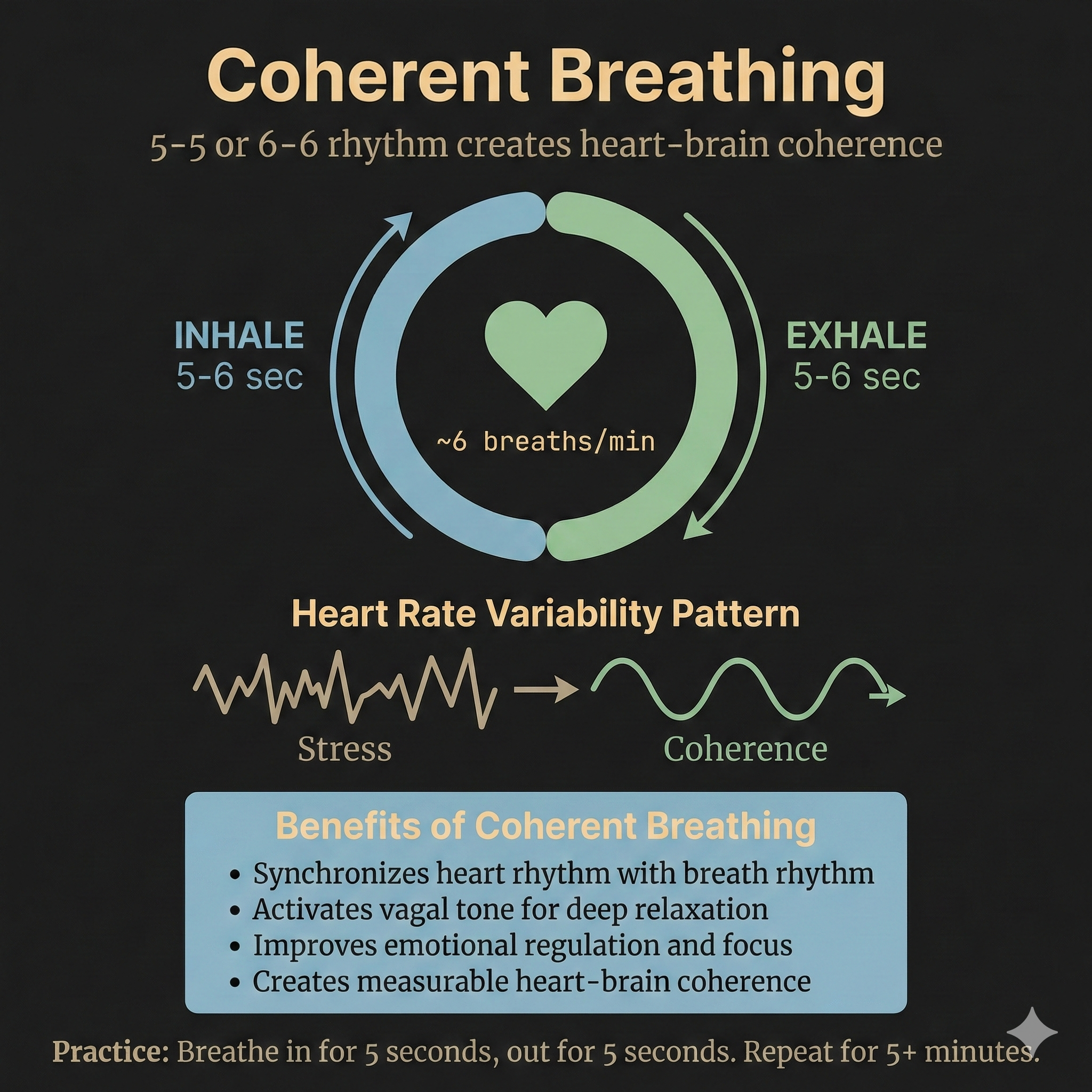
Research has identified an optimal breathing rate for maximizing Heart Rate Variability (HRV)—the key marker of nervous system flexibility and health.3 For most adults, this resonance frequency falls between 4.5-6.5 breaths per minute, with 6 breaths per minute (about 5 seconds in, 5 seconds out) being most commonly optimal. The scientific evidence for this—including findings from the largest HRV biofeedback dataset ever studied—is covered in detail in Section 22.5 below.
Breathing Pattern Quality
It’s not just rate that matters, but how you breathe:1
- Diaphragmatic breathing (belly expands on inhale): Highest HRV improvements
- Thoracic breathing (chest rises on inhale): Decreased HRV coherence
- Paradoxical breathing (belly pulls in on inhale): Lowest coherence, associated with anxiety disorders
Most adults have learned to breathe incorrectly. Watch a baby breathe—the belly rises and falls naturally. Then watch an anxious adult—the chest rises, the shoulders lift, the breath is shallow and reversed. This isn’t just a symptom of stress; it perpetuates stress.
The good news: breathing patterns are learned, which means they can be relearned.
Neuromodulation Through Breath
A 2025 study found that the mechanisms of pranayama—vagus nerve stimulation, autonomic regulation, and hemispheric shifts in brain dominance—are similar to contemporary neuromodulation approaches like:1
- Transcranial magnetic stimulation (TMS)
- Transcranial direct current stimulation (tDCS)
- Vagus nerve stimulation (VNS)
These are medical interventions requiring specialized equipment and clinical settings. Pranayama achieves similar effects with only your lungs and attention.
Research shows that controlled breathing directly influences cortical structures regulating emotion, mood, and arousal. When you breathe slowly and deeply, you’re not just relaxing. You’re reshaping your brain’s relationship with stress.1
8.4 CO2 Tolerance
The Paradox of Carbon Dioxide
Here’s something counterintuitive that most people don’t know: carbon dioxide isn’t just a waste product.
CO2 plays essential roles in your physiology:1
Triggers oxygen release: Via the Bohr effect, CO2 causes hemoglobin to release oxygen to tissues. Less CO2 = less oxygen delivery, even if your blood is fully saturated.
Regulates blood pH: CO2 dissolved in blood forms carbonic acid. The body carefully maintains pH through CO2 levels.
Affects smooth muscle tone: CO2 influences blood vessel dilation and constriction.
Signals breathing rate: The brainstem doesn’t monitor oxygen levels primarily—it monitors CO2. Rising CO2 triggers the urge to breathe.
Here’s the problem: low CO2 tolerance creates a vicious cycle.
- Even slight CO2 increase triggers “air hunger”
- You over-breathe to reduce CO2
- Over-breathing reduces CO2 further
- This actually DECREASES oxygen delivery to tissues
- The brain gets less oxygen, triggering more anxiety
- Anxiety causes more over-breathing
This is why telling an anxious person to “take a deep breath” often backfires. If they’re already over-breathing, deeper breaths make it worse. They need to breathe less, not more.
The BOLT Test
The Body Oxygen Level Test (BOLT), developed by Patrick McKeown of the Oxygen Advantage method, measures CO2 tolerance—how comfortable you are with rising CO2 in your blood.1
How to test:
- Breathe normally through your nose for a few minutes
- Take a normal breath in and out (not a big breath)
- At the end of the exhale, pinch your nose closed
- Time how long until you feel the first urge to breathe (not maximum hold)
- Resume normal, calm breathing
Interpreting your score:
| Score | Meaning |
|---|---|
| Below 10 seconds | Poor tolerance; likely affecting energy, sleep, and anxiety |
| 10-20 seconds | Moderate; may affect sleep quality and stress response |
| 20-40 seconds | Good functional breathing |
| 40+ seconds | Optimal tolerance; excellent nervous system flexibility |
Why CO2 Tolerance Matters
Higher CO2 tolerance indicates:
- Better buffering capacity (your body handles stress without overcorrecting)
- More efficient oxygen utilization (tissues get what they need)
- Greater stress resilience (the alarm system isn’t hair-trigger)
- Calmer baseline nervous system (less chronic sympathetic activation)
The deeper insight: Improving CO2 tolerance trains your nervous system to remain calm under internal stress. It’s not just a breathing skill. It’s a resilience skill. If your body learns to tolerate rising CO2 without panic, it learns the meta-skill of tolerating discomfort without reactivity — and that capacity transfers into every domain of life where the stakes feel high and the impulse is to flee. This is resilience at the physiological level.
Training CO2 Tolerance
The core exercise is simple: Breathe Light to Breathe Right (McKeown).
- Breathe slowly through the nose
- Reduce the volume of each breath slightly
- Maintain a light air hunger (like being at altitude)
- Continue for 10 minutes, 3 times daily
This gradually resets your breathing center’s CO2 sensitivity. You’re teaching your brainstem that rising CO2 isn’t an emergency. Over weeks and months, your baseline shifts. What once triggered panic becomes tolerable.
Breath holds during exercise further challenge the system. Walking while holding your breath (safely, not to exhaustion) increases resilience to hypoxia and improves buffering capacity.
Ponder This: Consider how you respond to internal discomfort—not just physical, but emotional and mental. Is your system hair-trigger, reacting to every slight perturbation? CO2 tolerance training is physical, but the resilience it builds transfers to every domain.
8.5 Heart Rate Variability
The Most Important Metric You’re Not Tracking
Heart Rate Variability (HRV) measures the variation in time between heartbeats. If your heart beats 60 times per minute, that doesn’t mean it beats exactly once per second. There’s natural variation—some beats slightly faster, some slower. This variation is HRV.4
Counter-intuitively, more variation is healthier than less.
- Low HRV: Rigid, stressed system; fight-or-flight dominance; reduced adaptability
- High HRV: Flexible, adaptive system; parasympathetic capacity; resilience
HRV is one of the best biomarkers for:
- Stress resilience
- Recovery capacity
- Autonomic balance
- Overall health and longevity
- Mental and emotional flexibility
Professional athletes monitor HRV daily. Elite performers optimize for it. Yet most people have never heard of it.
HRV and Breathing
HRV increases immediately with coherent breathing. A 2022 systematic review and meta-analysis confirmed increases in vagally-mediated HRV at three time points:4
- During slow breathing
- After a single session
- After multi-session interventions
This is remarkable: you can measurably improve your HRV in a single breathing session. And those improvements compound over time with consistent practice.
Resonance Frequency Breathing
Each person has a resonance frequency—the breathing rate that maximizes their HRV. For most adults: 4.5-6.5 breaths per minute (approximately 0.1 Hz).4
Research findings:
- 5.5 breaths per minute with 5:5 ratio maximizes HRV for most people
- Temporal coherence of respiratory, blood pressure, and cardiac oscillations occurs
- Baroreflex efficiency improves, enhancing cardiovascular stability
This is the scientific basis for “coherent breathing”—the foundation practice we’ll explore in detail.
Global Research Confirms the Pattern
A 2025 Nature Scientific Reports study analyzed 1.8 million user sessions—the largest HRV biofeedback dataset ever studied. Key findings:4
- HRV Coherence is linked to improved emotional stability and cognitive function
- Positive emotions reported by users were associated with higher Coherence scores
- More stable HRV frequencies correlated with better emotional states
The relationship is bidirectional: coherent breathing improves HRV, and improved HRV correlates with better emotional and cognitive states.
Ponder This: Your heart rate varies with every breath. More variability means more flexibility, more capacity to respond to life. What would it mean to have a more flexible heart—not just physiologically, but as a way of meeting experience?
8.6 Specific Techniques
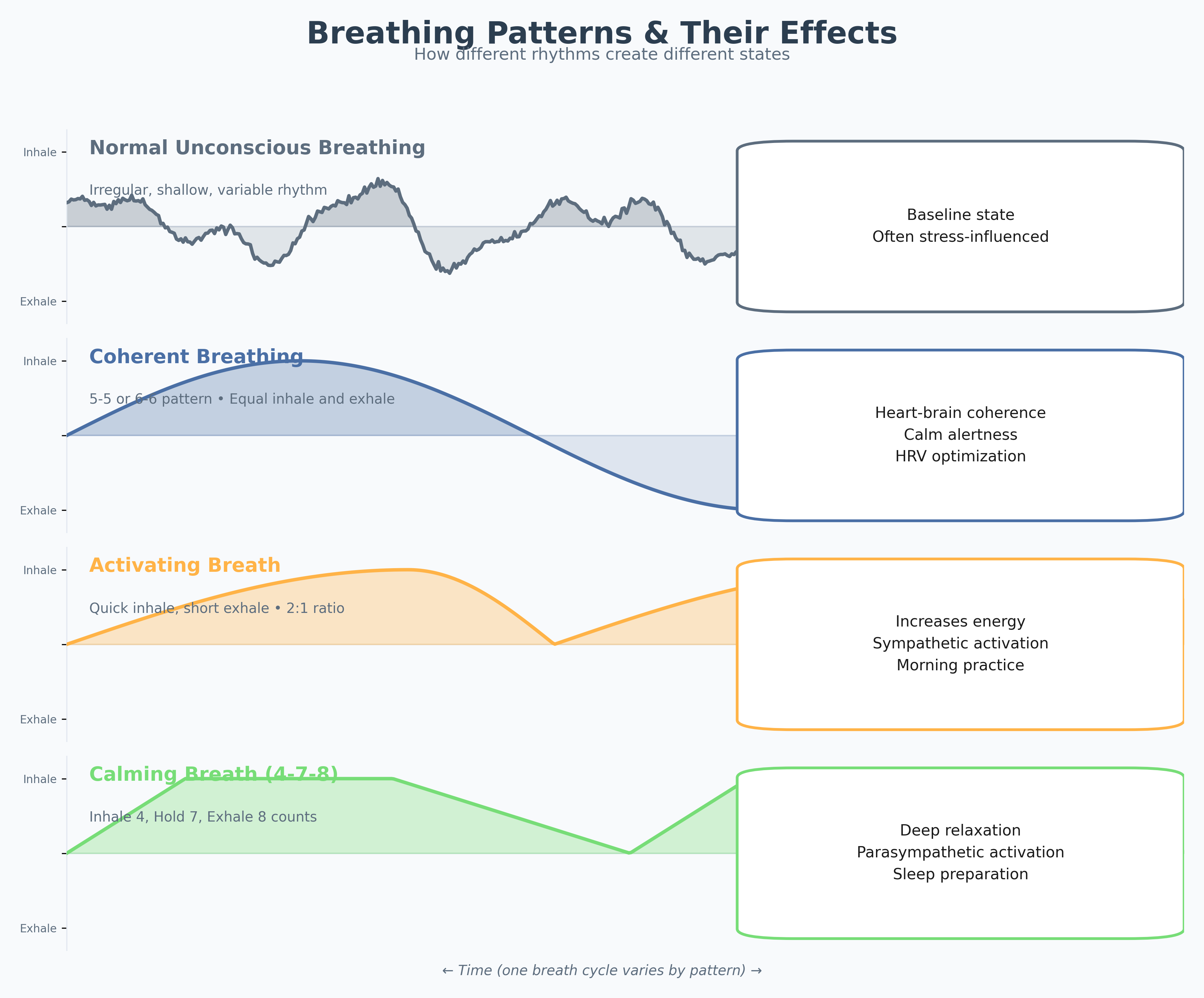
Let’s map specific breathing techniques to their effects and dimensional applications. These aren’t just variations for variety’s sake—each serves a different purpose.
1. Coherent Breathing (5:5)
Pattern: 5 seconds inhale, 5 seconds exhale (6 breaths per minute)
Mechanism:
- Activates resonance frequency for most adults
- Maximizes heart-brain coherence at 0.1 Hz
- Extended exhale stimulates vagus nerve
- Parasympathetic activation without sedation
Effects:
- Maximum HRV increase
- Parasympathetic dominance
- Emotional regulation
- Stress reduction
- Mental clarity
A 2025 Frontiers in Psychiatry meta-analysis found pranayama effective for mental disorders when integrated into care, with slow breathing techniques showing fewer adverse events than fast techniques.1
Use for: Daily practice, stress management, emotional regulation, meditation preparation, returning to baseline
3D/4D/5D mapping: Primary 3D anchor and gateway to 4D coherence. The foundation practice.
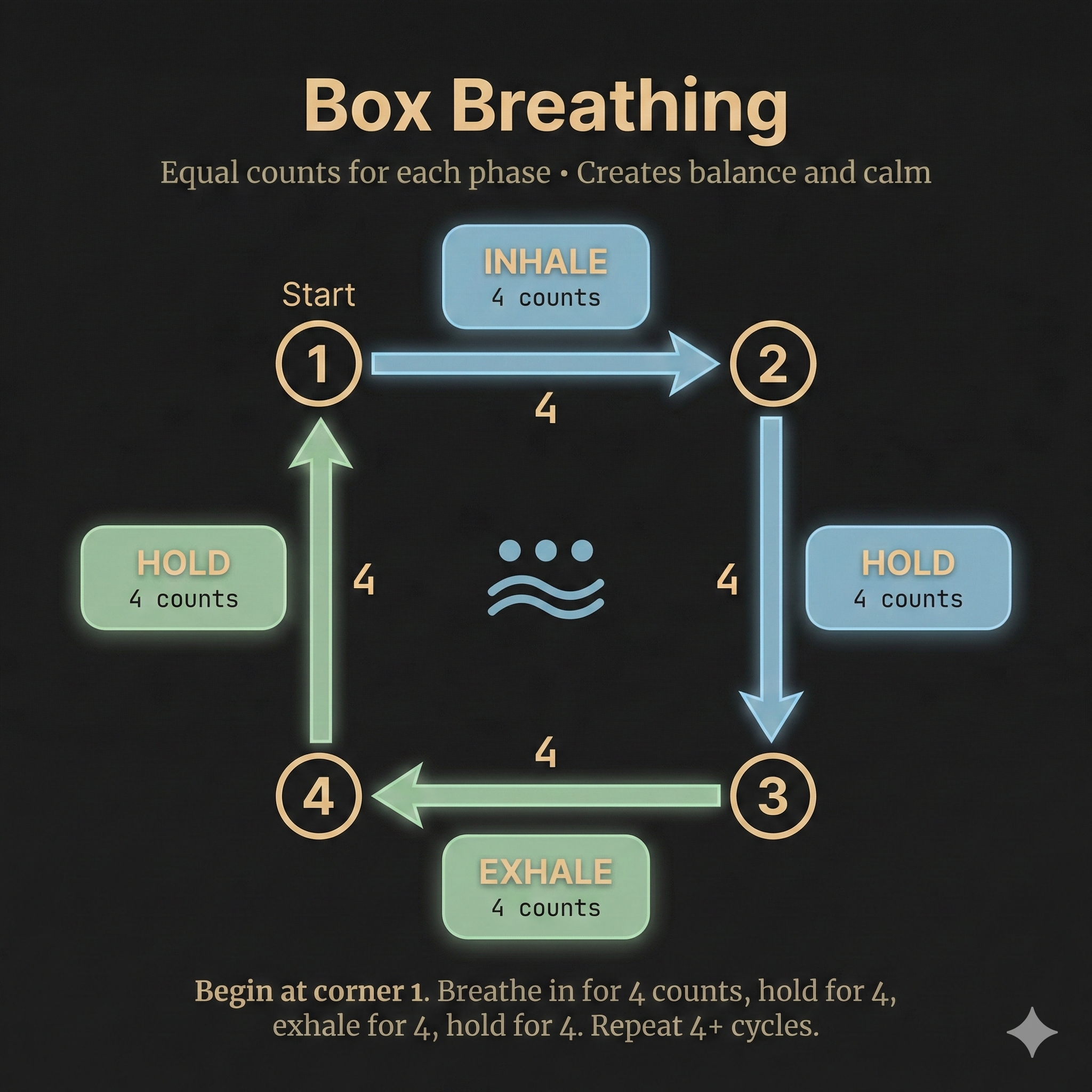
2. Box Breathing (4:4:4:4)
Pattern: 4 seconds inhale, 4 seconds hold, 4 seconds exhale, 4 seconds hold
Mechanism:
- The holds add additional vagal stimulation
- Creates alert but grounded state
- Engages both activation (slight CO2 buildup) and relaxation (extended exhale)
Effects:
- Neutral energetic state
- Alert yet grounded
- Focus and concentration
- Dampens sympathetic response
Used by U.S. Navy SEALs for performance under pressure. Stanford research found controlled breathing directly influences cortical structures regulating emotion, mood, and arousal.1
Use for: Pre-performance situations, high-stress moments, mental clarity, focus tasks
3D/4D/5D mapping: Stabilizes 3D for optimal performance; useful before 4D creative work
3. Extended Exhale Breathing (4:8 or 4:6)
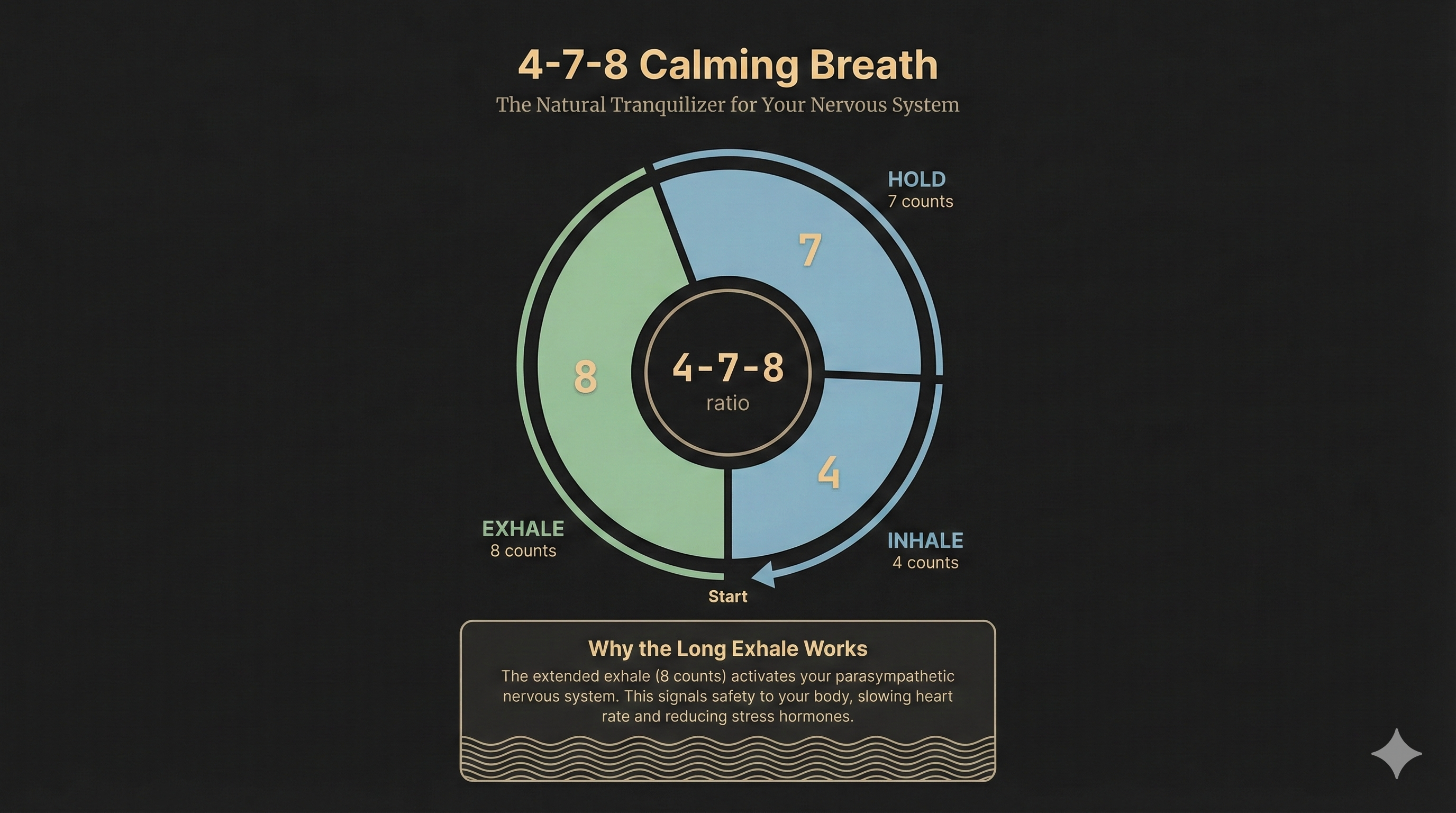
Pattern: Inhale for a count, exhale for double (or longer). Example: 4 in, 8 out.
The 4-7-8 breath variation: Inhale 4, hold 7, exhale 8.
Mechanism:
- Longer exhale = more vagal stimulation
- The hold amplifies the calming effect
- Rapid shift to parasympathetic dominance
Effects:
- Strong parasympathetic activation
- Rapid calming
- Vagal tone improvement
- Anxiety reduction
Use for: Acute stress, anxiety reduction, sleep preparation, panic management
3D/4D/5D mapping: Deep 3D grounding; gateway to stillness states
4. Alternate Nostril Breathing (Nadi Shodhana)
Alternating between nostrils balances hemispheric brain activity and equilibrates the sympathetic and parasympathetic branches. A 2025 high-density EEG study confirmed measurable shifts in alpha/mu and theta oscillations.1 Use it for mental balance, before meditation, or when you need both creative and analytical clarity. Full instructions, hand position, and step-by-step guidance are in the practices companion (Section 23.6).
5. Breath of Fire (Kapalabhati)
Rapid, forceful exhales through the nose (2-3 per second) briefly stimulate the sympathetic system and then produce a parasympathetic rebound—an activating practice that clears stagnation and sharpens alertness. Caution required: avoid during pregnancy, with cardiovascular or respiratory conditions, or if lightheadedness occurs. Full instructions, cautions, and progression guidance are in the practices companion (Section 23.7).
6. Wim Hof Method / Tummo
Controlled hyperventilation followed by breath retention on empty lungs produces voluntary sympathetic activation and a measurable anti-inflammatory response—a 2014 Radboud University study showed trained participants could significantly attenuate innate immune response during endotoxemia.1 This is an advanced practice with real safety requirements (never in water, never while driving). Full protocol and critical safety notes are in the practices companion (Section 23.10).
7. Holotropic Breathwork
Developed by Stanislav Grof after the legal suppression of psychedelic therapy, holotropic breathwork uses accelerated continuous breathing with evocative music to access non-ordinary states comparable to psychedelic experiences. This is an advanced practice that requires a trained facilitator, proper setting, and integration support—never solo, never without preparation. It is not a home practice and has no place in a self-directed daily routine; seek a certified facilitator and proper preparation before approaching it.
8.7 Breath as Dimensional Gateway
The Framework
Throughout this book, we’ve been working with the 3D/4D/5D framework:
- 3D: Physical reality, matter, ego-self, linear time
- 4D: Consciousness bridge, emotional body, non-linear time
- 5D: Pure consciousness, unity, soul-self, timeless presence
Breath provides graduated access across these dimensions. Different patterns open different doors.
Breath Patterns by Dimension
| Dimension | Breath Characteristics | Primary Techniques |
|---|---|---|
| 3D Grounding | Slow, deep, regular; nose breathing; diaphragmatic | Coherent breathing, Box breathing, Extended exhale |
| 4D Access | Altered patterns; holds; asymmetric ratios | Alternate nostril, Breath of Fire, Wim Hof |
| 5D Contact | Extended sessions; accelerated breathing; held states | Holotropic (advanced), deep pranayama, Tummo (advanced) |
The Progression Principle
Foundation first: Stable 3D coherence must be established before attempting 4D or 5D practices.
Why? Because higher-dimensional access without grounding creates:
- Dissociation without integration: The experience doesn’t land in the body
- Nervous system destabilization: Opening faster than you can process
- Spiritual bypassing: Using transcendent states to avoid necessary healing
- Psychological overwhelm: Accessing material without containers for it
The sequence:
- Master coherent breathing (weeks to months)
- Explore box breathing and extended exhale
- Add alternate nostril breathing
- Cautiously explore Breath of Fire (after solid foundation)
- Consider Wim Hof with proper training
- Advanced practices ONLY with experienced guidance
This isn’t arbitrary gatekeeping. It’s the same principle as physical training: you don’t attempt a marathon before you can walk a mile. The nervous system needs progressive challenge, not sudden overwhelm.
Daily Practice Framework
Here’s a practical structure for integrating breath practice into daily life:
Morning Activation (5-10 minutes):
- 5 minutes coherent breathing (grounding, establishing baseline)
- Optional: 1-3 minutes Breath of Fire (activation—skip if anxious or depleted)
Throughout the Day:
- Box breathing before challenging tasks or meetings
- Extended exhale for stress moments (even 3-6 breaths helps)
- Micro-coherence: Six slow breaths whenever you remember
Evening Integration (5-10 minutes):
- Extended exhale breathing (calming the system)
- Coherent breathing (settling into rest)
- Alternate nostril if the mind is scattered
Ponder This: What would shift in your life if you treated breath as seriously as you treat food, sleep, or exercise? If breathing well wasn’t an occasional practice but a daily discipline?
8.8 Breath as the Somatic Triad’s Anchor
Why Breath Is Central
In the Somatic Triad of Movement, Stillness, and Breath, each element has its role:
- Movement (Chapter 18) processes experience through the body, releases stored tension, builds physical resilience
- Stillness (Chapter 20) integrates experience, allows the nervous system to settle, opens the 4D interface
- Breath anchors both, weaves them together, provides the moment-to-moment lever for state change
Movement without breath awareness is exercise, but not medicine. Stillness without breath awareness is relaxation, but not meditation. Breath is the thread that makes both transformative.
Breath Throughout the Flow Cycle
Flow science reveals breath as an observable marker of flow state transitions. As you move through the four phases of the flow cycle—Struggle, Release, Flow, and Recovery—your breathing changes in characteristic ways:
- Struggle phase: Breath often becomes constrained, shallow, held. The prefrontal cortex is working hard, and the body reflects this effort.
- Release phase: When you let go and stop forcing, breath naturally softens and deepens. This is the moment of incubation.
- Flow phase: Breath becomes automatic, rhythmic, effortless. You may not notice it at all—because you’re fully absorbed in the activity. This is breath serving the state without requiring attention.
- Recovery phase: Breath normalizes and grounds. Slow, full breaths help integrate the experience and replenish the system.
Understanding this cycle transforms breath from passive indicator to active tool. When stuck in struggle, deliberately softening the breath can invite release. When returning from flow, conscious slow breathing supports recovery. The breath doesn’t just reflect your state—it can guide the transition.
Consider:
- Yoga: Movement synchronized with breath
- Tai Chi: Slow movement with continuous breath awareness
- Dance: Breath drives rhythm and sustains flow
- Meditation: Breath as anchor for attention
- Singing/Chanting: Breath as vehicle for sound and vibration
Every somatic practice that transforms consciousness involves breath. Because breath is the one thing that’s always with you, always available, always voluntary.
The Three Languages of Breath
Breath speaks three languages, one for each pillar of the Somatic Triad:
The Language of Movement (Breath as Fuel):
Breath powers physical action. Athletic performance improves with proper breathing. Recovery accelerates with conscious breath. Movement practices become medicine when breath is conscious.
Somatic marker: When breath and movement synchronize, there’s a sense of flow, of energy moving through rather than being pushed.
The Language of Stillness (Breath as Anchor):
In meditation, breath provides a home base for attention. The mind wanders; you notice the breath. Return. Wander. Notice. Return. This isn’t failure—it’s the practice itself.
Somatic marker: When breath anchors stillness, there’s a quality of settling, of the mind coming to rest without force.
The Language of Spirit (Breath as Bridge):
Breath connects the voluntary and involuntary, the conscious and unconscious, the 3D and 4D and 5D. It’s literal spirit—the interface between matter and something more.
Somatic marker: When breath touches spirit, there’s a quality of expansion, of the boundaries softening, of connection with something larger than the personal self.
Breath as First Language
Before we had words, we had breath. Before we could speak, we could sigh, gasp, laugh, cry. Breath was our first language—and remains our most honest one.
The etymology tells us: to inspire is to breathe in. We take in spirit with our breath. To express is literally to press out—the exhale that carries our voice, our truth, our presence into the world.
Every act of communication rides on breath. Every word is shaped air. Every song is organized breath. Before the 333 Triad of Expression-Reception-Resonance (Chapter 10), there is breath—the primal carrier wave of all human exchange.
Ponder This: Notice your breath right now. Is it shallow or deep? Fast or slow? Held or flowing? Your breath is speaking your current state more honestly than any words could. What is it saying?
8.9 Safety Guidelines
General Principles
Start slow: Begin with coherent breathing before any advanced practices. Master the foundation.
Nose breathing default: Unless a technique specifies otherwise, breathe through the nose. Nasal breathing filters, warms, and humidifies air; triggers nitric oxide production; and supports proper CO2 balance.
No forcing: Breathwork should never feel like strain or struggle. Discomfort is sometimes part of the practice (air hunger in CO2 training, tingling in Wim Hof). Pain, panic, or extreme distress is a signal to stop.
Position safety: Never practice breath holds or advanced techniques while standing, driving, in water, or operating machinery. Sit or lie down in a safe space.
Empty stomach: Wait 2+ hours after eating for intensive practices.
Hydration: Drink water before and after sessions.
Contraindications by Technique
Breath of Fire (Kapalabhati):
- Pregnancy
- Heart conditions
- High blood pressure (uncontrolled)
- Respiratory conditions
- Recent abdominal surgery
- First 2 days of menstruation (traditional teaching)
Wim Hof / Hyperventilation practices:
- Cardiovascular conditions
- Epilepsy
- Pregnancy
- Recent surgery
- Glaucoma
- NEVER in water (drowning is a real risk)
Holotropic Breathwork:
- Cardiovascular disease
- Pregnancy
- Severe psychiatric conditions
- Unprocessed trauma (without proper support)
- Certain medications (especially psychiatric)
- Never without a trained facilitator
When to Stop
Stop any practice immediately if you experience:
- Severe disorientation that doesn’t pass when you return to normal breathing
- Chest pain
- Extreme anxiety or panic that persists
- Loss of consciousness (and don’t resume without medical consultation)
- Persistent dizziness after stopping
Integration Matters
Especially after more intensive practices:
- Allow time for integration—don’t rush back into activity
- Journal experiences while they’re fresh
- Have support available (a person you can call, a safe environment)
- Don’t operate machinery or drive immediately after
- Ground yourself through gentle movement or nature contact
8.10 The 3D/4D/5D Mapping of Breath
A Reference Summary
| Dimension | Breath Goal | Primary Techniques | Brainwave State | Somatic Signature |
|---|---|---|---|---|
| 3D (Grounding) | Stabilize, ground, establish coherence | Coherent (5:5), Box (4:4:4:4), Extended exhale | Alpha (8-12 Hz) | Settled, stable, present |
| 4D (Clearing) | Balance, clear, access emotional body | Alternate nostril, Breath of Fire (moderate), Wim Hof | Theta (4-8 Hz) | Open, flowing, emotional material surfaces |
| 5D (Activating) | Transcend, access unity states | Holotropic, Tummo, advanced holds | Gamma (30+ Hz) | Expansive, boundary dissolution, timelessness |
The Progression Path
Weeks 1-4: Foundation (3D Focus)
- Coherent breathing: 5-10 minutes daily
- Box breathing: Before challenging situations
- Extended exhale: For stress moments
- Goal: Establish baseline regulation, improve HRV
Weeks 5-8: Building (3D-4D Bridge)
- Add alternate nostril breathing: 5 minutes daily
- Explore light breath holds
- Begin tracking HRV with wearable if desired
- Goal: Expand capacity, touch 4D territory
Weeks 9-12: Deepening (4D Access)
- Add Breath of Fire: 1-3 minutes (build slowly)
- Increase coherent breathing to 15-20 minutes
- Notice emotional material surfacing during practice
- Goal: Regular 4D access, increased resilience
Months 3-6+: Integration (4D Mastery, 5D Glimpses)
- Consider Wim Hof method with proper guidance
- Deepen all foundation practices
- 5D practices only with experienced facilitator
- Goal: Stable access across dimensions
8.11 Integration Practice
A Complete Breath Journey
Here is an integrated practice that moves through all three dimensions using breath. Allow 15-20 minutes. Read through first, then practice.
Preparation (2 minutes)
Find a comfortable position, seated or lying down. Close your eyes or soften your gaze. Take a moment to arrive. There’s nothing you need to do right now except be here.
Phase 1: Grounding (5 minutes) — 3D
Begin coherent breathing: 5 seconds inhale, 5 seconds exhale.
Breathe through the nose. Let the belly expand on the inhale, soften on the exhale.
No forcing. Just a steady, even rhythm.
As you breathe, feel your body. The weight of it. The places where you contact the surface beneath you. The physical reality of being here, now, in a body.
This is the 3D. This is ground.
Continue for about 15 breath cycles.
Phase 2: Clearing (5 minutes) — 4D
Shift to alternate nostril breathing.
Close your right nostril with your thumb. Inhale through the left nostril.
Close the left nostril with your ring finger, release the right. Exhale through the right.
Inhale through the right.
Close the right, release the left. Exhale through the left.
Continue this pattern. One complete round: left-inhale, right-exhale, right-inhale, left-exhale.
As you practice, notice any emotions or sensations that arise. The 4D often speaks during this practice. You might feel waves of feeling without clear cause. You might notice energy moving. Let it be.
Continue for about 10 complete rounds.
Phase 3: Opening (5 minutes) — 5D Gateway
Return to natural breathing through both nostrils.
Let the breath become very soft, very subtle. Almost as if breathing is happening to you rather than by you.
Release any technique. Just presence. Just awareness.
If thoughts arise, let them pass like clouds.
If nothing special happens, that’s perfect. You’re not trying to achieve a state. You’re creating conditions for opening. Sometimes the door opens. Sometimes you just sit near it. Both are practice.
Rest here.
Return (2-3 minutes)
Gradually let the breath deepen again.
Begin to sense the room around you. The sounds. The temperature.
Move your fingers and toes.
When ready, open your eyes.
Take a moment before returning to activity. Notice how you feel. Different? The same? Clearer? Softer?
Whatever you notice is information. There’s no wrong way to return.
8.12 Chapter Summary
Ninety-seven cultures said breath is spirit. The neuroscience agrees on mechanism, if not metaphysics: change the breath, change the state.2 Every technique in this chapter is a different angle on the same truth — the breath is always available, always honest, and it was working on you before you finished reading page one.
8.13 For Your Journey
This week, experiment with treating breath as a practice rather than an automatic function.
- Try coherent breathing for 5 minutes each morning. Notice what shifts.
- Use extended exhales whenever stress arises. Three breaths, exhale twice as long as inhale. Notice the effect.
- Check your BOLT score at the beginning and end of the week. Is it changing?
Consider these questions:
- What is your default breathing pattern? Shallow and fast? Deep and slow? Where do you breathe from—chest or belly?
- When does your breath change? Notice the relationship between breath and emotional state throughout the day.
- What happens when you consciously slow your breath? Try it during stressful moments. What shifts?
- How would your life change if you treated breath as seriously as food, sleep, or exercise?
The most powerful practice is often the simplest. You don’t need special circumstances. You don’t need equipment. You have everything you need right now, moving in and out of your body about 15 times per minute.
What would change if you breathed consciously, deliberately, like it mattered?
Because it does.
8.14 Bridge to Next Chapter
We’ve now explored all three pillars of the Somatic Triad:
- Movement (Chapter 18): The body’s language
- Stillness (Chapter 20): The mind’s technology
- Breath (this chapter): The bridge between dimensions
In the next chapter, we bring them together. Chapter 9: Nervous System Coherence & Somatic Healing integrates everything we’ve learned into a comprehensive approach to healing—the practical application of the Somatic Triad for transforming trauma, building resilience, and restoring the coherence that is your birthright.
The tools are in your hands. The breath is in your lungs. The journey continues.
The bridge is already under your feet.