23 Nervous System Coherence & Somatic Healing
The Body Keeps the Score—And Knows the Solution
24 Nervous System Coherence & Somatic Healing
9.1 The Body Keeps the Score—And Knows the Solution
“Trauma is not what happens to you. Trauma is what happens inside you as a result of what happens to you.” — Gabor Maté
Opening: The Man Who Couldn’t Feel Safe
Marcus was a Marine veteran who had done everything right.
He’d completed his tours honorably, sought help when the nightmares started, and spent three years in traditional talk therapy working through his combat experiences. He could tell his story without flinching now. He understood intellectually that he was safe. He’d processed the events thoroughly, gained insight into his patterns, and genuinely believed he’d healed.
So why did his body still act like the war had never ended?
Every car backfire sent him diving behind furniture. Crowded restaurants triggered a scanning vigilance he couldn’t switch off. His wife’s gentle touch in sleep made him jolt awake with his hands already raised. And worst of all: the constant hum of threat that lived in his chest, an unshakable certainty that danger was imminent, even as his rational mind knew perfectly well it wasn’t.
“I’ve talked about this for three years,” Marcus told me. “I understand everything about why I react this way. But my body doesn’t care about my understanding.”
Then he found a therapist who worked with the nervous system directly.
The first session, she didn’t ask about his traumas. Instead, she had him notice his feet on the floor. The temperature of his hands. The quality of his breath. When his heart started racing during their conversation—something he’d learned to ignore—she paused and asked, “What just happened in your body?”
For the first time, someone was speaking to the part of him that was still in combat.
Over the following months, through techniques he’d never heard of in traditional therapy—titration, pendulation, completing defensive responses—something shifted that three years of talk therapy hadn’t touched. His nervous system began to learn something his mind had known all along: the war was actually over.
This chapter is about why Marcus’s body didn’t believe his mind. About why trauma lives not in our memories but in our nervous systems. And about why the path to healing runs not through insight alone but through the body itself.
You’ve already explored the Somatic Triad—Movement, Stillness, and Breath. Now we go deeper: into the neurobiology of why these practices work, the concept of the window of tolerance, and the revolutionary understanding that healing happens not in isolation but in relationship.
Your nervous system keeps the score. It also knows the way home.
Music for Psychedelic Therapy by Jon Hopkins—an album designed specifically to support nervous system regulation during deep inner work. Or, for something more accessible, Weightless by Marconi Union, scientifically designed to reduce anxiety.
9.2 The Three States of Your Nervous System
Beyond Fight or Flight
You’ve likely heard of the “fight or flight” response—Walter Cannon’s 1920s discovery that our bodies mobilize for action when threatened. What you may not have learned is that this model is incomplete. There’s a third response, older than fight or flight, that explains why some people freeze in crisis rather than act, why depression feels like being trapped underwater, and why Marcus’s body couldn’t accept that he was safe.
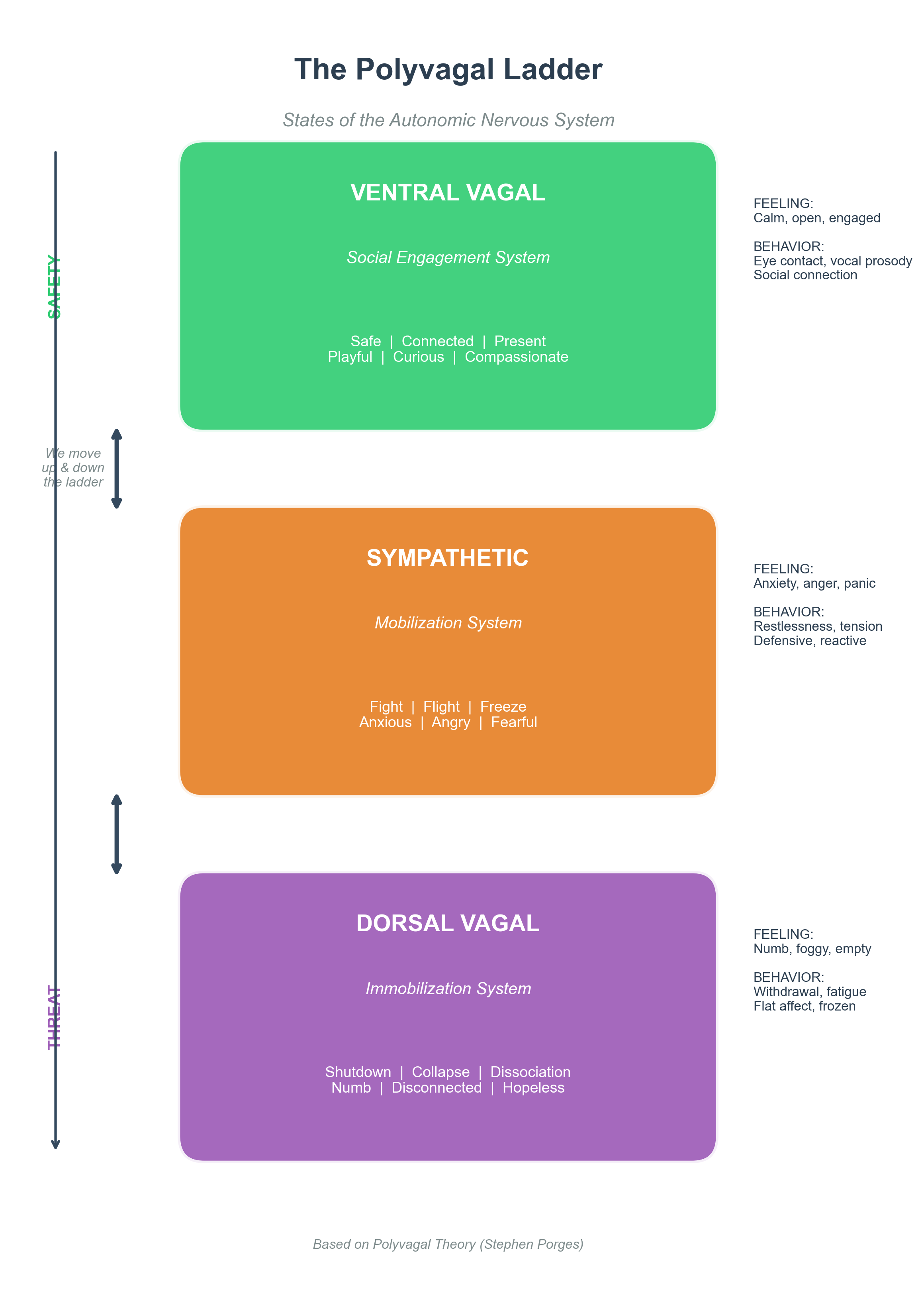
In 1994, Stephen Porges proposed something that changed how we understand safety, connection, and shutdown. Your autonomic nervous system doesn’t have two modes. It has three. And the oldest one — the one nobody talked about — explains everything from depression to dissociation to why some people freeze in crisis instead of fighting or running1.
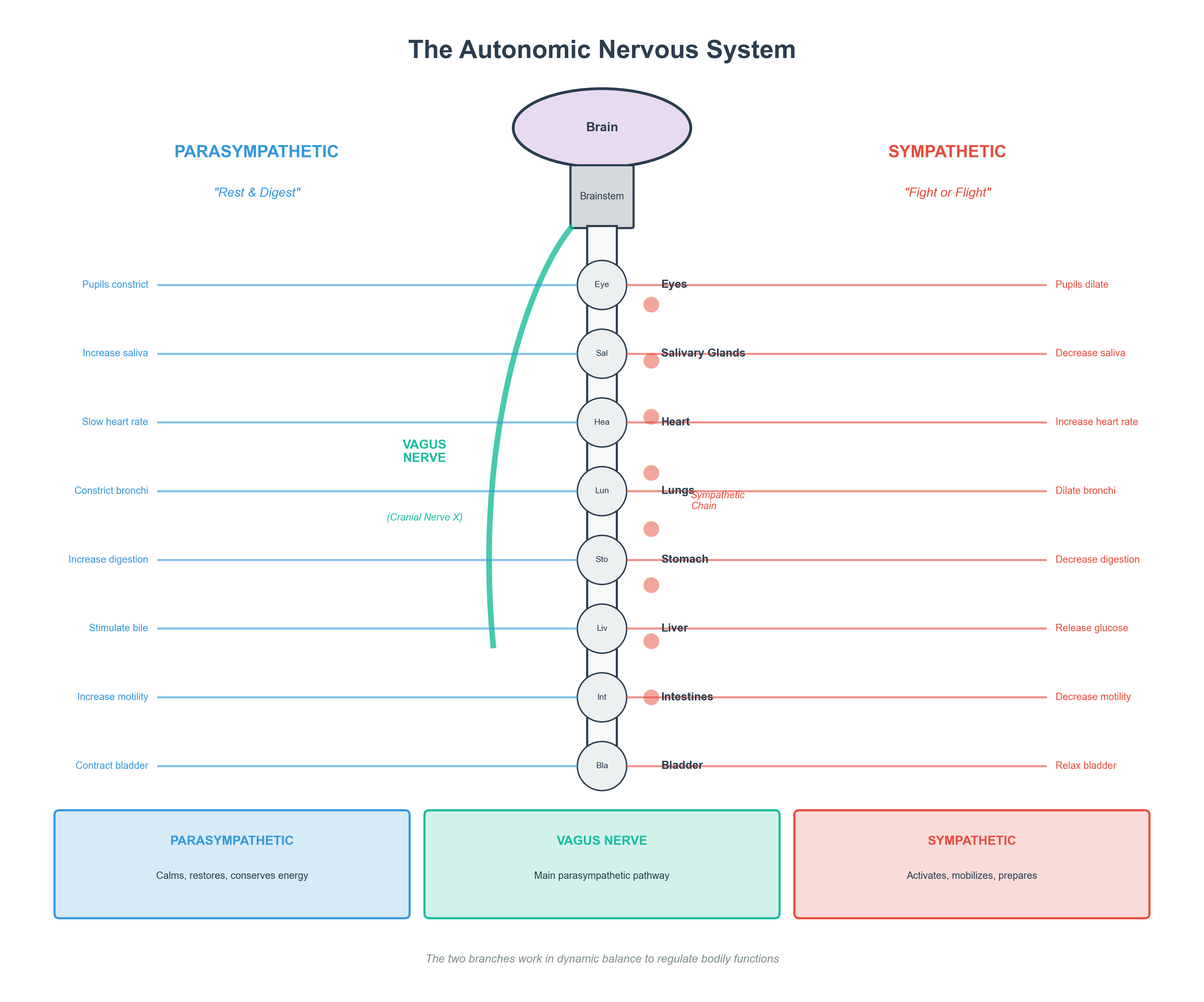
A note on scientific status: Polyvagal Theory is clinically influential but scientifically debated2. Some of its neuroanatomical claims have been questioned by researchers. However, the clinical framework—three states, hierarchical recruitment, the concept of neuroception—remains therapeutically useful regardless of whether the underlying mechanisms are precisely as Porges describes. We’ll use the framework here for its practical value while acknowledging the ongoing scientific discussion.
State 1: Ventral Vagal (Safety and Connection)
The newest evolutionary development. This state allows for social engagement, calm presence, and the capacity to connect with others. When you’re in ventral vagal, your nervous system has concluded: I am safe. I can relax. I can connect.
Physiological markers3:
- Heart rate is calm and steady
- Breathing is full and easy
- Muscles are relaxed but alert
- Facial expressions are animated and responsive
- Voice has varied tone (prosody)
- High heart rate variability (HRV)
What it feels like:
- Present and grounded
- Open to connection
- Curious rather than defensive
- Able to handle stress without becoming overwhelmed
- Joy and play are accessible
- You feel like yourself
Somatic Triad Connection:
| Element | Ventral Vagal Expression |
|---|---|
| Movement | Fluid, responsive, graceful |
| Stillness | Restful without collapse |
| Breath | Full, natural, variable |
This is the state you want to have access to most of the time. It’s not about being perpetually calm—it’s about having flexibility, the capacity to respond appropriately to circumstances and return to baseline afterward.
State 2: Sympathetic Activation (Fight or Flight)
The mobilization response. When your nervous system perceives threat, it shifts resources toward action. Heart rate increases. Stress hormones flood the system. Blood moves to large muscles. The thinking brain goes offline in favor of survival circuits.
Physiological markers3:
- Elevated heart rate and blood pressure
- Rapid, shallow breathing
- Muscle tension, especially in shoulders, jaw, and back
- Scanning eyes, hypervigilant attention
- Reduced HRV
- Cortisol and adrenaline elevated
What it feels like:
- Anxiety, panic, restlessness
- Anger, irritability, impatience
- Racing thoughts, difficulty concentrating
- Urge to flee or fight
- Sense of impending danger
- Hypervigilance
Somatic Triad Connection: In sympathetic activation, movement goes rigid or compulsive, stillness becomes nearly impossible, and breath moves up into the chest—shallow and rapid. The body is primed for action whether or not action is actually needed.
This response is adaptive in actual danger. The problem arises when it becomes chronic—when the nervous system gets stuck in mobilization even without real threat.
State 3: Dorsal Vagal (Freeze and Shutdown)
The oldest response. When fight or flight is impossible—when the threat is overwhelming or escape blocked—the nervous system can drop into an ancient survival mode: immobilization. This is the possum playing dead, the deer frozen in headlights, the dissociation that allows consciousness to leave a body it can’t escape.
Physiological markers3:
- Dramatically slowed heart rate
- Shallow, held, or restricted breathing
- Muscle collapse or heaviness
- Flat facial expression
- Low energy, difficulty initiating action
- Very low HRV
What it feels like:
- Numb, disconnected, “not here”
- Foggy, dissociated, spacey
- Depressed, hopeless, “what’s the point?”
- Trapped, stuck, unable to move
- Fatigued for no physical reason
- Collapsed posture and heavy limbs
Somatic Triad Connection: Dorsal vagal shutdown takes each pillar to its shadow side—movement becomes impossible or costs something enormous, stillness becomes collapse rather than rest, and breath drops to the minimum the body needs to stay alive. This is not peace. This is the system choosing not-death over everything else.
When the Eyes Tell the Story
There’s one somatic marker that deserves special attention—because it sits at the intersection of danger and grace, and getting it wrong matters.
Eyes rolling upward.
In somatic work and in contemplative practice, this eye movement means two completely different things depending on context1. The same visible gesture can signal dorsal vagal shutdown or deep meditative absorption. The stakes of confusing them are real: one requires gentle intervention, the other requires leaving well enough alone.
The oculocardiac reflex links eye position directly to vagal tone—upward gaze activates parasympathetic pathways, slows heart rate, and deepens physiological calm. This is likely why eyes naturally drift upward in meditation and in prayer across cultures. But upward eye movement also appears in dissociation and shutdown, when the nervous system is withdrawing from an overwhelming experience.
The eyes aren’t the signal. The context the eyes go up in is the signal.
Reading the Difference:
| Marker | Dorsal Vagal (Shutdown) | Meditative (Deepening) |
|---|---|---|
| Eye quality | Glazed, vacant, “lights off” | Soft, alive, “lights on but directed inward” |
| Posture | Collapsed, slumped, loss of tone | Upright, maintained, subtle aliveness |
| Breath | Shallow, held, barely there | Steady, possibly deepening naturally |
| Skin | Pallor, cold, sometimes sweaty | Warm, normal color, relaxed |
| Contactability | Unreachable, dissociated | Deeply absorbed but can be reached |
| Preceded by | Overwhelm, threat, too much too fast | Intentional practice, gradual deepening |
| Recovery feels like | Disoriented, confused, foggy | Refreshed, clear, integrated |
The posture, breath, and skin color rows are the most clinically reliable anchors. The eye quality descriptions are phenomenological approximations—useful, but harder to verify from the outside.
If you’re holding space for someone and their eyes roll upward, don’t intervene immediately—read the context first.
Check posture, breath, and skin color before doing anything.
If the person is upright, breathing steadily, and warm: they’re likely deepening. Leave them alone. Your intervention will interrupt something real.
If the person is collapsed, pale, cold, or genuinely unresponsive: they may have slipped into dorsal vagal shutdown. Ground them gently—speak their name slowly and warmly, ask them to feel the floor beneath them. If touch is part of your agreed facilitation container, a steady hand on their feet or shoulder can help. Don’t alarm. Don’t rush. Just bring them back to the room.
The key phrase: the eyes going up is not the signal. The context the eyes go up in is the signal.
This distinction matters because shutdown can look peaceful from the outside. The person may be very still, seemingly relaxed. What’s actually happening is a withdrawal of presence—the opposite of the rich interior contact of deep meditation. If you mistake shutdown for depth and leave someone there, you’ve missed an opportunity to help. If you mistake depth for shutdown and pull someone back, you’ve broken something worth protecting.
If you want clinical tools for navigating this terrain: Bruce Greyson at the University of Virginia developed a 19-item Physio-Kundalini Scale specifically designed to distinguish spiritual emergence from psychiatric emergency. And ophthalmologist-psychiatrist Lee Sannella created a physio-kundalini syndrome framework that maps the full spectrum of energy-movement phenomena—including eye changes—from benign kriyas to states requiring clinical attention. These aren’t fringe resources. They’re peer-reviewed instruments designed for exactly the moment when someone’s eyes roll back and you need to know whether to wait or act.
I know this distinction from the inside, not just from theory.
The meeting I described earlier in this chapter—the one where the world went flat—my eyes did something during that, though I couldn’t have told you what at the time. Everything went distant. My gaze softened and diffused. From the outside, I might have looked very still.
What I know now: that wasn’t the same stillness I find in meditation. In meditation, going interior feels like coming home—alive, rich, directed somewhere meaningful even if inward. What happened in that meeting felt like going absent. The lights didn’t turn inward. They just went off.
When I eventually encountered this framework, it helped me understand the difference between experiences I’d been conflating. The body looked similar from the outside. But from the inside, one was descent and one was depth. One was my nervous system abandoning ship. The other is what I go looking for in practice.
I’m still learning to tell them apart in real time. But now I have landmarks to navigate by.
Dorsal vagal shutdown is not laziness or weakness. It’s a sophisticated survival mechanism designed to conserve resources when action is futile. But when it becomes the default state, it manifests as depression, chronic fatigue, dissociation, and the inability to engage with life.
Ponder This: Which of these three states do you spend the most time in? Not which would you prefer, but where does your nervous system actually live? Can you recall specific times you’ve been in each state? What triggered the shifts?
A Note from Tyler: When the World Went Flat
I need to tell you what dorsal vagal feels like from inside, because the clinical language doesn’t capture it.
I was in a meeting—important people, high stakes. The conversation was happening, and I was there. I could see mouths moving, hear words in what felt like the wrong order. Someone asked me a question. I heard my own voice answer, but it sounded like someone else was using my mouth. Like I was watching a puppet that looked like me operate a life that was supposed to be mine.
My body felt like it weighed a thousand pounds. My vision went flat—everything looked like a photograph instead of reality. Colors were there but muted, like someone had turned down the saturation on the world. I remember thinking: I should feel something about this. Why don’t I feel anything?
I was there, but I wasn’t there.
At the time, I thought I was just tired. Burned out. Not handling stress well. I told myself to push through, drink more coffee, try harder. I didn’t know there was a word for what was happening. I didn’t know my nervous system had dropped into an ancient survival response because somewhere deep below conscious awareness, it had decided fighting and fleeing were both impossible.
Months later, I stumbled across Polyvagal Theory. I was reading about dorsal vagal shutdown, expecting some clinical abstraction, and instead I found a description of myself. Not metaphorically—literally. The heavy limbs, the flatness, the dissociation, the voice that didn’t sound like your own. I sat there staring at the page thinking: This is what that was. This is what I’ve been doing my whole life.
That moment of recognition—finding words for something my body had always known—was the first step toward a different relationship with my own nervous system. Not fixed. But seen.
9.3 Neuroception—Why Your Body Doesn’t Believe Your Mind
The Subconscious Safety Scan
Here’s why Marcus’s body didn’t care about his mind’s understanding: his nervous system wasn’t listening to his prefrontal cortex. It was listening to something far older and faster.
Dr. Porges coined the term “neuroception” to describe the nervous system’s continuous, subconscious evaluation of safety and danger1. Unlike perception—which is conscious—neuroception happens below awareness, in circuits that predate the thinking brain by hundreds of millions of years.
Your neuroception evaluates:
- Facial expressions of people around you
- Tone of voice (is it warm or hostile?)
- Body posture and movement patterns
- Environmental sounds and smells
- Social cues and group dynamics
- Internal sensations from body and gut
All of this happens in milliseconds, outside conscious awareness, and the nervous system shifts state accordingly.
When Neuroception Goes Wrong
Trauma can miscalibrate neuroception4. When someone has experienced repeated danger—especially in childhood—their nervous system can become calibrated for threat. It perceives danger where none exists and fails to recognize safety even when present.
Faulty neuroception looks like:
- Feeling unsafe in objectively safe environments
- Being triggered by neutral stimuli (certain sounds, smells, postures)
- Inability to relax even when nothing is wrong
- Reading hostility in friendly faces
- Chronic hypervigilance or chronic numbness
- The feeling that “something bad is about to happen” with no evidence
This explains the paradox that frustrated Marcus: he knew he was safe, but his nervous system hadn’t gotten the memo. The information was in the wrong place—in his thinking brain, which wasn’t running the show.
The Clinical Implication
If trauma is stored in the nervous system—not primarily in explicit memory—then healing must address the nervous system directly.
The body keeps the score, as Bessel van der Kolk titled his landmark book4. The imprint is in the tissues, the reflexes, the default autonomic settings. And the healing path runs through the same territory.
Ponder This: Have you ever been somewhere objectively safe yet felt unsafe? Or been in actual danger and felt strangely calm? These are examples of your neuroception at work. Your nervous system is constantly making assessments that may or may not match the actual circumstances.
9.4 The Window of Tolerance—Your Capacity for Life
The Concept
Psychiatrist Dr. Dan Siegel developed the concept of the “window of tolerance” to describe the optimal zone of arousal within which a person can function effectively5. Within this window, you can experience emotions—even strong ones—without becoming overwhelmed or shutting down.
Remember from Chapter 1: if the nervous system is dysregulated—if the 4D multiplier approaches zero—the entire coherence formula zeros out. This is why nervous system work isn’t optional. It’s foundational. Everything else we build rests on this capacity to stay present.
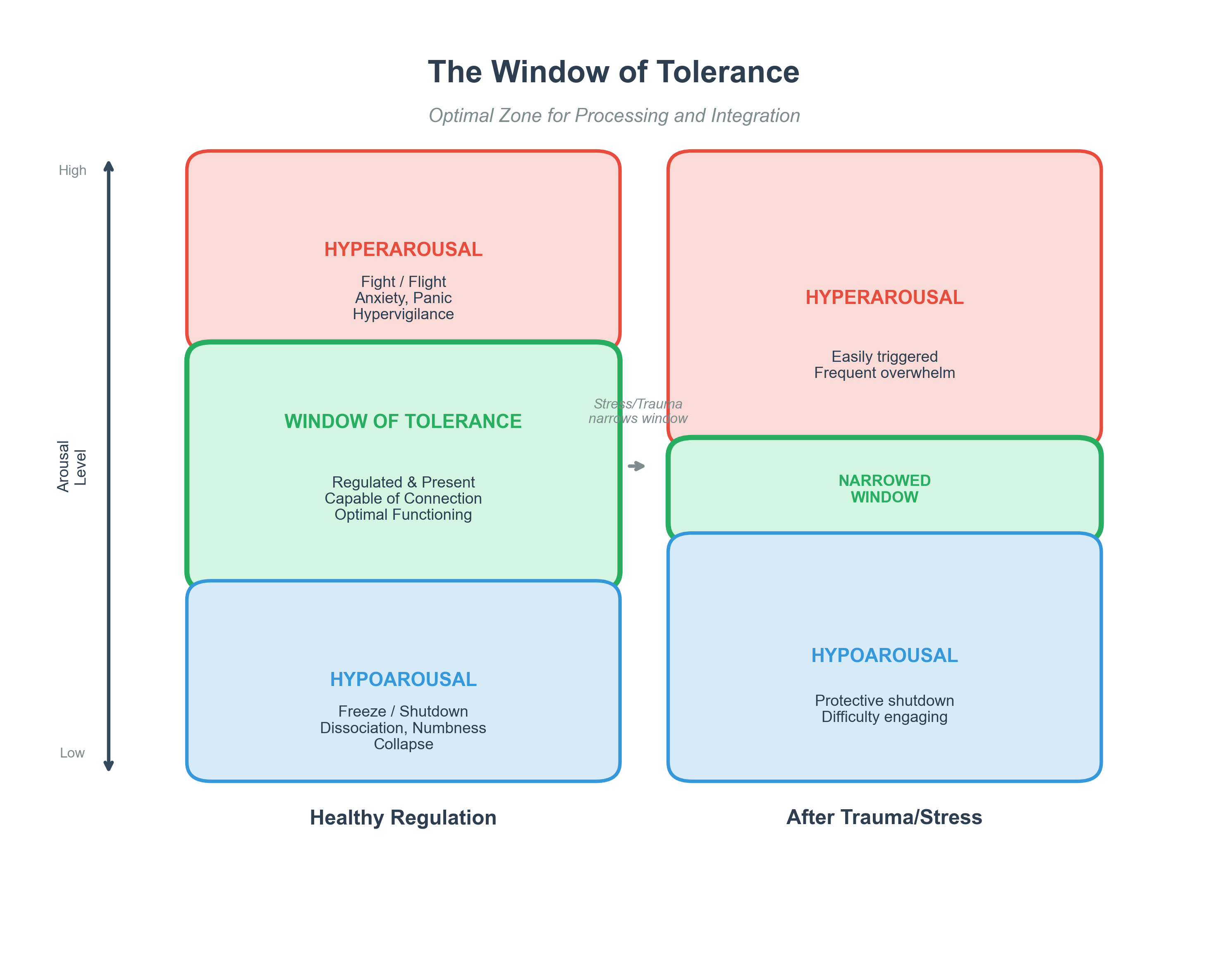
Imagine your capacity for experience as a window:
         HYPERAROUSAL
    ↑    (Overwhelm, panic, rage)
    |    ─────────────────────────
    |
    |      WINDOW OF TOLERANCE
    |      (Optimal zone: thinking
    |       clear, feelings manageable,
    |       social engagement possible)
    |
    |    ─────────────────────────
    ↓    HYPOAROUSAL
         (Numbness, dissociation, collapse)
Within your window:
- Emotions are felt but not overwhelming
- Thinking stays clear and flexible
- You can tolerate distress without dysregulating
- Social engagement remains possible
- Learning and growth can occur
Above your window (hyperarousal):
- Anxiety, panic, rage, hypervigilance
- Thinking becomes rigid or chaotic
- Difficulty controlling reactions
- Fight or flight dominant
- Social engagement offline
Below your window (hypoarousal):
- Numbness, disconnection, “checking out”
- Foggy thinking, slow processing
- Difficulty initiating anything
- Freeze or shutdown dominant
- Feeling like you’re watching life from behind glass
Trauma Narrows the Window
Trauma significantly affects the window of tolerance, typically narrowing it considerably5. Someone with a narrow window can be pushed into hyperarousal or hypoarousal by relatively minor stressors. Not because they’re weak. Because their system learned that danger can come from anywhere — and recalibrated accordingly.
Why windows narrow:
- The nervous system becomes calibrated for danger
- Baseline arousal shifts higher or lower
- Less stress is required to trigger dysregulation
- The internal state feels perpetually precarious
This explains why trauma survivors often describe walking on eggshells — not externally, but internally. Their window is so narrow that ordinary life events can push them out of it.
Window Width Varies
Your window isn’t fixed. It shifts with sleep, context, relationship, and even topic. You might have a wide window at home and a narrow one at work. You might discuss money calmly but unravel when the conversation turns to your father. The window is less like a window and more like a living thing — it breathes.
- Person to person (some people naturally have wider windows)
- Within the same person day to day (poor sleep narrows the window)
- Context to context (you might have a wide window at home, narrow at work)
- Topic to topic (you might discuss some subjects easily, others trigger you)
Here’s something worth pausing on: you’re reading this chapter with a nervous system. Right now, as your eyes move across this page, your autonomic state is shaping what you take in and what slides past. Are you reading from ventral vagal—curious, open, letting it land? Or from sympathetic—scanning for what’s useful, sorting, a little defended? The chapter about states is being processed by a state. Notice which one. You don’t have to change it. Just see it.
Expanding the Window
The therapeutic goal is not to eliminate emotions. It’s not to prevent dysregulation entirely. It’s to widen the window of tolerance so you can experience more of life — the full range of it — without being pushed outside your capacity5.
Window expansion happens through:
- Titration: Working with small, manageable “doses” of activation
- Pendulation: Moving between activation and settling
- Grounding: Returning to the body and present moment
- Co-regulation: Borrowing another nervous system’s regulation capacity
- Practice: Building new neural pathways through repetition
The Somatic Triad—Movement, Stillness, and Breath—provides the tools. The window provides the map.
Flow States and the Window of Tolerance
Research from the Flow Research Collective adds another dimension to understanding the window of tolerance: flow states occur within the window, near the upper edge6.
The “challenge-skills balance” that flow researchers identify—where the task slightly exceeds current ability by approximately 4%—is neurobiologically equivalent to staying within your window while stretching it. Too much challenge pushes you into hyperarousal (anxiety, overwhelm). Too little leaves you in the lower range (boredom, disengagement). The “flow channel” is your window of tolerance, experienced from the inside.
What enables flow? Transient hypofrontality—the temporary quieting of the prefrontal cortex. This is the neurobiological mechanism behind flow’s signature features: the inner critic going silent, time distorting, self-consciousness dissolving. The prefrontal cortex is essentially the “watchdog” that keeps scanning for threats. When it relaxes its grip—because the challenge is engaging enough to absorb full attention but not so demanding that it triggers alarm—flow becomes possible.
This explains why window expansion and flow access go hand in hand. As your nervous system develops greater capacity to tolerate activation without dysregulating, you gain access to more experiences, including peak states. The wider your window, the more room for flow.
The Neurochemistry of Flow
Flow states involve a distinctive neurochemical cascade that amplifies the experience6. When the conditions are right—challenge meets skill at the 4% edge, attention becomes absorbed, the prefrontal cortex quiets—the brain releases a potent cocktail: dopamine (motivation and reward), norepinephrine (arousal and focus), endorphins (pain reduction and pleasure), anandamide (the “bliss molecule,” related to runner’s high), and serotonin (satisfaction and well-being upon completion).
This chemistry connects directly to what we’ve explored about polyvagal states. The flow neurochemical cascade essentially anchors the nervous system into ventral vagal engagement while simultaneously elevating performance capacity. It’s the nervous system’s signature of optimal functioning—neither the stress hormones of sympathetic activation (cortisol, adrenaline alone) nor the shutdown chemistry of dorsal vagal, but a unique state of activated calm that our ancestors would have recognized as being “in the zone” for hunting, creating, or navigating danger with preternatural clarity.
Ponder This: How wide is your window right now? What tends to push you above it (into hyperarousal) or below it (into hypoarousal)? Have you noticed your window width varying based on sleep, stress, or circumstances?
9.5 The Four Trauma Responses
Beyond Fight or Flight
While we’ve discussed the three nervous system states, trauma responses manifest in four distinct patterns. Understanding your pattern helps target the healing work.
Fight
Autonomic state: Sympathetic activation
Core strategy: Confront and overcome threat through assertion or aggression
Adaptive in actual danger, the fight response becomes problematic when it’s the default mode—when you meet the world with fists raised even when no threat exists7.
Maladaptive expressions:
- Explosive anger over minor frustrations
- Controlling behavior in relationships
- Difficulty with collaboration or vulnerability
- Chronic irritability and short fuse
- Using aggression to feel safe
Somatic markers:
- Clenched fists, tight jaw
- Forward-leaning posture
- Tension in shoulders and neck
- Heat, especially in face and hands
- Shallow, rapid breathing
Flight
Autonomic state: Sympathetic activation
Core strategy: Escape threat through physical or psychological withdrawal
The flight response isn’t always literal running. It shows up as chronic busyness, perfectionism, over-achieving, and any pattern that keeps you moving so you don’t have to feel7.
Maladaptive expressions:
- Workaholism (too busy to feel)
- Perfectionism (if I’m perfect, I’m safe)
- Chronic anxiety and restlessness
- Inability to be still or present
- Substance use as escape
Somatic markers:
- Restless energy, bouncing leg
- Difficulty sitting still
- Eyes scanning for exits
- Rapid heart rate
- Feeling of needing to go somewhere
Freeze
Autonomic state: Mixed (sympathetic mobilization + dorsal vagal immobilization)
Core strategy: Immobilization when fight or flight is impossible
Freeze is often confused with calm, but they’re opposites. Freeze is high internal activation with external immobility—like pressing the gas and brake simultaneously7.
Maladaptive expressions:
- Chronic dissociation or “spacing out”
- Feeling stuck, unable to move or decide
- Procrastination and paralysis
- Depression with underlying anxiety
- Inability to act even when action is clear
Somatic markers:
- Muscle tension with inability to move
- Held breath or very shallow breathing
- Feeling of being frozen or paralyzed
- Time distortion, tunnel vision
- Disconnection from body sensations
Fawn
Autonomic state: Social engagement system co-opted for survival
Core strategy: Appease threat through people-pleasing and self-abandonment
The fawn response—term coined by trauma therapist Pete Walker—develops when fighting, fleeing, and freezing are all impossible, typically in childhood with threatening caregivers8. The child learns: If I become exactly what they need, I’ll be safe.
Maladaptive expressions:
- Chronic people-pleasing, inability to say no
- Loss of authentic self and preferences
- Difficulty with boundaries
- Hypervigilance to others’ emotions
- Attraction to unavailable or abusive relationships
- Resentment building beneath the surface
Somatic markers:
- Constant scanning of others’ faces for cues
- Shape-shifting body language to match others
- Collapse of posture when boundaries needed
- Tension in gut (walking on eggshells)
- Disconnection from own needs and desires
Which Pattern is Yours?
Most people have a dominant response, often with a secondary backup. Your pattern isn’t your fault—it’s the adaptive strategy your nervous system developed to survive. Understanding it is the first step to having a choice about it.
Somatic Triad Connection:
| Response | Movement | Stillness | Breath |
|---|---|---|---|
| Fight | Rigid, aggressive | Impossible | Forceful, through teeth |
| Flight | Restless, compulsive | Impossible | Rapid, shallow |
| Freeze | Paralyzed | Collapsed | Held or absent |
| Fawn | Adaptive to others | Anxious scanning | Shallow, held to stay small |
Ponder This: Reading these four patterns, which one feels most familiar? Which one do you default to under stress? Are there different responses for different types of threat?
9.6 Co-Regulation—Healing Happens in Relationship
We Are Wired for Connection
Humans are not designed to regulate alone9. From birth, we develop our nervous system capacity through relationship. Babies can’t self-regulate—they need an adult’s regulated presence to help them settle. This doesn’t change in adulthood. We never outgrow the need for co-regulation.
Co-regulation is the process by which one person’s regulated nervous system helps another’s come into balance. It’s what happens when a calm friend helps you settle during anxiety, when a therapist’s steady presence creates space for your activation to discharge, when holding your child helps them stop crying.
Why Co-Regulation Matters for Healing
Research shows that trauma healing happens more effectively in the context of safe relationship9. Isolated self-help has limits. The nervous system that was wounded in relationship often heals in relationship.
How co-regulation supports healing:
- Provides safety cues that update neuroception
- Offers a regulated nervous system to entrain with
- Creates capacity to tolerate more activation (borrowed regulation)
- Models what regulation looks and feels like
- Helps complete interrupted defensive responses with witness
This is why the best trauma therapists don’t just ask “what happened”—they create a regulated presence that allows the client’s nervous system to begin updating its threat assessment.
A Note from Tyler: The Woman Who Held the Room
I didn’t understand co-regulation until I experienced it in a way I couldn’t deny.
I was in a group workshop—one of those “transformational experiences” I’d rolled my eyes at for years before desperation finally got me through the door. Twenty strangers in a circle, everyone sharing things they’d never said out loud. I was performing calm. Probably looked fine. Inside, I was vibrating at a frequency somewhere between “fight” and “flee.”
Then the facilitator walked into the center of the room.
She didn’t say anything profound. Didn’t have to. She just stood there, and something in the air changed. I felt it before I could name it. My shoulders—which had been hovering somewhere near my ears—dropped. Not because I told them to. Because something in me recognized something in her.
Her presence was like a weight. Not heavy—grounding. The kind of weight that says I’m not going anywhere. I’m not afraid of what happens here. I’ve got you.
Someone across the circle started crying. Hard crying, the kind that comes from somewhere old. I watched the facilitator’s face. She didn’t fix. Didn’t advise. Didn’t even move. Just witnessed. Present. Her breathing stayed slow, steady. And here’s the part I can’t explain: I felt my own breathing match hers. Like my nervous system had been waiting for permission to slow down, and her steadiness was the signal.
That’s when I understood what all the books meant about “borrowed regulation.” My body couldn’t find its own baseline—too many years of running hot. But it could borrow hers. Entrain with hers. For just a moment, ride her wavelength until I remembered what settling felt like.
I started crying too. Not the person across the circle’s grief—my own. Stuff I didn’t know was in there. And somewhere in that unraveling, I realized: I wasn’t alone. The room was full of people, but more than that, someone was holding the space. Someone whose nervous system was steady enough to hold mine while it fell apart.
I don’t know that woman’s name. But my body still remembers her presence. It remembers what regulated feels like—not because I achieved it, but because someone who already had it stood close enough for me to borrow it.
We are not designed to heal alone. I know that now. Not as theory. As lived fact.
The 22×22×22 Scale: Relational Coherence
In the Triple-Nested Triad Model from Chapter 10, the middle scale (22×22×22) represents Individual × Relational × Collective coherence. Nervous system healing shows us why the relational dimension is essential—not optional.
Individual coherence: Your own 3D/4D/5D alignment (Chapters 1-8) Relational coherence: Co-regulation between nervous systems (this chapter) Collective coherence: Group field effects (Chapter 28)
Your nervous system doesn’t exist in isolation. It exists in constant dialogue with other nervous systems. Healing isn’t complete until it includes this relational dimension.
Practical Applications
Finding co-regulating relationships:
- Notice who your nervous system relaxes around
- Seek regulated presence in times of stress
- Be selective about your nervous system inputs
- Practice being a co-regulating presence for others (this also regulates you)
When safe relationships aren’t available:
- Therapeutic relationship can provide co-regulation
- Pets offer surprisingly effective co-regulation
- Nature has documented calming effects on nervous system
- Recorded voices of regulated people (podcasts, guided meditations) can help
- Building regulation capacity expands options for connection
Ponder This: Who in your life do you co-regulate with? Whose presence helps your nervous system settle? Whose presence does the opposite? Are there relationships you avoid because something feels “off” even if you can’t explain why?
Interactive 3D Visualization: The Heart-Centered Field
Explore the toroidal energy field centered on the heart. This visualization represents the coherent field pattern that emerges when nervous systems enter states of safety and connection. Watch particles flow through the coherent field, entering through the crown and exiting through the root - a representation of the vertical energy flow that accompanies nervous system coherence. Drag to rotate, scroll to zoom.
The heart generates the strongest electromagnetic field in the body - approximately 60 times stronger than the brain’s electrical field. When we co-regulate with another person, our heart fields literally overlap and can synchronize. This visualization offers a visual metaphor for that field coherence, showing how energy flows through the body’s vertical axis when the nervous system is in ventral vagal safety.
9.7 Demon Dialogues—When Nervous Systems Collide
The Relational Dimension of Dysregulation
So far we’ve explored the nervous system primarily from an individual perspective: your states, your window, your responses. But here’s a truth that changes everything: your nervous system doesn’t exist in isolation. It exists in constant communication with other nervous systems. And when two dysregulated nervous systems interact—especially in intimate relationships—they can lock into predictable patterns of mutual destruction.
Dr. Sue Johnson, the developer of Emotionally Focused Therapy (EFT), has identified three specific “demon dialogues”—negative interaction cycles that couples fall into when their attachment systems are threatened9. What makes Johnson’s work revolutionary is the recognition that these aren’t communication problems or personality conflicts. They are nervous system events.
When your attachment system perceives threat—when you feel your partner pulling away, when you fear abandonment, when you don’t feel seen—your nervous system shifts state. And the state you shift into determines how you interact, which triggers a state shift in your partner, which triggers a response from you, which… and so the dance continues.
Understanding these patterns through a nervous system lens transforms them from mysterious relationship problems into navigable territory.
The Three Demon Dialogues
Demon Dialogue 1: Find the Bad Guy (Mutual Sympathetic Activation)
Nervous system states involved: Both partners in sympathetic activation (fight mode)
What it looks like:
- Both partners blaming, criticizing, accusing
- Point-counterpoint argumentation
- “It’s YOUR fault” / “No, it’s YOUR fault”
- Historical grievances weaponized
- Volume escalates, temperature rises
The polyvagal picture: When both partners are in sympathetic activation, their nervous systems are mobilized for threat. The thinking brain goes offline. Each perceives the other as the danger. The survival imperative is to win—because losing feels like being destroyed.
Partner A: Sympathetic (Fight) ←→ Partner B: Sympathetic (Fight)
          [Mutual attack/defend cycle]
What’s actually happening underneath: Both partners are scared. Find the Bad Guy is a shame spiral—underneath the accusations is the terror of being found inadequate, unlovable, at fault. The aggression is protective: If I can prove YOU’RE the problem, then I’M not the problem.
Johnson notes that this pattern “diverts attention from underlying attachment fears”9. The real conversation—I’m terrified you don’t love me anymore—never happens because both nervous systems are too activated to access vulnerability.
Somatic markers:
- Elevated heart rate in both partners
- Tight jaw, clenched fists
- Forward-leaning, aggressive posture
- Shallow, rapid breathing
- Cortisol and adrenaline flooding both systems
- Very low HRV
The exit: This pattern can only shift when one partner’s nervous system settles enough to step out of the attack. This is extraordinarily difficult when both systems are firing—which is why couples often need a therapist’s regulated presence to help de-escalate.
Demon Dialogue 2: The Protest Polka (Asymmetric Activation)
Nervous system states involved: One partner in sympathetic activation (pursue), one partner in dorsal vagal (withdraw)
This is the most common pattern in distressed relationships, and it’s a perfect illustration of how two nervous systems can lock into complementary dysregulation.
What it looks like:
- One partner pursues: criticizes, demands, pushes for response
- One partner withdraws: shuts down, goes silent, leaves
- The more one pushes, the more the other retreats
- The more one retreats, the more the other pushes
- A “dance” that intensifies over time
The polyvagal picture:
Partner A (Pursuer):         Partner B (Withdrawer):
Sympathetic Activation  →    Dorsal Vagal Shutdown
[Fight/Flight energy]        [Freeze/Collapse]
         ↑                            ↓
    "Why won't you         "I can't do this
     TALK to me?"           anymore—I'm out"
         ↓                            ↑
    Escalation    ←—————————    Withdrawal
What’s happening in the pursuer’s nervous system: The pursuer is in sympathetic activation but using it for pursuit rather than attack. Their nervous system has detected a threat—emotional distance from their attachment figure—and is mobilizing to eliminate that threat by closing the gap. The energy feels urgent, desperate, like survival depends on getting a response.
Underneath the criticism is often panic: I can’t feel you. Are you there? Do you still love me? I need to know you’re still here.
What’s happening in the withdrawer’s nervous system: The withdrawer has shifted into dorsal vagal—the shutdown response. From the outside, this looks like stonewalling, dismissiveness, or cold indifference. From the inside, it’s often a form of freeze: the system is overwhelmed and has gone offline.
The withdrawer often reports: When they come at me like that, I can’t think. I go blank. It’s like I’m not even there. This isn’t choice—it’s a survival response.
Underneath the withdrawal is often despair: Nothing I do is right. I can’t win. The only way to not make things worse is to disappear.
Why it escalates:
- Pursuer’s nervous system reads withdrawal as abandonment → escalates
- Withdrawer’s nervous system reads pursuit as attack → shuts down more
- Each partner’s survival strategy makes the other’s fear worse
- A self-reinforcing cycle that can continue for decades
Johnson describes this as “banging on the door” versus “pushing it closed”9. Both partners are desperately trying to feel safe—and both are making the other feel less safe with every move.
Somatic Triad connection: Watch the bodies. The pursuer can’t stop moving—approaching, gesturing, restless—and their breath runs shallow and quick. The withdrawer has frozen mid-retreat, turned away, and their breath has gone held and shallow too. Neither can find stillness. The pursuer because their nervous system won’t allow it; the withdrawer because what they have isn’t rest, it’s collapse.
Demon Dialogue 3: Freeze and Flee (Mutual Dorsal Vagal Shutdown)
Nervous system states involved: Both partners in dorsal vagal shutdown
This is the most dangerous pattern, because by the time couples reach it, both have given up fighting for the relationship.
What it looks like:
- Both partners emotionally absent
- Long silences, parallel lives
- “Roommate relationship”—functional but dead
- Neither initiates repair attempts anymore
- Hopelessness pervades the atmosphere
The polyvagal picture:
Partner A: Dorsal Vagal ←→ Partner B: Dorsal Vagal
     [Shutdown/Despair]      [Shutdown/Despair]
              ↓                      ↓
         "What's the point?"    "Nothing will help"
What’s actually happening: This pattern often emerges after years of Protest Polka. Both partners’ nervous systems have concluded: Reaching out doesn’t work. Fighting doesn’t work. There’s no point in trying. The attachment system hasn’t disappeared—it’s just collapsed under the weight of repeated failure.
Johnson notes this is the “most dangerous pattern because no one is fighting for the relationship”9. When both nervous systems are in dorsal shutdown, there’s no energy for repair. The couple may stay together out of inertia, but the vitality is gone.
Somatic markers:
- Both partners report feeling “dead inside” regarding the relationship
- Low energy, flat affect
- Minimal eye contact
- No touch or physical connection
- Both HRVs may be chronically low
- Relationship feels like slow suffocation
The challenge: Freeze and Flee requires more energy to shift than the other patterns because both nervous systems need to be reactivated before repair work can begin. This often requires a skilled therapist who can bring enough energy into the room to restart hearts that have flatlined toward each other.
The Neurobiological Truth of Demon Dialogues
What Sue Johnson’s work reveals—and what nervous system science confirms—is that these patterns are not choices. When your attachment system is threatened, your nervous system takes over. The fighting, the withdrawing, the giving up—these are survival responses, as automatic as ducking when something flies at your head.
This doesn’t absolve responsibility. But it does change the target. The pattern is the enemy, not your partner.
Understanding demon dialogues through the Somatic Triad: Each pattern has a somatic signature — not a label, but something you can feel. When you’re in Find the Bad Guy, what happens in your body? Probably aggression in the limbs, no capacity for stillness, breath forced and rapid. When you’re the pursuer in the Protest Polka, where does that relentless reaching live — legs, hands, chest? When you’ve both fallen into Freeze and Flee, what does that paralysis actually feel like, and where does the breath go? The pattern is running you. But the body is always telling the truth about which pattern it is.
Breaking the Cycle: A Nervous System Approach
The demon dialogues can only shift when at least one partner’s nervous system can access a different state. This is why co-regulation (Section 24.6) matters so much in relationship—and why many couples need a third party (therapist) to provide the regulated presence that neither can access alone.
Johnson’s approach focuses on9:
- De-escalating the cycle — Helping couples see the pattern is the enemy
- Accessing underlying attachment emotions — The fear, loneliness, and need beneath the surface behavior
- Creating new patterns — Where vulnerability is met with responsiveness
From a nervous system perspective, this means:
- Getting at least one nervous system into ventral vagal — Social engagement online
- Allowing softer emotions to surface — When fight/flight calms, the vulnerability emerges
- Co-regulating through the vulnerability — Partner’s presence soothes activated system
The “Hold Me Tight” conversation—the core of Johnson’s approach—is essentially a nervous system intervention. It creates the conditions for one partner to express deep attachment fear (“I’m terrified you’re going to leave me”) while the other partner’s nervous system stays regulated enough to receive it with compassion rather than defense.
This is co-regulation in action. And it’s why trauma healing in relationship is so powerful: the nervous system that was wounded in connection can be healed in connection.
Practice Note: Recognizing Your Demon Dialogue
Before you can break a pattern, you must recognize it. In your primary relationship(s), notice:
- When conflict arises, what happens to YOUR nervous system?
- Do you mobilize (heart racing, heat rising, urge to fight or flee)?
- Do you shut down (going blank, numb, checking out)?
- What happens to your PARTNER’S nervous system?
- Do they escalate or shut down?
- What’s the dance between your states?
- Which demon dialogue do you recognize?
- Find the Bad Guy: Both attacking
- Protest Polka: One pursuing, one withdrawing
- Freeze and Flee: Both withdrawn
- What’s the attachment fear underneath?
- Pursuer: I can’t reach you. I’m losing you.
- Withdrawer: I can’t do anything right. I’ll only make it worse.
- Both withdrawn: We’ve given up on each other.
The invitation: Can you see your partner’s behavior not as a character flaw or deliberate cruelty, but as a nervous system trying desperately to feel safe? Can you see your own behavior the same way?
Research shows that 70-75% of couples move from distress to recovery through EFT, with effects sustained at follow-up9. The demon dialogues can be transformed—not by willpower or communication techniques, but by creating the conditions for nervous systems to settle into safety together.
Does your heart rate spike when your partner doesn’t text back? (Your attachment system is online)
Do you feel your chest tighten when they’re emotionally distant? (Your nervous system detected threat)
Do you sometimes pursue harder when they withdraw? (Your survival circuits are trying to re-establish connection)
Does their calm presence make your shoulders drop? (Co-regulation is working)
Do you feel more regulated when you know someone is there? (This is biology, not weakness)
None of this is neediness. This is your nervous system functioning exactly as designed.
We’ve pathologized what Polyvagal Theory reveals as survival wiring. The pursuer in the Protest Polka isn’t “too needy”—their nervous system has detected a threat to attachment and is mobilizing to eliminate it. The withdrawer isn’t “cold”—their system has been overwhelmed and has gone into protective shutdown.
The pattern is the enemy, not your partner. And certainly not your very human need for safe connection.
What you call “neediness” is actually your nervous system doing its job—seeking the co-regulation that every mammalian nervous system requires. You are not designed to regulate alone. The shame around needing is often more damaging than the need itself.
The question isn’t how do I need less? The question is how do I find safe people who can meet my need for connection while I learn to meet theirs?
Ponder This: Which demon dialogue shows up most in your relationships? Not just romantic ones—these patterns appear with family, friends, even colleagues. Can you feel how your nervous system shifts when the pattern begins? What would it be like to see the pattern as the enemy, rather than your partner?
9.8 The 4D Coherence Map—Where Trauma Lives
Beyond Physical and Mental
In Chapter 8, we introduced the 4D self—the subconscious, the emotional body, the plasma field that acts as interface between 3D mind and 5D soul. Now we see its critical role in nervous system health.
The 4D is where trauma lives. Not in the explicit memory of the event, but in the patterns, beliefs, and nervous system settings that persist after the event is over.
The 4D Storage System
What gets stored in the 4D:
- Emotional charges from unprocessed experiences
- Implicit beliefs about self, others, and world (“I’m not safe,” “People can’t be trusted”)
- Nervous system calibration settings (how threat is assessed)
- Defensive response patterns (fight/flight/freeze/fawn defaults)
- Unfinished survival movements (the punch you didn’t throw, the escape you couldn’t make)
- Attachment patterns from early relationships
How it affects daily life:
- Current situations get filtered through old 4D programming
- Triggers activate stored patterns regardless of present safety
- Relationships repeat familiar dynamics (even when consciously trying to change)
- Intuition gets confused with trauma-based hypervigilance
- The body reacts to the past as if it were the present
A Note from Tyler: The Pattern That Wasn’t Mine
For years I had a trigger I couldn’t explain.
Anytime someone raised their voice—not at me, just in general—I would feel this flood of something. My chest would tighten, my throat would close, and I’d have this overwhelming urge to make myself small. To disappear. Sometimes I’d leave the room without even knowing I was doing it.
I tried to think my way out of it. I hadn’t been yelled at as a child—not really. My parents were good people. Loving. Present. So why did my body react like this?
One day I was doing some breathwork, and something unexpected came up. Not a memory of mine, exactly. More like an impression. A feeling of being a small child in a kitchen that wasn’t mine, with a man’s voice filling the room like thunder, and nowhere to go. No door. No escape. Just smallness and waiting for it to be over.
I mentioned it to my mother later, almost casually. “What was your dad like when he got angry?”
Her face changed. “How did you know about that?”
I didn’t know. Not consciously. But my body knew. Stored in the 4D field like a family heirloom I never asked for, my nervous system had inherited a pattern from a grandfather I barely remembered. His rage. Her fear. Passed down through the ways she held me, the tension she carried that my infant body absorbed before I had words.
This isn’t mine. That recognition was the first relief I’d felt in years.
But understanding didn’t erase the pattern—not immediately. It gave me a target. Finally, I knew what I was working with. Somatic work could reach what thinking couldn’t: the stored tension that lived below story, below memory, in the body itself.
I still feel that flutter sometimes when voices rise. The difference now is that I know what I’m feeling. And I know it’s not mine to carry anymore.
Clearing the 4D: The Somatic Triad Approach
The Somatic Triad works directly with 4D material:
Movement addresses the body component:
- Completes frozen defensive responses
- Releases fascia-stored tension patterns
- Discharges sympathetic activation
- Restores natural movement quality
Stillness addresses the energetic component:
- Allows 4D field to reorganize
- Creates space for insights to emerge
- Supports integration of released material
- Accesses theta brainwave states where reprogramming occurs
Breath bridges physical and energetic:
- Directly stimulates vagus nerve
- Can either calm or activate, as needed
- Provides real-time access to nervous system state
- Anchors awareness in present moment
The Coherence/Decoherence Dynamic
Remember from Chapter 14: coherence is when 3D mind, 4D field, and 5D soul are aligned. Decoherence is when they’re in conflict.
| Dimension | Decoherence Pattern | Coherence Restored |
|---|---|---|
| 3D | Cognitive distortions, hypervigilance | Clear thinking, accurate threat assessment |
| 4D | Stored trauma, limiting beliefs, nervous system dysregulation | Processed material, updated beliefs, flexible regulation |
| 5D | Disconnection from intuition, purpose, meaning | Access to guidance, sense of path, inner knowing |
Ponder This: What might be stored in your 4D field that’s running your present-day experience? What beliefs about yourself or the world formed in childhood that might need updating? What defensive patterns served you once but now limit you?
9.9 Measuring Coherence—Tracking Your Progress
Objective Markers
One of the most empowering aspects of nervous system work is that you can measure it. Unlike vague claims of “spiritual progress,” coherence shows up in data.
Heart Rate Variability (HRV)
HRV is the gold standard measure of autonomic nervous system flexibility10. It reflects the variation in time between heartbeats—not how fast your heart beats, but how adaptively it responds to moment-to-moment demands.
What HRV tells you:
- Higher HRV = better vagal tone, more regulation capacity
- Lower HRV = reduced flexibility, chronic stress impact
How to track:
- Consumer wearables (Oura ring, Whoop, Apple Watch) provide daily HRV
- Morning measurements are most reliable (sleep HRV removes daily variability)
- Look for trends over weeks, not single measurements
Typical ranges:
- Below 20 ms: Concerning (consult healthcare provider)
- 20-40 ms: Below average
- 40-60 ms: Average
- 60-100 ms: Good
- Above 100 ms: Excellent
Note: HRV varies significantly by age and individual. Your personal trends matter more than comparing to others.
Resting Heart Rate
Lower resting heart rate generally indicates better parasympathetic tone3.
Tracking:
- Morning measurement before rising is most consistent
- Typical healthy range: 60-80 bpm
- Athletes often have 40-60 bpm
- Elevated resting heart rate can indicate stress, illness, or overtraining
Breath-Hold Time (BOLT Test)
The Body Oxygen Level Test measures CO2 tolerance, which correlates with nervous system resilience3.
How to test:
- Take a normal breath in through your nose
- Exhale normally through your nose
- Pinch your nose and time until the first definite urge to breathe
- Resume normal breathing
Interpretation:
- Below 10 seconds: Poor tolerance, likely chronic overbreathing
- 10-20 seconds: Below average
- 20-30 seconds: Average
- 30-40 seconds: Good
- Above 40 seconds: Excellent
Respiratory Rate
Slower breathing at rest indicates better nervous system regulation3.
Typical ranges:
- Above 16 breaths/minute: May indicate chronic stress
- 12-16 breaths/minute: Normal
- 8-12 breaths/minute: Good
- 6-8 breaths/minute: Optimal (resonance frequency range)
Subjective Markers
Not everything shows up in numbers. These subjective indicators are equally valuable:
Emotional capacity:
- Can you feel emotions without being overwhelmed?
- Is joy accessible, not just familiar?
- Can you tolerate discomfort without reacting?
Sleep quality:
- Time to fall asleep
- Night wakings
- Feeling rested on waking
Gut function:
- Digestion quality
- Regularity
- Freedom from chronic issues
Social engagement:
- Ease of eye contact
- Voice expressiveness
- Capacity for connection
Resilience:
- Recovery time after stress
- Proportion of day spent regulated vs. dysregulated
- Ability to return to baseline
Tracking Progress
Create a simple weekly log:
- Morning HRV (from wearable)
- Morning resting heart rate
- Weekly BOLT test
- Subjective rating 1-10 for: regulation, sleep, energy, mood
- Notes on what helped or hindered
Progress isn’t linear. You’ll have bad weeks. What matters is the trend over months.
Ponder This: What markers would you most like to track? If you’ve been doing practices for a while, have you noticed improvements in these areas even without formal tracking? What would change if you knew your nervous system health was measurable?
9.10 The Somatic Triad Approach to Nervous System Healing
Integration: How Movement, Stillness, and Breath Work Together
Having explored the nervous system map, we can now see how the Somatic Triad—introduced in Chapter 18, Chapter 20, and Chapter 22—specifically addresses nervous system healing.
Movement for Discharge and Completion
Trauma often involves interrupted defensive responses11. The body wanted to fight or flee but couldn’t. The energy mobilized for action got stuck.
Movement completes what couldn’t be completed:
- Shaking and tremoring (discharge)
- Pushing movements (completing fight response)
- Running or walking (completing flight response)
- Stretching and releasing (freeing fascia-stored tension)
Matching movement to state:
| State | Movement Needed | Examples |
|---|---|---|
| Hyperarousal | Discharge excess energy | Vigorous shaking, stomping, running |
| Hypoarousal | Gentle activation | Slow walking, rocking, stretching |
| Freeze | Both discharge AND completion | Shaking followed by push/run movements |
| Window | Maintenance and expansion | Fluid yoga, dance, tai chi |
Stillness for Integration and Settling
After activation comes integration. The nervous system needs time to consolidate changes, to let the new patterns settle11.
Stillness provides:
- Time for processing
- Access to deeper brain states (theta)
- Space for insight and meaning-making
- Practice tolerating without doing
Matching stillness to state:
| State | Stillness Needed | Examples |
|---|---|---|
| Hyperarousal | Active stillness with grounding | Body scan with emphasis on feet, weight |
| Hypoarousal | Supported, gentle activation | Restorative yoga with blankets, warmth |
| Window | Deep practice | Meditation, yoga nidra, sound healing |
Breath as the Master Dial
Breath offers immediate, voluntary access to the nervous system3. Unlike movement and stillness, which take time, breath shifts your state within minutes.
Matching breath to state:
| State | Breath Needed | Technique |
|---|---|---|
| Hyperarousal | Extended exhale, slow | 4:8 ratio, coherent breathing |
| Hypoarousal | Gentle activation | Breath of Fire (mild), energizing inhale |
| Window | Maintenance | 5:5 coherent breathing, natural |
A Complete Practice Sequence
The Somatic Triad sequence for nervous system regulation:
Phase 1: Orient and Ground (2-3 minutes)
- Stillness: Feel feet on floor, weight in chair
- Breath: Natural, observing without changing
- Notice: What state am I in right now?
Phase 2: Match and Meet (5-10 minutes)
- Movement: Match movement to current state (vigorous if hyper, gentle if hypo)
- Breath: Let breath follow movement naturally
- Notice: Allow the discharge or activation to happen
Phase 3: Settle and Integrate (5-10 minutes)
- Breath: Shift to coherent breathing (5:5)
- Stillness: Allow movement to slow naturally
- Notice: What’s different now?
Phase 4: Complete and Close (2-3 minutes)
- Stillness: Rest in whatever state has emerged
- Breath: Natural, easy
- Notice: Resource any positive states for future access
The 40-Day Framework Applied
Based on established nervous system research, a progressive approach7:
Week 1-2: Foundation
- Establish baseline measurements (HRV, BOLT, resting HR)
- Daily: 5 min coherent breathing (5:5)
- Daily: 5 min gentle movement
- Daily: 3 min body scan stillness
- Goal: Build awareness of states
Week 3-4: Deepening
- Daily: 10 min breathwork (add techniques matched to state)
- Daily: 10 min movement (add discharge practices)
- Daily: 5 min stillness (meditation or sound)
- Weekly: Co-regulation practice with safe other
- Goal: Begin working with activation edges
Week 5-6: Integration
- Daily: 15 min movement practice
- Daily: 10 min stillness practice
- Daily: 5 min breathwork
- Weekly: Group practice if possible
- Goal: Window expansion through titrated exposure
Week 7-8+: Embodied Living
- Somatic Triad becomes automatic stress response
- Use breath in real-time throughout day
- Movement as medicine when activated
- Stillness for integration and insight
- Goal: Wider, more flexible window
9.11 The 3D/4D/5D Mapping: Nervous System Coherence
| Dimension | Nervous System Expression | Coherence Looks Like | Practice Focus |
|---|---|---|---|
| 3D (Mind) | Cognitive understanding of states | Clear thinking about regulation | Psychoeducation, tracking |
| 4D (Field) | Stored patterns, nervous system settings | Flexible regulation, cleared trauma | Somatic Triad, co-regulation |
| 5D (Soul) | Connection to purpose, guidance | Trust in the healing process | Meaning-making, spiritual practice |
9.12 Integration Practice: The Safe Place Body Scan (15-20 minutes)
This practice builds internal resources that support window expansion.
Setup:
- Find a comfortable position (lying or sitting)
- Have a blanket available for warmth
- Optional: Play soft background music at 432Hz or 528Hz
Instructions:
1. Ground (3 minutes)
- Feel the surface supporting you
- Notice the weight of your body
- Feel your feet (or legs) connecting to earth
- Breath: Natural, observing
2. Scan with Kindness (5 minutes)
- Move attention slowly from feet up through body
- At each area, simply notice what’s there
- Not trying to change anything—just kind observation
- If you find tension, acknowledge it: “I see you”
- If you find ease, appreciate it: “Thank you”
3. Find Safety (5 minutes)
- Let attention settle somewhere in your body that feels okay
- It doesn’t have to feel great—just not distressed
- This might be your feet, hands, back against the surface
- Rest attention here
- Notice: What tells you this area is okay?
- Amplify that slightly—let the “okayness” spread if it wants to
4. Resource (5 minutes)
- From this place of relative safety, imagine a place where you feel completely safe
- This could be real or imagined, indoor or outdoor
- See it, hear it, smell it, feel it
- Let your body respond to being there
- Notice where in your body you feel this safety
- Anchor this with a word or image you can return to
5. Complete (2 minutes)
- Gently begin to move fingers and toes
- Take a deeper breath
- When ready, open your eyes
- Orient to the room: name 3 things you see
- Notice how you feel compared to when you started
9.13 Chapter Summary
Your nervous system operates in three states—ventral vagal safety, sympathetic mobilization, and dorsal vagal shutdown—and trauma can lock it into the wrong one, causing the body to not believe what the mind already knows[1]4. The window of tolerance can be widened through the Somatic Triad: Movement discharges what got stuck, Stillness integrates what shifted, and Breath offers real-time access to your state in any moment[5]11. None of this happens in isolation—the nervous system that was wounded in relationship heals in relationship, through co-regulation with people whose steadiness you can borrow until you find your own9.
9.14 “For Your Journey” Closing
As you close this chapter, consider:
What state is your nervous system in right now? Not what you think it should be, but what it actually is. Can you name it without judgment?
Who in your life serves as a co-regulator? Whose presence helps you settle? Have you told them they do this for you?
What might your body be trying to complete? Are there old defensive responses waiting to finish? What movement might want to happen if you let it?
How wide is your window today? What would it feel like to have more capacity—not for extraordinary experiences, but for ordinary life?
The nervous system doesn’t lie. It doesn’t care about your thoughts or beliefs or good intentions. It responds to experience: what actually happens in your body, in your relationships, in the moment-to-moment flow of being alive.
But here’s the good news: it can learn. Through the Somatic Triad—Movement, Stillness, and Breath—practiced in relationship with safe others, your nervous system can discover something that all the understanding in the world couldn’t teach it: that the war is over. That safety is possible. That you can come home.
Not to who you were before the wounds. To who you are becoming because of them.
9.15 Bridge to Chapter 10
You’ve now explored the neurobiology of healing—how the nervous system stores and releases trauma, how the window of tolerance can expand, how co-regulation supports transformation.
But there’s a frequency that underlies all of this. A coherence that precedes technique. A state that isn’t achieved through practice but recognized as what we are beneath the protective adaptations.
The ancient traditions called it by many names. Modern science is beginning to measure it in heart fields and neural synchrony and group coherence effects.
We simply call it love.
In Chapter 26, we’ll explore love not as sentiment but as frequency—the root resonance that makes all healing possible, the field in which nervous systems entrain toward coherence, the force that dissolves the boundaries that trauma created.
If the nervous system keeps the score, love is what finally pays the debt.