25 Love as the Root Frequency
The Coherence That Makes Healing Possible
26 Love as the Root Frequency
10.1 Opening: The Woman Who Remembered How to Feel
“The day science begins to study non-physical phenomena, it will make more progress in one decade than in all the previous centuries of its existence.” — Nikola Tesla
Elena had been in therapy for six years.
She’d processed her childhood trauma methodically—the neglectful mother, the absent father, the siblings who competed rather than connected. She could tell you exactly why she struggled with intimacy, why she chose unavailable partners, why she kept people at arm’s length. Her insight was impeccable. Her defenses were expertly mapped. And still, at forty-three, she felt hollow.
“I understand everything about why I can’t feel connected,” she told me. “I’ve done the work. I’ve said the words. But there’s something inside me that just… doesn’t turn on.”
She’d tried everything. EMDR for the memories. Somatic therapy for the body. Breathwork for regulation. Each helped—the nightmares stopped, her panic attacks decreased, her window of tolerance widened. But that hollow place remained: a chamber in her chest that should have contained something warm but felt like an empty room.
Then she attended a retreat where the facilitator did something unexpected.
There was no new technique. No clever intervention. The facilitator simply looked at Elena—really looked at her—and said: “You don’t have to earn what you’re looking for. You already are what you’re looking for.”
Something happened that Elena couldn’t explain. The words themselves weren’t new; she’d heard similar things before. But something in the way they were delivered—some quality in the facilitator’s presence, some frequency in the exchange—bypassed all her defenses and landed somewhere beneath them.
For the first time in four decades, Elena felt the hollow chamber in her chest begin to warm.
She wept for three days. Not the managed tears of therapeutic processing, but something more fundamental—like a frozen spring finally cracking and flowing. When it stopped, the hollow place wasn’t hollow anymore. Something had moved in. Something had always been there, waiting to be remembered.
“It wasn’t what she said,” Elena told me later. “It was what she was transmitting. Like… a frequency I’d forgotten existed. And my system just… recognized it.”
This chapter is about that frequency.
It’s not sentiment. It’s not emotion. It’s not the romantic love that comes and goes, or the familial love that carries obligation, or even the unconditional love that we aspire to. It’s something more fundamental: the coherence pattern that makes all healing possible. The resonance that underlies all connection. The force that dissolves the barriers trauma creates—not through analysis, but through recognition.
The ancient traditions had a thousand names for it. Modern science is beginning to measure it. We simply call it love.
An Ending (Ascent) by Brian Eno—a piece that seems to transmit something beyond its notes. Or, for a full album experience, For Emma, Forever Ago by Bon Iver—raw and warm simultaneously, like a heart breaking open into something larger.
10.2 Love Is Not What You Think
The Problem with the Word
We use the same four letters for pizza and God. For sex and sacrifice. For the reason we stay and the reason we leave. English has one word for love. The Greeks had six. We should probably listen to the Greeks on this one.
This imprecision creates confusion that runs deeper than vocabulary. When we say “love is the answer,” most people hear something sentimental, something soft, something that belongs in greeting cards rather than healing protocols.
But the love we’re exploring here isn’t sentimental. It’s structural.
What Love Actually Is
Here is the definition we’ve been building toward: Love is the coherence pattern that enables communication between differentiated systems. The nodes don’t dissolve; they resonate—distinct entities communicating while remaining distinct.
HeartMath Institute research has documented that:1
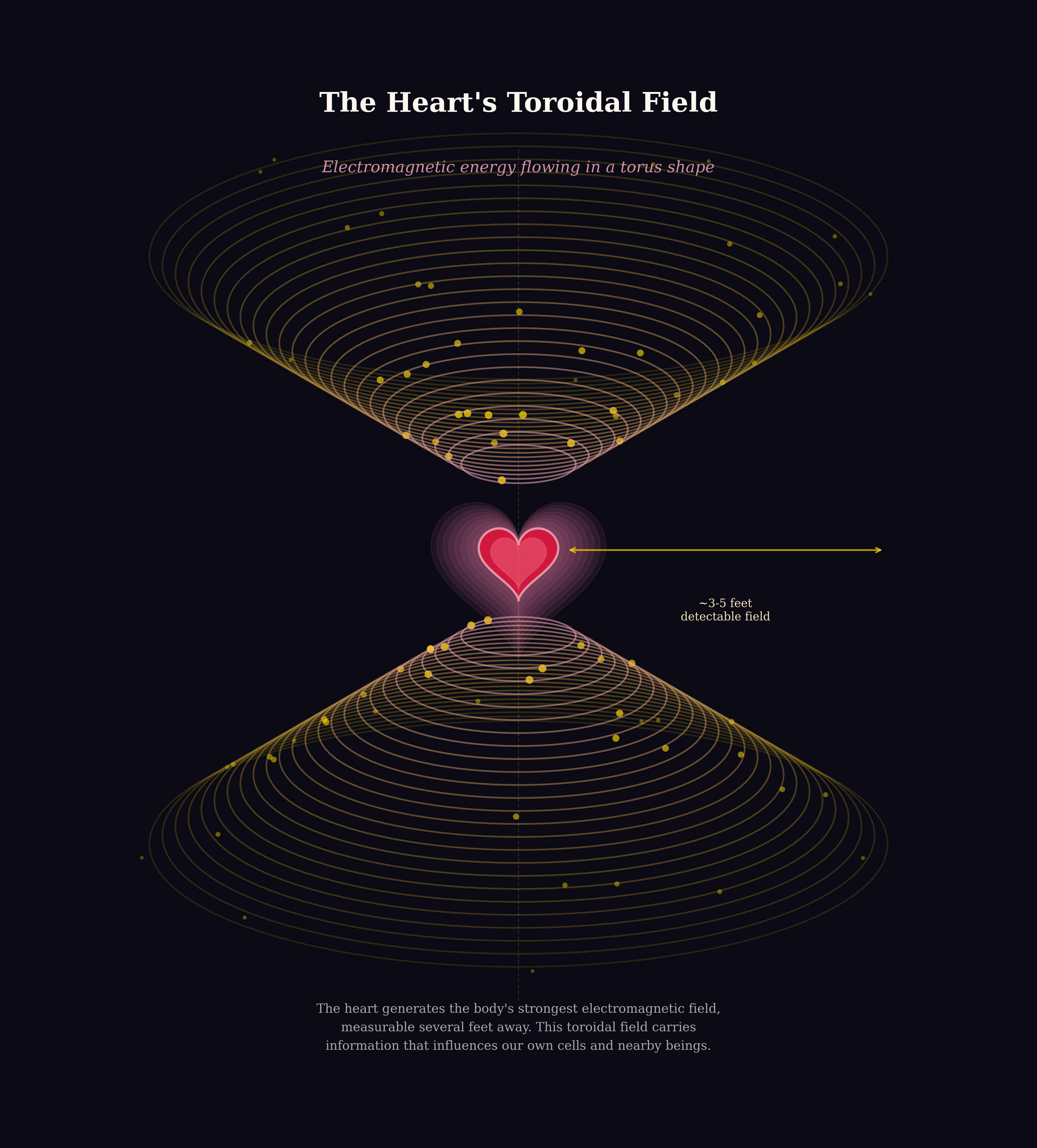
- The heart generates an electromagnetic field 60 times stronger than the brain’s
- This field extends several feet from the body
- It can be measured in another person’s brain waves when they’re in close proximity
- Coherent heart rhythms create organized electromagnetic patterns
- These patterns correlate with positive emotional states
I was walking through a park last spring when I saw something that stopped me. An old couple sitting on a bench. They must have been in their eighties—weathered hands, faces mapped with decades. Neither was speaking. Neither was looking at each other. They were just… sitting. Side by side. Watching pigeons.
But there was something in the space between them.
I couldn’t name it at first. It wasn’t romantic—no lingering gazes, no whispered words. It wasn’t obligation—the way some couples sit together because they’re supposed to. It was something else. Something I could almost feel from twenty feet away.
Their breathing was synchronized. I watched for a minute, then two. Inhale together. Exhale together. Not coordinated—not intentional. Just… aligned. Like two instruments that had been playing together so long they’d forgotten they were separate.
That’s when I understood what I’d been reading about for years.
Two nervous systems that had learned to oscillate together. Two electromagnetic fields—heart broadcasting to heart—that had entrained over decades until the boundary between them was more suggestion than wall. Two beings who had done the impossible: remained distinct while becoming one rhythm.
Neither would have called it love. If you’d asked, they probably would have talked about the grandchildren, or the weather, or whether dinner should be chicken or fish.
But I knew what I was seeing.
Love isn’t what happens in the wedding or the passionate nights or even the hard conversations. Love is what remains when two people have oscillated together long enough that being apart would feel like missing a limb. Not because of need or fear or obligation. Because their systems literally resonate at the same frequency now.
That’s what coherence looks like after sixty years.
The Three Dimensions of Love
Like everything in our framework, love operates across dimensions:
| Dimension | Expression of Love | What It Looks Like |
|---|---|---|
| 3D (Mind) | Commitment | Choosing to love, showing up, keeping promises |
| 4D (Field) | Resonance | Emotional attunement, feeling felt, energetic connection |
| 5D (Soul) | Recognition | Seeing the other’s essence, knowing yourself in them |
Most people live in 3D love: love as choice, as action, as willpower. This is valuable but exhausting because it’s swimming upstream—trying to create through effort what exists naturally at deeper levels.
4D love is what Elena experienced at the retreat: a resonance that bypassed words and landed in the field. When your 4D field resonates with another’s, something transmits that couldn’t be said.
5D love is recognition: the moment you see past someone’s personality, history, and defense mechanisms to the essence beneath. This is what every mystical tradition calls “seeing the divine in the other.”
Notice that these three dimensions of love aren’t separate experiences you graduate through. They’re a fractal expression of the same phenomenon at different scales of consciousness. When you experience 3D commitment, you’re expressing the same love principle that operates at 4D as resonance and at 5D as recognition. The quality is identical; the scope expands.
This means learning to love fractally: instead of searching for more love at some higher level, you deepen into the love already present and let it express at increasingly subtle scales. The old couple on the bench isn’t expressing a ‘higher’ love than passionate young lovers—they’re expressing the same love at a different scale, so completely coherent it needs no words.
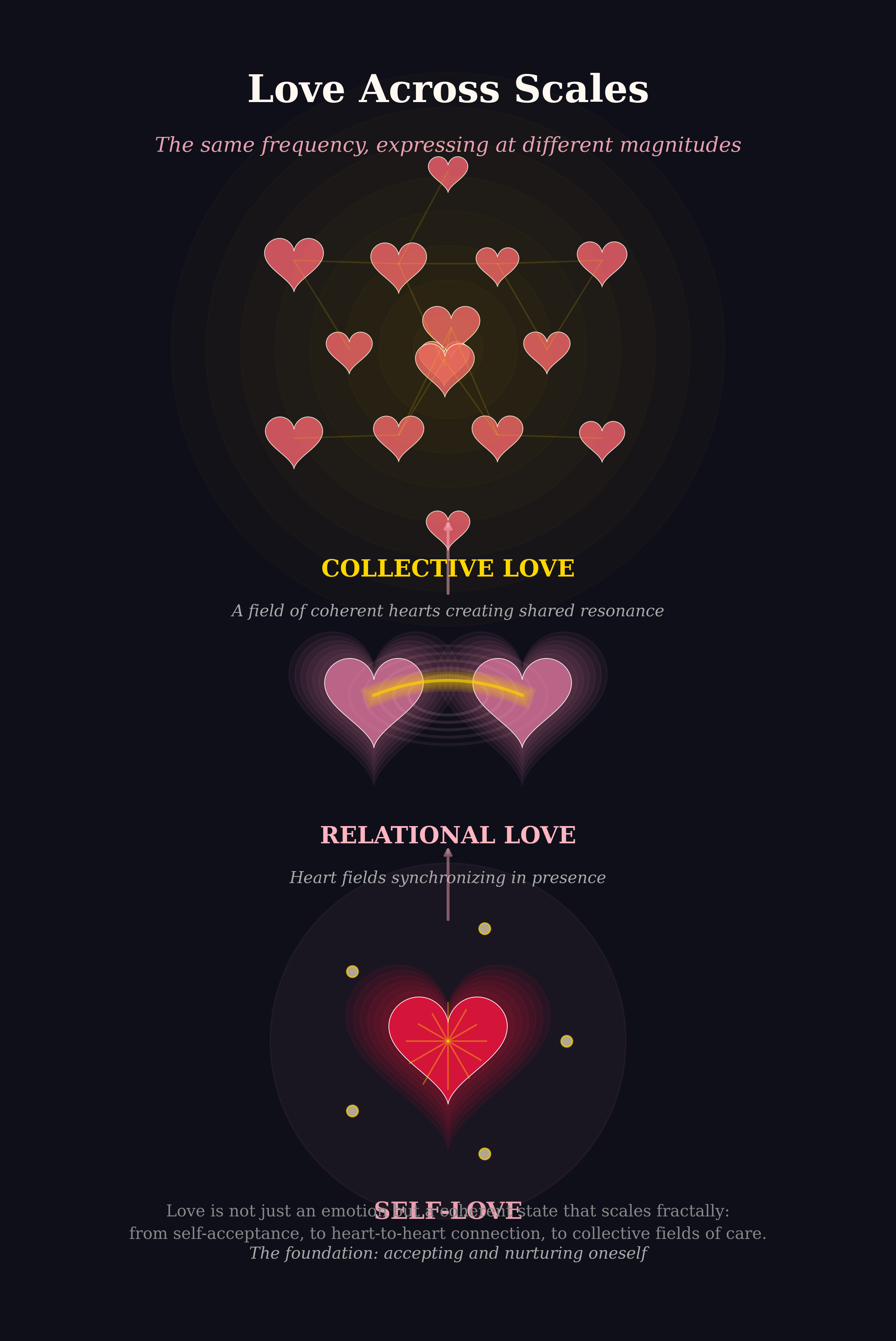
The same frequency vibrates everywhere: in your capacity to feel worthy of love (self-love), in recognition between you and another (dyadic love), in synchronized hearts of a thousand people meditating together (collective love). Same pattern. Different magnification.
When you think of love, which dimension comes most naturally to you? The commitment of 3D, the resonance of 4D, or the recognition of 5D? Have you experienced love at a level that surprised you—that was more than emotion but felt like something fundamental?
10.3 The Physics of Love
Frequency and Coherence
We’ve touched on this research before, but let’s go deeper. The 528 Hz frequency has been called the “Love Frequency” in traditional systems. What does the science actually show?
The Research:
Akimoto et al. (2018) found that 528 Hz music significantly reduced stress markers in the endocrine and autonomic nervous systems after just 5 minutes of listening.
Babayi & Riazi demonstrated that 528 Hz sound waves reduced cell death in human astrocyte cells treated with ethanol, increasing cell survival by approximately 20%.
Multiple HRV studies show that listening to music at 432 Hz and 528 Hz produces measurable shifts in heart rate variability toward coherent patterns.
In ancient solfeggio systems, 528 Hz corresponds to:
- The “MI” note (Mira gestorum - miracle)
- The heart chakra
- DNA repair and transformation
The Honest Position: The research is promising but preliminary. We can’t claim that 528 Hz magically repairs DNA or that any specific frequency IS love. What we can say is that certain frequencies appear to facilitate physiological coherence—and coherence is measurable while love is not (directly).
Here’s honest uncertainty: While preliminary studies suggest 528 Hz may affect cellular coherence, we don’t have large-scale replicated evidence or a clear mechanism. This frequency appears in traditional systems, and anecdotal reports suggest benefits, but we’re in the “interesting hypothesis” stage, not the “established fact” stage. The studies cited are small; independent replication is limited.
Use it because it resonates with you, not because science has proven it works. If it helps you access states of love and coherence, that’s valuable regardless of whether the frequency itself is “doing” something measurable. Sometimes the ritual matters more than the mechanism.
My synthesis: Love IS coherence at a particular frequency. The 528 Hz research may be pointing at something real—not that 528 is magical, but that certain resonance patterns create the conditions under which love becomes possible.
The Heart’s Electromagnetic Field
The heart is far more than a pump. HeartMath research has documented:1
- The heart’s electromagnetic field is approximately 60 times greater in amplitude than the brain’s
- The heart’s magnetic field can be detected several feet away with sensitive magnetometers
- The heart sends more signals to the brain than the brain sends to the heart
- The heart contains approximately 40,000 neurons—a “heart brain”
What happens when two people connect:1
- Their heart rhythms can synchronize even without touch
- The electromagnetic field of one person’s heart can be detected in another person’s brain waves
- People in positive emotional states generate coherent heart rhythms that affect those nearby
- This effect is amplified in states of love, care, and appreciation
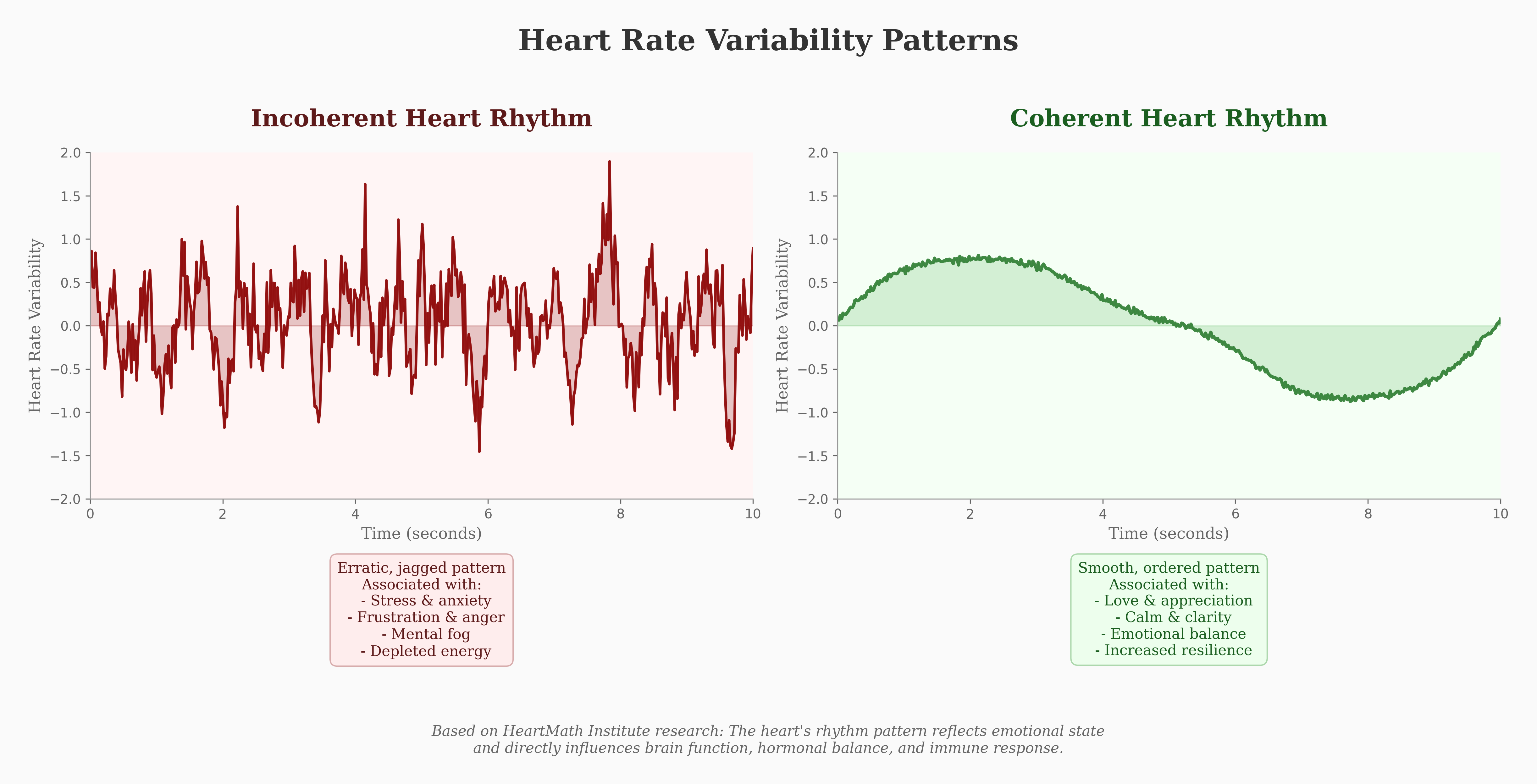
The heart is a broadcasting station. When it’s in coherent rhythm (smooth, sine-wave-like HRV), it broadcasts a coherent field. When it’s in incoherent rhythm (jagged, chaotic HRV), it broadcasts noise.
The heart clearly generates a measurable electromagnetic field—about 60 times stronger than the brain’s in electrical amplitude, and 5,000 times stronger magnetically. Whether this field directly influences nearby brains, or whether the synchronization we observe is mediated by other mechanisms (breathing patterns, micro-expressions, temperature changes), remains an open question. What we know: emotionally connected people show synchronized physiology. How this works mechanistically is still being investigated. The experience of heart connection is real; the physics of it is still unfolding.
Love might be understood as what happens when two broadcasting stations tune to the same frequency.
# The heart's field: a torus of electromagnetic love
theta = np.linspace(0, 2*np.pi, 100)
phi = np.linspace(0, 2*np.pi, 100)
R, r = 3, 1  # Major and minor radii

x = (R + r*np.cos(theta)) * np.cos(phi)
y = (R + r*np.cos(theta)) * np.sin(phi)
z = r * np.sin(theta)
# This shape: your heart broadcasts it constantly
Love isn’t opposed to mathematics—it’s expressed through it.
Interactive 3D Visualization
Experience the Love Frequency (528 Hz) in three dimensions. Watch the heart breathe, golden spirals radiate, and coherent waves emanate from the center. Drag to rotate, scroll to zoom.
The Vagus Nerve Connection
The vagus nerve connects the heart to the brain and plays a crucial role in love and connection:2
- High vagal tone correlates with capacity for connection, empathy, and social engagement
- The “social engagement system” (Polyvagal Theory) enables face-to-face connection, prosody in voice, and the feeling of safety required for love
- Vagal activation shifts the body from defensive states to connective states
The Safe and Sound Protocol and other vagal interventions show that:2
- Training the nervous system for safety directly improves capacity for connection
- People with trauma histories often have reduced vagal tone—their systems are calibrated for threat, not love
- Vagal tone can be improved through practice, shifting the physiological substrate of love
Key Insight: Love isn’t just an emotion or a choice. It’s a physiological state. You can’t fully experience love when your nervous system is in fight-or-flight or freeze. The ventral vagal state—safety and social engagement—is the biological prerequisite for love.
Somatic Triad Connection: Movement is how love expresses physically — touch, approach, the reach of an arm. Stillness is how love receives — truly being with another rather than just near them. And breath is the bridge: coherent, slowed breathing creates the physiological state where love is actually possible, not just intended.
When you feel loved, what happens in your body? Where do you feel it? What happens to your breath, your posture, your heart rate? Conversely, when you feel unloved or rejected, what bodily sensations arise?
10.4 The 333 Triad—Love as Communication
Expression, Reception, Resonance
In Chapter 10, we introduced the Triple-Nested Triad—three scales of coherence that nest within each other:
Scale 1 (1×1×1):       Mind × Field × Soul
                       → Inner coherence of the individual

Scale 2 (22×22×22):    Individual × Relational × Collective
                       → Coherence across scales of being

Scale 3 (333×333×333): Expression × Reception × Resonance
                       (Logos × Eros × Gnosis)
                       → The Language/Love layer that CONNECTS entities
At the 333 scale, love becomes communication. Let’s explore each element:
Expression / Logos / Voice
What it means: Putting truth into form. Speaking what is real. Moving from inside to outside.
The Greek concept of Logos encompasses:
- The word, statement, discourse
- Reason and rational thought
- The ordering principle of reality
- In Christianity: “In the beginning was the Word (Logos)”
In love: Expression is how we offer ourselves to another. Not manipulation, not performance, but the authentic transmission of what we are.
Expression without love becomes:
- Manipulation (using words to control)
- Imposition (forcing our truth on others)
- Performance (saying what we think they want to hear)
Expression WITH love:
- Speaks from the heart, not just the head
- Includes feeling (4D) as well as content (3D)
- Carries presence (5D) beyond the words themselves
Reception / Eros / Listening
What it means: Creating space to receive another’s transmission. Opening rather than defending. Listening not just with ears but with whole being.
The Greek concept of Eros encompasses:
- The force drawing things together
- Desire for union with beauty and goodness
- In Plato: the ladder ascending from physical to spiritual beauty
- The receptive, yin principle
In love: Reception is how we make space for another to exist fully. Not judging, not fixing, not waiting to respond—truly receiving.
Reception without love becomes:
- Consumption (taking what serves us, discarding the rest)
- Extraction (getting information to use against them)
- Evaluation (listening to find fault)
Reception WITH love:
- Creates spacious, non-judgmental presence
- Feels the feeling behind the words
- Receives the whole person, not just the message
Neuroscience of deep listening shows:
- Active listening engages prefrontal cortex, limbic system, and mirror neurons
- Deep listening creates neural synchronization between speaker and listener
- The listener’s brain patterns begin to mirror the speaker’s
- This synchronization IS love at the neural level
Resonance / Gnosis / Presence
What it means: What emerges when expression and reception are both coherent. The “third thing” that arises between two beings truly meeting.
The Greek concept of Gnosis encompasses:
- Direct knowing (vs. secondhand knowledge)
- Experiential wisdom through encounter
- In Gnostic traditions: salvific knowledge that transforms
- The alive quality that makes communication meaningful
In love: Resonance is not something we create; it’s what becomes possible when expression and reception are aligned. It’s the space where something new can emerge.
Resonance without love cannot exist. Resonance IS love in action—the coherence pattern made manifest between beings.
When all three elements align:
- Expression carries truth from one heart to another
- Reception creates space for that truth to land
- Resonance arises—the shared field where healing occurs
This is what Elena experienced. The facilitator’s expression was coherent (authentic, embodied, 3D+4D+5D). Elena’s reception was open (her defenses finally allowing something through). And resonance arose—that “frequency she’d forgotten existed” that her system recognized.
The Somatic Triad at the 333 Scale
The Somatic Triad operates between people, not just within them. Movement becomes Expression — the active, form-giving reach of Logos. Stillness becomes Reception — the space-creating, listening quality of Eros. Breath becomes Resonance — the alive, circulating quality of Gnosis, the thing that happens between two people when both are actually present.
Practical Application—The 333 Dialogue:
- Expression Phase: One person speaks what is true (Movement)
- Reception Phase: The other receives with full presence (Stillness)
- Resonance Phase: Both pause, allowing the third thing to arise (Breath)
This simple structure creates the conditions for love to occur—not sentimental love, but love as coherent communication between differentiated systems.
Think of a conversation where you felt truly met. What made it different from ordinary exchanges? Was there spacious reception? Authentic expression? Something that emerged between you that neither of you created alone?
10.5 Why Love Heals
The Coherence Mechanism
Trauma creates decoherence: the 4D field patterned with fear and contraction filters the 5D signal until it arrives distorted. Your essence never stops broadcasting wholeness—but the interference prevents it from landing. When someone in a coherent state (regulated, open, present) relates to someone in decoherence, their field creates a reference pattern the traumatized system can entrain to. Techniques help. Understanding helps. But the transformation occurs through resonance with coherent presence.
This isn’t just theory. We see it in:3
- Attachment research: Secure attachment with a caregiver literally shapes brain development
- Therapeutic alliance research: The relationship between therapist and client predicts outcomes more than any specific technique
- Co-regulation studies: Regulated presence measurably affects another’s nervous system
- Heart coherence research: Coherent heart rhythms create measurable effects in nearby people
The Validation Paradox
Here’s something paradoxical about love and healing:
Before healing: “I need validation to feel worthy.” After healing: “I don’t need external validation—I know my worth.”
But here’s the twist: you can’t get to “I don’t need validation” through validation-seeking, AND you often can’t get there without receiving genuine love from another.
The resolution:
It’s not validation OF you BY another. That would leave you dependent on external approval.
It’s recognition BETWEEN beings IN the field. When two nervous systems, two hearts, two beings resonate, something shifts that isn’t about one approving the other. It’s about both recognizing something they share.
Notice what’s happening right now: you’re encountering a text that’s trying to do something beyond transferring information. It’s attempting to transmit a frequency. And the question of whether you’re analyzing these words or receiving them—holding them at arm’s length to evaluate, or letting them land—is exactly the phenomenon the chapter is describing. You are the paradox, meeting itself on the page.
Martin Buber called this the I-Thou relationship:
I-It: The other as object, tool, thing to be evaluated. I-Thou: The other as presence, as equal, as meeting.
In I-It, love is impossible—we’re relating to our idea of the other, not to them. In I-Thou, love is inevitable—genuine meeting dissolves the barriers that separate.
Why Isolation Doesn’t Heal
Research consistently shows that social isolation is as damaging to health as smoking, and that strong social connections are among the strongest predictors of longevity and wellbeing.
But the implication goes deeper:
If love is the coherence pattern that enables healing, then healing in isolation has fundamental limits. You can develop regulation capacity alone. You can clear some 4D patterns through individual practice. But the full recalibration of the 4D field—especially from relational trauma—requires relational repair.
This is why:
- Support groups help even when nobody gives advice
- Therapy works better than self-help books
- Being truly witnessed creates shifts that insight alone cannot
- Even pets improve health outcomes (they offer co-regulation without judgment)
The nervous system that was wounded in relationship heals in relationship. And relationship, at its deepest level, is love.
Have you experienced healing through being loved—not through advice or intervention, but simply through being truly received? What happened in that moment? Did something shift that you couldn’t have created alone?
10.6 Love as Secure Attachment—The EFT Framework
The Science of Bonding
For the past three decades, Dr. Sue Johnson has been revolutionizing our understanding of love through Emotionally Focused Therapy (EFT). Her work bridges the gap between attachment theory, neuroscience, and practical relationship healing—and it provides a powerful complement to everything we’ve been exploring about love as coherence.3
Johnson’s central insight: Love is not primarily about chemistry, compatibility, or communication skills. Love is about attachment—the primal need for safe emotional connection that is wired into our nervous systems.
Here’s what the research shows:
- Over 35 years of peer-reviewed clinical research validates EFT
- 70-75% of couples move from distress to recovery using this approach
- 90% show significant improvements—the best outcomes of any couples therapy
- Effect size of 1.3—larger than any other couples intervention
- Results sustained at 6-12 month follow-up with no regression
This isn’t sentiment. This is measurable change in how nervous systems relate.
The A.R.E. Framework: Love’s Fundamental Question
At the heart of EFT is a simple question that captures what love really asks:
“Are you there for me?”
This question encompasses what Johnson calls A.R.E.—three dimensions of secure connection:
| Element | Question It Answers | What It Looks Like |
|---|---|---|
| Accessibility | “Can I reach you?” | Being emotionally available when your partner needs you |
| Responsiveness | “Can I rely on you?” | Tuning in emotionally and offering comfort when distress arises |
| Engagement | “Do I matter to you?” | Being actively present, fully engaged, absorbed in the relationship |
Johnson writes: “Distressed partners ask the same basic questions: ‘Are you there for me? Do I matter to you? Will you come when I need you?’”3
When we feel secure in the answers—yes, yes, and yes—we experience love. When we feel uncertain, our attachment systems activate, often in ways that create the very disconnection we fear.
A.R.E. and the Triple-Nested Triad
The A.R.E. framework maps beautifully onto our 333 Triad:
| A.R.E. Element | 333 Triad Element | Dimension | Somatic Quality |
|---|---|---|---|
| Accessibility | Expression/Logos | 3D/4D | “I am available to you” (active offering) |
| Responsiveness | Reception/Eros | 4D | “I receive your distress” (attuned presence) |
| Engagement | Resonance/Gnosis | 4D/5D | “We are together in this” (shared field) |
When all three elements are present, something shifts at the nervous system level. The partner’s vagus nerve receives signals of safety. The 4D field becomes coherent between you. Recognition happens—not as concept, but as felt sense.
The Demon Dialogues: Decoherence in Relationship
Johnson identifies three destructive patterns she calls “Demon Dialogues.” These are the attachment system’s emergency responses when A.R.E. feels threatened:
1. Find the Bad Guy (Blame Game)
- Both partners point fingers and accuse
- Creates a shame spiral—someone must be “wrong”
- Diverts attention from the underlying attachment fear
- Nervous system state: Both in sympathetic activation (fight mode)
2. Protest Polka (Demand-Withdraw Pattern)
- One partner pursues, criticizes, seeks response
- The other withdraws, shuts down, distances
- Johnson’s metaphor: “Banging on the door” vs. “pushing it closed”
- Nervous system state: One sympathetic (pursuit), one dorsal vagal (withdrawal)
- Most common pattern in distressed couples
3. Freeze and Flee (Hopeless Withdrawal)
- Occurs when Protest Polka persists too long
- Both partners emotionally check out
- Nervous system state: Both in dorsal vagal shutdown
- Most dangerous because “no one is fighting for the relationship”
The Key Insight: The pattern is the enemy, not your partner. When we see the demon dialogue as a shared trap rather than personal failing, something shifts. We move from I vs. You to We vs. The Pattern.
The Seven Hold Me Tight Conversations
EFT guides couples through seven conversations that progressively build secure attachment:
Recognizing the Demon Dialogue — Name the pattern; see it as the enemy, not each other
Finding the Raw Spots — Identify each partner’s sensitive triggers; understand how past wounds shape present reactions
Revisiting a Rocky Moment — Return to a significant fight; redo it with new understanding
Hold Me Tight—Engaging and Connecting — Express deepest attachment fears and needs; move beyond surface issues to core vulnerabilities
Forgiving Injuries — The hurt person speaks their pain; the injuring partner stays present and acknowledges
Bonding Through Sex and Touch — Emotional presence during intimacy; sex as expression of secure attachment
Keeping Love Alive — Establish rituals to maintain connection; “bonding is an eternal process of renewal”
These conversations aren’t techniques—they’re pathways. Each one creates conditions where the 4D field can become coherent, where recognition can occur, where love can land.
Physical Touch: The Somatic Language of Attachment
Johnson emphasizes what neuroscience confirms: physical touch is not merely a expression of love—it is a primary pathway through which attachment security is built and maintained.3
The neurochemistry:
- Oxytocin (the “bonding hormone”) is released during close physical contact
- This creates feelings of trust, calm, and connection
- The vagus nerve is activated, shifting toward social engagement
- Cortisol (stress hormone) decreases measurably
Johnson’s prescription: Hold, hug, and kiss on waking, on sleeping, on leaving home, and on returning. These aren’t just nice gestures—they’re nervous system regulators.
Learning to Be Held
The first time someone told me about the 20-second hug, I rolled my eyes.
Twenty seconds? That’s an eternity. That’s standing in an embrace while the clock ticks, while the awkwardness builds, while your brain screams okay, we’re done here. I was in my head, calculating. Twenty seconds of vulnerability with no exit strategy.
But I was desperate. My nervous system was shot. The research said this worked. So I tried it.
What I didn’t expect was what happened at second seven.
My whole body wanted to pull away. Not politely, not gently—urgently. My shoulders tensed. My jaw tightened. Something in my chest started to close, like a fist forming around my heart. This is too much. This is too long. I need to get out.
I stayed anyway. I don’t know why. Maybe because I’d read enough to know that the wanting-to-flee was the whole point.
At second twelve, something shifted.
I didn’t decide to relax. My body just… stopped fighting. My shoulders dropped. The fist in my chest opened. I could feel my partner’s heartbeat against my chest, steady and slow, and something in me started syncing to it without my permission.
By second twenty, I didn’t want to let go.
We stayed for probably forty seconds. Maybe a minute. When we finally pulled apart, I realized I was crying. Not grief-crying. Something else. Relief, maybe. Or recognition.
Here’s what I learned: the awkwardness isn’t a problem. It’s data. It’s your nervous system reporting that it’s not used to this. That sustained holding is so rare, so countercultural, that your body reads it as threat before it reads it as love.
We aren’t used to being held. We’re used to brief contact—the performative hug, the quick pat, the socially acceptable three seconds and done. Our nervous systems have adapted to isolation and called it normal.
It’s not normal. It’s deprivation.
That first long hug cracked something open in me. It showed me how defended I was, how much my body had learned to brace against connection, how much I needed to re-learn the simple act of staying.
I still practice this. Some days it’s easy. Some days my body still wants to flee at second seven. But now I know: that’s not a reason to stop. That’s the whole reason to stay.
The 20-Second Hug
Research suggests that sustained hugs of at least 20 seconds trigger significant oxytocin release and vagal activation. This is long enough for the nervous systems of both people to begin synchronizing—for co-regulation to occur at the physiological level.3
“It should be normal to have long hugs,” Johnson emphasizes. In a culture that rushes past connection, reclaiming the sustained embrace is revolutionary.
How to practice:
- Face your partner standing up
- Wrap arms around each other in a full-body hug
- Breathe together naturally
- Stay for at least 20 seconds—longer if comfortable
- Notice what happens in your body as you settle
- Release slowly, maintaining soft eye contact
What you may notice:
- Initial impulse to pull away (cultural conditioning)
- Nervous system settling as you stay longer
- Breath naturally slowing and synchronizing
- Warmth spreading in chest area
- Sense of “arriving” or “landing”
Heart Coherence Meets Attachment Security
The HeartMath research we explored earlier takes on new significance through the attachment lens:
- When we feel securely attached, our heart rhythms become coherent
- This coherent electromagnetic field extends several feet from the body
- It can be measured in our partner’s brain waves when we’re close
- Physical closeness with a secure attachment figure literally changes our physiology
Here’s the synthesis: Attachment security creates the nervous system state where love becomes possible. Love creates the coherent field that can be measured. Physical touch is the most direct pathway to both.
“The magic of connection is rooted in deep attachment,” Johnson writes, “and we as human beings are hardwired to need those close connections to survive.”
Reaching and Responding: The Secure Attachment Cycle
At its core, healthy love is a cycle of reaching and responding:
Partner A reaches — Shows vulnerability, expresses need, asks for connection Partner B responds — Receives the vulnerability with presence, offers reassurance Partner A receives — Lets the response land, allows themselves to be comforted The cycle completes — Both feel the bond strengthening; trust deepens
This is the opposite of the demon dialogues. Instead of:
- Pursuing → Withdrawing
- Blaming → Defending
- Freezing → Fleeing
We get:
- Reaching → Receiving
- Expressing need → Offering presence
- Vulnerability → Safety
The Beautiful Paradox: It takes security to be vulnerable, AND vulnerability builds security. Each successful cycle of reaching and responding creates more trust, which enables more reaching, which deepens the bond.
Learning to Hold
I talked about learning to be held. There’s another side.
When my mom felt the pain of cancer, she came to me. She would come to me.
I would visit her in the shards, tucked away between the contrasts of the shadows and the light, the glimmering sparkles, the sharp edges. I could taste the glass. I could taste the glass and it tasted like this, like I busted my lip. Do you know that feeling you have when you roll your lip over your top tooth inside of you? When your inside-outside part goes inside your inside.
That taste. Can you taste your stitches? I can. I can taste the stitches on my forehead. When I hit my head on the bunk bed and I felt I had to go to the hospital. I can taste the stitches in my forehead. I can taste my chin. I feel my chin. I can taste the fur on my head.
That’s what holding someone in their pain feels like. The body remembers. Not in metaphor—in sensation. In taste. In the places where your edges meet theirs.
When someone reaches for you in their suffering, you don’t just hold them. You hold the whole weight of what the body knows. The sharp edges become yours too, for a moment. And that’s not a burden—that’s the privilege of being trusted with someone’s shards.
Sue Johnson on the Nature of Love
“Love is a constant process of tuning in, connecting, missing and misreading cues, disconnecting, repairing, and finding deeper connection. It is a dance of meeting and parting and finding each other again.”3
This quote captures something crucial: love is not a state to achieve but a process to participate in. The demon dialogues aren’t failures—they’re the “missing and misreading” part of the dance. What matters is the repair, the return, the renewal.
“Bonding is an eternal process of renewal. Relationship stability depends not on healing huge rifts but on mending the constant small tears.”
The small moments matter: the daily touch, the moment of eye contact, the reaching toward rather than turning away. These micro-connections are the tissue of secure attachment.
“Each time lovers share their ‘soft places’ and their need for each other and respond with empathy and care, they offer their loved one reassurance that he or she is the chosen, irreplaceable one.”
This is recognition at the relational level—not validating that the other is “good enough,” but seeing them as the chosen one. The one you turn toward. The one whose distress matters.
The Love Frequency Through the Attachment Lens
Now we can see why love is described as a frequency, not just an emotion:
- Attachment security creates a coherent nervous system state
- This coherent state generates a coherent electromagnetic field
- This field can be measured and affects nearby people
- Physical touch amplifies and stabilizes this field
- Each reaching-and-responding cycle strengthens the pattern
Love, in this framework, is the resonance pattern that emerges when two nervous systems achieve secure attachment. It’s not something we manufacture—it’s what becomes possible when the conditions are right.
The conditions: A.R.E. present. Demon dialogues recognized. Vulnerability met with presence. Touch that says “you are safe with me.”
When you think of the relationships where you’ve felt most loved, what made them feel safe? Was there someone who embodied A.R.E.—who was accessible, responsive, and engaged? What happens in your body when you imagine being held by someone who truly sees you?
Do you want to feel your partner’s presence—not just know they exist? (Normal)
Does physical touch settle something in you that words alone can’t reach? (Normal)
Do you sometimes ache for connection so deeply it feels almost physical? (Normal)
Does separation anxiety whisper that maybe they’ll forget you? (Normal)
Do you feel your heart literally open when someone holds you well? (Normal)
None of this is neediness. This is love seeking its natural expression.
The love frequency we’ve been exploring in this chapter isn’t abstract—it’s what your body is reaching for when you want to be held, when distance feels unbearable, when you need to know someone is there.
We’ve called these needs “clingy.” We’ve called them “codependent.” We’ve told ourselves we should be able to self-soothe, regulate alone, need less.
But the heart’s electromagnetic field extends feet from the body. It wants to connect with other fields. The nervous system is designed for co-regulation. The 528 Hz in your cells resonates when it meets resonance.
Your longing for love isn’t a character flaw. It’s coherence seeking coherence. It’s the root frequency trying to find itself in another.
The question isn’t how do I stop wanting this?
The question is how do I find people safe enough to meet me there?
10.7 From Healing to Risking: The Bridge Most Books Don’t Build
There’s a gap most personal development books don’t address. You do the inner work. You regulate your nervous system. You understand your attachment patterns. You feel genuinely different, more coherent, more available.
And then… what?
The actual risk of opening to another person remains. The theory doesn’t take it. The healing doesn’t take it. Only you can take it.
Why Healing Isn’t Enough
Individual healing prepares you for relationship but doesn’t guarantee it. You can have:
- A regulated nervous system that still braces at the first sign of conflict
- Secure attachment theory mastered while still choosing unavailable partners
- Deep self-compassion that doesn’t translate to letting someone else in
The gap between “I’ve healed” and “I trust enough to be vulnerable” is where many people get stuck. It’s not a failure of the work—it’s the next stage of it.
The First Vulnerability After Healing
Here’s what I’ve learned, mostly through getting it wrong:
Choose consciously. Not everyone deserves your opened heart. Vulnerability isn’t a gift you scatter everywhere—it’s a trust you extend to specific people who’ve demonstrated capacity to hold it. Look for: consistency over time, repair after rupture, curiosity about your inner world, respect for your boundaries even when they’re inconvenient.
Start small. You don’t have to share your deepest wound first. Share something true but contained. Watch how they respond. Do they receive it? Dismiss it? Try to fix it? Use it against you later? Small tests reveal patterns.
Expect imperfection. Even trustworthy people will sometimes disappoint you. The question isn’t whether they’ll get it wrong—they will. The question is whether they can acknowledge it, repair it, and stay present through the discomfort of having hurt you.
Trust is rebuilt, not restored. If past relationships broke trust, new relationships don’t automatically restore it. Trust is rebuilt through accumulated experiences of vulnerability-met-with-care. This takes time. There’s no shortcut.
When You Choose to Trust Anyway
Sometimes you’ll choose to trust before you feel ready. Not because you’re certain it’s safe—you’re never certain—but because staying closed has become more painful than the risk of opening.
This isn’t naive. It’s courageous. It’s saying: I know this might hurt, and I’m choosing to try anyway, because the alternative is a life defended against the very connection I most want.
The coherence you’ve built individually doesn’t disappear when you open to another. It becomes the foundation. You can feel your heart race AND stay present. You can notice fear AND speak truth. You can be triggered AND choose repair instead of protection.
That’s what all the inner work was for: not to eliminate vulnerability, but to make it survivable.
Is there someone in your life who has demonstrated trustworthiness, with whom you’ve been holding back? What would it look like to take one step toward them—not a leap, just a step?
10.8 Physical Touch as Love Technology
The Neglected Pathway
We live in a peculiar paradox: a culture saturated with images of physical intimacy yet starving for actual human touch. This “skin hunger”—a term researchers use to describe chronic touch deprivation—has become what some call a silent epidemic. Studies consistently show that people who lack nurturing physical contact experience higher rates of loneliness, depression, anxiety, and immune dysfunction.
Touch isn’t a luxury. It’s a biological necessity.
Human beings evolved in constant physical contact—infants carried, family members sleeping together, physical greeting and comfort between community members. What we experience now—isolated bodies in separate rooms, perfunctory handshakes, touch reserved for romantic contexts—is historically anomalous and neurologically problematic.
Physical touch is not merely an expression of love. It’s a primary pathway through which love becomes physiologically real.
The Neurochemistry of Touch
When we experience safe, nurturing touch, a cascade of neurochemical changes occurs:
Oxytocin Release
- Often called the “bonding hormone” or “cuddle hormone”
- Released during close physical contact, especially sustained touch
- Creates feelings of trust, connection, and emotional safety
- Increases feelings of empathy and emotional attunement
Cortisol Reduction
- Touch interventions have buffering effects on cortisol responses to stress
- Tactile stimulation of C-fiber receptors triggers vagal and parasympathetic activity
- Stress hormone levels measurably decrease during sustained embrace
- Effects persist beyond the moment of contact
Dopamine and Serotonin Activation
- Touch activates the brain’s reward centers
- Mood-stabilizing neurotransmitters increase
- Pleasure pathways activate without the addictive quality of stimulant substances
- Creates a natural sense of wellbeing
Vagal Tone Enhancement
- Touch stimulates pressure receptors in skin
- Messages travel to the brain and stimulate the vagus nerve
- Heart rate slows, blood pressure decreases
- The nervous system shifts from sympathetic arousal to parasympathetic restoration
The Science of Sustained Embrace
While brief touch has benefits, research suggests that duration matters. Dr. Kory Floyd, Professor of Communication and Psychology at the University of Arizona, explains: “Increases in oxytocin show benefits on the body; it makes us feel calmer and alleviates pain. When people are under acute stress, a hug helps the body return to its natural state.”
The 20-Second Threshold
Research indicates that hugs of at least 20 seconds trigger significant neurochemical changes:
| Duration | What Happens |
|---|---|
| 0-5 seconds | Social acknowledgment; minimal nervous system shift |
| 5-10 seconds | Beginning of relaxation response; slight oxytocin increase |
| 10-20 seconds | Nervous systems begin synchronizing; measurable cortisol reduction |
| 20+ seconds | Full oxytocin release; significant vagal activation; blood pressure and heart rate normalize |
A foundational study published in PubMed found that participants who received 10 minutes of handholding followed by a 20-second hug before a stressful task showed significantly lower systolic blood pressure, diastolic blood pressure, and heart rate increases compared to those without partner contact.
Why This Matters:
In our culture, a 20-second hug feels long. Most social embraces last 1-3 seconds—barely enough time to acknowledge each other, far too brief to trigger the neurochemical cascade that creates bonding.
It should be normal to have long hugs.
This isn’t self-indulgence. It’s nervous system care.
Synchronized Breathing: The Amplifier
When physical touch combines with synchronized breathing, the effects multiply. Here’s why:
Resonance Frequency Breathing
Research on slow-paced breathing at approximately 0.1 Hz (about 6 breaths per minute) shows:
- Cardiac oscillations increase in synchronization
- Blood pressure and heart rhythm phases become coherent
- Vagal tone improves measurably
- Emotional regulation capacity increases
When two people breathe together at this rate while in physical contact:
- Heart rhythms begin to synchronize
- Blood pressure patterns align
- Both nervous systems shift toward parasympathetic dominance
- The dyadic field becomes coherent
The Heart-to-Heart Connection
HeartMath research has documented that:
- The heart’s electromagnetic field extends several feet from the body
- This field can be detected in another person’s brain waves when in close proximity
- Heart rhythms of people in close contact tend to synchronize
- This synchronization is enhanced during positive emotional states
When two people embrace with synchronized breathing, we might understand what’s happening as field coherence—two electromagnetic broadcasting stations tuning to the same frequency.
Safe Touch as Attachment Repair
For many trauma survivors, touch is not automatically soothing. Trauma can teach the body to associate touch with danger, loss of control, or violation. Even well-intentioned gestures may feel threatening.
However, research increasingly shows that gentle, supportive, and nurturing touch offers a profoundly restorative experience—when appropriately applied.
What Safe Touch Heals:
| Wound | How Safe Touch Helps |
|---|---|
| Attachment ruptures | Creates new experiences of safe connection; rewires implicit expectations |
| Touch aversion | Gradually recalibrates the nervous system’s response to physical contact |
| Chronic shame | Touch communicates acceptance at the somatic level, beneath words |
| Interoception deficits | Helps the body learn to accurately sense internal states |
| Boundary confusion | Models appropriate boundaries through clear, respectful contact |
The Key Principle:
Touch that wounded was touch without consent, without attunement, or without care for the receiver’s experience. Touch that heals is touch given with full consent, complete attunement, and genuine care.
Dr. Bessel van der Kolk’s research (The Body Keeps the Score) emphasizes that trauma lives in the body and must be addressed somatically, not just cognitively. Stephen Porges’ Polyvagal Theory explains how safe touch activates the social engagement system, creating the neurophysiological foundation for attachment repair.2
The Cultural Reclamation
We need to reclaim touch as a normal human need, not a special occasion or a romantic privilege.
The Shift Required:
| From | To |
|---|---|
| Touch is sexual or romantic | Touch is a basic human need met in multiple contexts |
| Long hugs are awkward | Sustained embrace is how nervous systems co-regulate |
| Physical affection is for children | Adults need nurturing touch throughout life |
| Asking for touch is needy | Healthy attachment includes reaching for contact |
| Touch is reserved for intimate partners | Safe touch can be appropriate in family, friendship, and healing contexts |
Sue Johnson’s Invitation:
Johnson emphasizes that we should hold, hug, and kiss on waking, on sleeping, on leaving home, and on returning. These aren’t just nice gestures—they’re nervous system regulators. They’re how attachment security is built and maintained.
“It should be normal to have long hugs.”
Touch and the 3D/4D/5D Framework
| Dimension | Touch Function |
|---|---|
| 3D (Physical) | Skin contact, pressure receptors, physical warmth |
| 4D (Energetic/Emotional) | Field synchronization, emotional co-regulation, oxytocin cascade |
| 5D (Recognition) | Felt sense of being known, accepted, loved at essence level |
When touch is truly safe and present, all three dimensions activate simultaneously. The physical contact creates the conditions for emotional resonance, which opens the door to deeper recognition. This is why truly present embrace feels like coming home.
When was the last time you experienced a truly long hug—one where you let yourself settle in and stay? What happened in your body? What would change if you made sustained, present embrace a daily practice?
10.9 The 528 Hz Practices—Sound as Love Technology
Working with Frequency
While we maintain appropriate skepticism about specific frequency claims, there’s enough research to suggest that sound can be a practical technology for cultivating the love frequency.
What the research suggests:
- Certain frequencies appear to facilitate physiological coherence
- Sound can stimulate the vagus nerve, shifting toward social engagement
- Chanting and humming create measurable shifts in nervous system state
- Group sound practices create shared coherence that may exceed individual practice
See Section 27.1 for the full practice protocols including the 528 Hz Heart Meditation, Love Breath, and Coherent Dialogue.
10.10 Love and the Collective Field
The 22×22×22 Scale: How Individual Love Becomes Collective Coherence
Remember the middle scale of the Triple-Nested Triad:
Individual × Relational × CollectiveLove doesn’t stop at two people. As Chapter 28 will explore in depth, individual coherence creates relational coherence, which creates collective coherence.
The research on group coherence shows:4
- The Maharishi Effect: Group meditation created measurable reductions in crime rates when the group reached sqrt(1%) of the population
- HeartMath Global Coherence Initiative: Documents correlation between human emotional states and Earth’s magnetic field
- Princeton Global Consciousness Project: Random number generators show anomalies during major global events when human attention synchronizes
The principle: Love scales. When enough individuals achieve coherent states, the effects ripple outward in ways that may influence collective consciousness.
Why This Matters Now
We are living through the transition between astrological ages—the shift from Pisces (hierarchy, faith, separation) to Aquarius (network, knowledge, connection).
This transition manifests as:
- Breakdown of old hierarchical structures
- Rise of networked, distributed systems
- Tension between old and new paradigms
- Acceleration of both chaos and awakening
The invitation: Personal love work is not just self-improvement. It’s participation in collective evolution. Every coherent heart contributes to the field.
The Reciprocal Luminosity Formula
From the earlier chapters, recall:
Coherence Power = (3D Belief × 4D Feeling × 5D Essence)^Collective AmplificationWhat this means for love:
- Your personal coherence (3D×4D×5D alignment) contributes to the collective field
- This contribution isn’t additive—it’s multiplicative
- Groups in coherent love create exponentially more effect than the sum of individuals
- Even small numbers of coherent people can influence large populations
This isn’t mystical thinking. It’s what we see in:
- Social movement tipping points
- Cultural shifts that happen “suddenly” after long preparation
- The way a single regulated person can calm a room
- How love spreads when genuinely offered
The Normal Map Vision
The Normal Map framework proposes:
- Each person has a unique frequency signature—your “normal map”
- When you achieve personal coherence, this signature broadcasts clearly
- When many people achieve coherence, their frequencies combine
- This collective coherence creates conditions for planetary awakening
Love isn’t just the feeling between individuals. It’s the frequency that enables collective evolution.
If your personal coherence contributed to planetary healing, would you practice differently? What changes when you realize that self-work is also service?
10.11 Common Obstacles to Love
Why We Resist
If love is our natural state, why is it so hard to access? The obstacles are worth naming.
Obstacle 1: Trauma Calibration
Trauma recalibrates the nervous system for threat. When the system is in sympathetic (fight/flight) or dorsal vagal (freeze/shutdown), love is physiologically difficult.2
Signs:
- Opening feels dangerous
- Softening triggers vulnerability panic
- Love feels like a setup for hurt
- Walls feel safer than windows
The Way Through: Somatic work first. Before love can land, the nervous system needs enough regulation to receive it. This is why Chapter 24 (nervous system) precedes this chapter.
The Filter I Couldn’t See
I could articulate intellectually why I was worthy.
I’d done the therapy. I could recite the research on inherent human value. I knew, cognitively, that worth isn’t earned—it’s intrinsic. I could write about it. I could even teach it.
But at 4D, something whispered differently.
The pattern showed up not in what I said but in what I did. I gave love freely—poured it out, actually. Showed up for friends in crisis, remembered birthdays, offered help before it was asked. But receiving? That was different. A compliment would arrive and I’d deflect it before it landed. Someone would try to do something kind for me and I’d feel… suspicious. What do they want? They’re just being nice. They don’t really know me.
That was the whisper: They don’t really know me. If they did, they wouldn’t.
I didn’t know I had this filter. That’s the thing about 4D patterns—they operate beneath awareness. I thought I was humble. Modest. Not needing external validation. What I actually was: terrified of being seen and found wanting.
It took someone who wouldn’t leave.
She wasn’t dramatic about it. She just… stayed. When I deflected her love, she didn’t escalate or withdraw. She just came back the next day, steady. When I pushed her kindness away, she didn’t take offense. She kept offering. Not forcing, not demanding I receive—just consistently present, as if my inability to take in what she was giving was interesting data rather than a reason to leave.
At some point—I can’t tell you when—her steadiness wore something down. Not through argument, not through insight. Through repetition. Her nervous system kept broadcasting safety, and eventually mine started to believe it.
The whisper is still there sometimes. Old patterns don’t die; they get quieter. But now I can hear it: They don’t really know me. And I can talk back: Maybe they do. Maybe what they see is real.
I’m still learning to receive. Some days are harder than others. But at least now I know there’s a filter—and filters can be changed.
Obstacle 2: Unworthiness Beliefs
Perhaps the most common obstacle is the 4D belief pattern: “I am not worthy of love.”
How it manifests:
- Deflecting compliments
- Attracting partners who confirm unworthiness
- Sabotaging intimacy when it gets close
- Giving love but unable to receive it
The Paradox: You can’t think your way out of unworthiness. The belief exists at 4D, beneath thinking. It shifts through:
- Somatic processing (releasing the charge)
- Corrective emotional experiences (receiving love and surviving)
- 5D recognition (directly knowing your essence)
Obstacle 3: Confusion with Attachment
Many confuse love with attachment:
| Love | Attachment |
|---|---|
| Wants the other’s wellbeing | Wants the other |
| Holds loosely | Grasps tightly |
| Survives loss | Devastated by loss |
| From wholeness | From lack |
| Enhances freedom | Creates dependency |
The confusion: When we feel “in love,” we often feel attachment—the desperate need for the other. This isn’t love; it’s the ego’s attempt to complete itself through another.
True love: Doesn’t need the other to complete you. It sees the other as already complete and celebrates their completeness.
Obstacle 4: Cultural Distortions
Modern culture has distorted love in specific ways:
- Romanticization: Love is supposed to feel a certain way (butterflies, obsession)
- Commodification: Love as transaction, earning, deserving
- Sentimentality: Love as softness without strength
- Conditionality: Love earned through performance
The Aquarian shift: Part of the epochal transition is recovering an understanding of love as structural coherence rather than romantic sentiment.
Working with Obstacles
Rather than fighting obstacles, we work with them:
- Name the pattern: Awareness is the first step
- Locate it somatically: Where does this live in your body?
- Trace its origin: When did this pattern first make sense?
- Offer love to the obstacle itself: The part of you that can’t receive love needs love most
The Paradox of Healing: You need love to heal from not being able to receive love. This is why relationship is essential—someone else’s coherent field can provide the love your system won’t let you give yourself.
Which obstacle is most active in you? Trauma calibration, unworthiness beliefs, attachment confusion, or cultural distortion? Can you hold that obstacle with compassion rather than frustration?
10.12 The 3D/4D/5D Mapping: Love as the Root Frequency
| Dimension | How Love Appears | Decoherence Pattern | Coherence Restored |
|---|---|---|---|
| 3D (Mind) | Commitment, choice, action | “I should love but don’t feel it” | Aligned words and feelings |
| 4D (Field) | Resonance, feeling, energetic connection | Walls, numbness, defensive patterns | Open, flowing, responsive heart |
| 5D (Soul) | Recognition, knowing, essence meeting essence | Isolation, separation, forgetting true nature | Direct knowing of connection |
The Integration:
- 3D love without 4D: Dutiful but hollow
- 4D love without 3D: Feeling but unstable
- 5D love without 3D/4D: Transcendent but ungrounded
Full coherence: When all three dimensions align, love is stable, felt, and recognized as fundamental reality rather than added emotion.
10.13 Integration Practice: The Heart Coherence Meditation
Duration: 15-20 minutes
This practice integrates the chapter’s teachings into a single coherent experience.
Setup:
- Comfortable position (sitting or lying)
- If desired, 528 Hz or heart-coherence music playing softly
- Dim lighting, minimal distraction
Phase 1: Ground (3 minutes)
- Feel your body on the surface beneath you
- Notice the weight, the contact points
- Breath: Natural, observing without changing
- Let awareness settle
Phase 2: Center (3 minutes)
- Bring attention to the center of your chest
- Place hands there if helpful
- Breathe into this space
- Don’t force anything—just witness
Phase 3: Remember (5 minutes)
- Recall a moment when you felt genuine love
- This could be: receiving love, giving love, witnessing love
- Don’t force emotion—just hold the memory
- Notice what happens in your body
- Let the feeling spread if it wants to
Phase 4: Recognize (5 minutes)
- Consider: this capacity to love is always present
- It doesn’t come and go—only your access to it does
- The love you felt in that memory was YOUR love, flowing
- That capacity is here now
- Rest in the recognition
Phase 5: Complete (4 minutes)
- If you feel warmth, softness, opening—stay with it
- If you feel nothing—stay with that; the practice is still working
- Slowly begin to move fingers and toes
- When ready, open your eyes
- Notice how you feel compared to when you started
10.14 Chapter Summary
Love is structural, not sentimental—a coherence pattern that enables communication between differentiated systems, measurable in the heart’s electromagnetic field and in the way a regulated presence can physically shift another person’s nervous system state[1]2. You can’t fully experience it from sympathetic or dorsal vagal states; the ventral vagal body—safe, open, engaged—is its biological prerequisite. Love heals not through insight but through entrainment: a coherent field provides a reference pattern that a decoherent system can tune itself to, which is why the relationship matters more than the technique, and why personal coherence is, at its outer edge, a form of service3.
10.15 For Your Journey
As you close this chapter, consider:
What would change if you treated love as physics rather than sentiment? Not as something you feel or don’t feel, but as a coherence pattern you can practice cultivating?
Who in your life offers coherent presence—the kind that helps you access your own love? Have you told them what their presence provides?
What obstacle to love is most active in you right now? Can you offer that obstacle itself some compassion?
If the nervous system keeps the score, love is what finally pays the debt. What debt are you ready to release?
The hollow place Elena felt for four decades wasn’t actually empty. It was full of static—the interference pattern of old survival mechanisms. When the facilitator’s coherent presence met her system, it wasn’t that love was added from outside. It was that Elena’s system finally received a reference frequency it could tune to.
That frequency was already within her. It had been broadcasting all along—from 5D, through 4D, trying to reach 3D. The trauma patterns blocked it. The coherent encounter cleared the channel.
Love isn’t something you earn, achieve, or find in another. It’s the frequency you already are—beneath the defenses, beneath the unworthiness, beneath the fear. Every practice in this chapter is simply a way of clearing the channel so the broadcast can be received.
You are the love you’re looking for.
The question is not whether the signal is present. The question is: what patterns are blocking reception? And how do we clear them?
That’s what the whole journey has been about. Movement to shake loose what’s stuck. Stillness to receive what’s always present. Breath to bridge the dimensions where trauma lives and love heals.
The Somatic Triad is how love becomes practice.
10.16 Bridge to Chapter 11
You’ve now explored love as the root frequency—the coherence pattern that enables all healing and connection.
But love doesn’t stop at two people. When individual coherence meets individual coherence, something larger emerges. When groups practice together, the effects multiply. When enough people achieve alignment, the collective field itself begins to shift.
This is the territory of Chapter 28: Collective Consciousness and the Field.
What happens when the love frequency scales beyond individuals? What does the research on group coherence actually show? How do we participate in collective awakening without losing individual discernment?
If love is the root frequency, collective consciousness is the symphony. Let’s learn to hear it.