28 Transcendence & The Mystic Path
When the Caterpillar Dissolves
29 Transcendence & The Mystic Path
“The only way out is through.” — Robert Frost
“Before enlightenment: chop wood, carry water. After enlightenment: chop wood, carry water.” — Zen proverb
12.1 Opening: The Teacher Who Lost Everything
For years, David had been the one who held space for others.
As a respected meditation teacher, he had guided hundreds of students through their dark nights, their crises of meaning, their encounters with the void. He knew the territory—or thought he did. He had maps, techniques, frameworks. He had phrases that helped: “This too shall pass.” “The ego fears what the soul desires.” “Dissolution is the doorway to expansion.”
Then it happened to him.
It started with physical symptoms—a mysterious fatigue, vertigo, a sense that gravity had shifted. Then the unraveling went deeper. Practices that had been his anchor for twenty years stopped working. Meditation brought not peace but terror. The self he had so carefully constructed—the wise teacher, the spiritual person, the one who understood—began to disintegrate.
For months, David couldn’t teach. Some days he couldn’t get out of bed. The certitudes he had offered others now rang hollow. “Just witness the experience” felt like telling a drowning person to observe the water. Everything he knew about awakening seemed to belong to a different person, a person who was dissolving.
His students didn’t know what to do. Some thought he had lost his way. Some projected meaning: “He’s ascending to a higher level.” The truth was simpler and more terrifying: David was dying. Not his body—his body was fine. But the person he had been, the structure of identity he had mistaken for himself, was coming apart.
The dissolution lasted two years.
What emerged on the other side wasn’t the old David enhanced or improved. It was someone else entirely—someone who no longer claimed to know, who no longer needed to be the teacher, who could finally admit how mysterious this existence is. Someone who had walked through the fire of transcendence and discovered that the fire doesn’t leave you unchanged.
This chapter is about that fire. About the real path of transcendence—not the spiritual bypass that skips over the hard parts, not the peak experience that fades by morning, but the fundamental reorganization that happens when consciousness genuinely transforms. It is perhaps the most dangerous chapter in this book, and the most necessary.
Sigur Rós — ( ) (the untitled album). Music without words for territory beyond words. The slow crescendos mirror the long descent and gradual emergence of genuine transcendence. Or, for something more intense: A Perfect Circle — Thirteenth Step—an album about dissolution, addiction, and the painful rebirth that follows surrender.
12.2 What Is Transcendence, Really?
Beyond the Instagram Version
The word “transcendence” has been cheapened. It now appears in marketing copy for yoga retreats, in advertisements for wellness products, in self-help books promising quick transformation. The cultural image of transcendence involves sitting peacefully on a mountaintop, filled with bliss, problems dissolved into light.
This image is mostly fiction.
Real transcendence is not an escape from difficulty. It’s a passage through difficulty so complete that the one who was having the difficulty no longer exists in the same way. It’s not adding spiritual experiences to your life. It’s a death and rebirth of your sense of self.
Across wisdom traditions, transcendence is described in remarkably consistent—and remarkably uncomfortable—terms:
| Tradition | Term | Description |
|---|---|---|
| Christianity | Dark Night of the Soul | The mystic St. John of the Cross described a prolonged period where God seems absent, all consolation fails, and the soul undergoes purification |
| Buddhism | The Dissolving of the Five Aggregates | Progressive letting go of form, sensation, perception, mental formations, and consciousness as separate self |
| Hinduism | Ego Death (Ahamkara Dissolving) | The dissolution of the sense of separate self, often preceded by intense crisis |
| Alchemy | Nigredo (Blackening) | The first stage of transformation: putrefaction, dissolution, necessary decomposition |
| Shamanism | Dismemberment | Being torn apart by spirits as initiation, dying to be reborn as healer |
| Sufism | Fana | Annihilation of the ego-self in the divine |
Notice the common thread: death. Not metaphorical death dressed up nicely. Death as dissolution, as loss, as the collapse of everything familiar.
The Alchemical Stages
The alchemical tradition provides perhaps the clearest map of the transcendence process:
NIGREDO (Blackening)
The decomposition, the dark night, the dissolution
Everything falls apart, meaning collapses, the old self dies
         |
         v
ALBEDO (Whitening)
The purification, the clarifying, the simplification
What remains after burning is washed clean
         |
         v
CITRINITAS (Yellowing)
The dawn, the first light, wisdom emerging
New understanding that wasn't possible before
         |
         v
RUBEDO (Reddening)
The integration, the philosopher's stone
Embodied wisdom, transformed and returned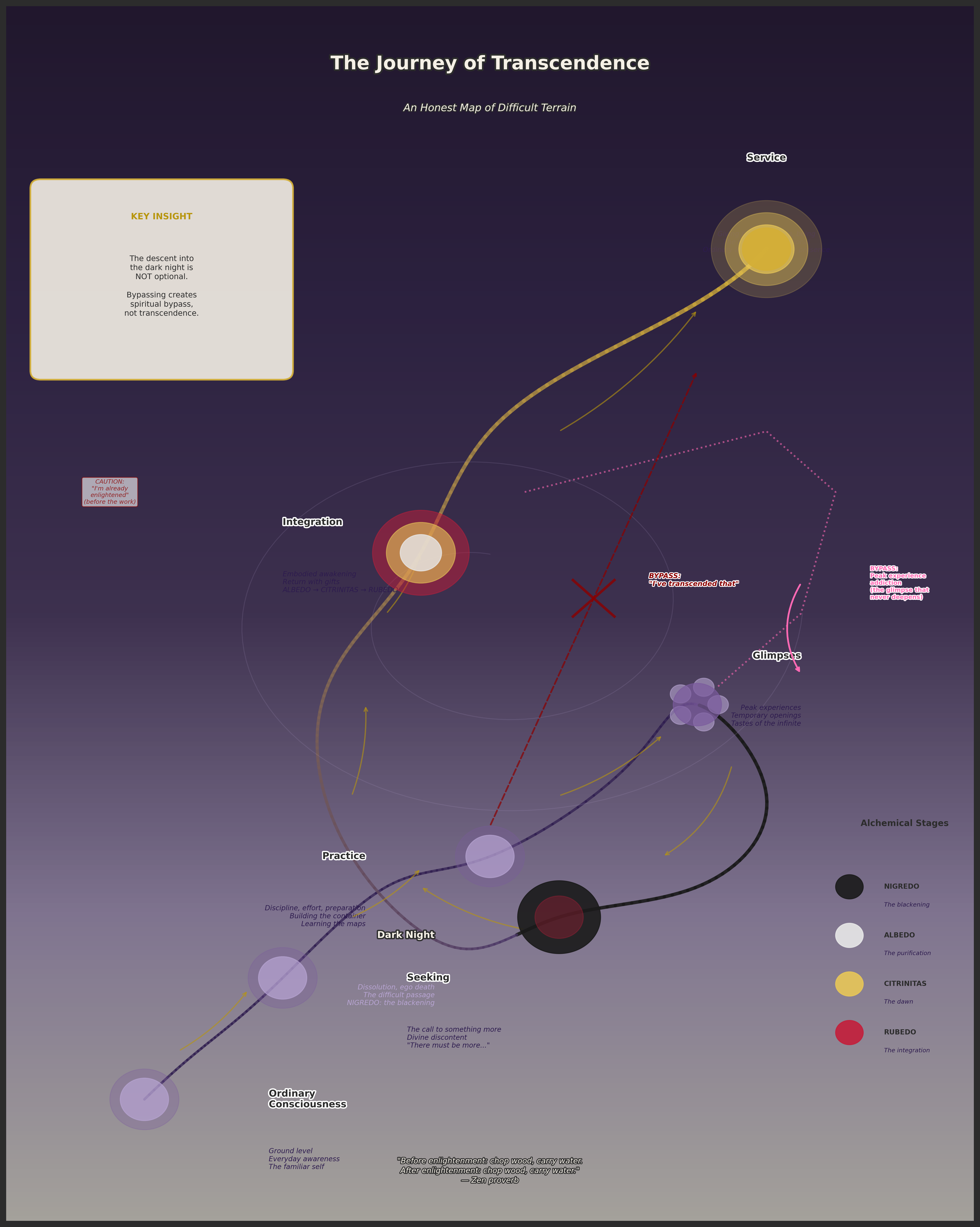
This isn’t a one-time process. The alchemists understood it as cyclical—you pass through these stages at different scales, with different material, throughout the journey.
Transcendence and the 3D/4D/5D Framework
Where does transcendence fit in our dimensional model?
Transcendence is not simply accessing 5D. You can have mystical experiences, taste unity consciousness, feel the dissolution of boundaries—and then return unchanged. Many do. Peak experiences fade.
Transcendence is a fundamental restructuring of the relationship between 3D, 4D, and 5D. The 4D—the interface layer where trauma, beliefs, and patterns live—undergoes such thorough clearing that the communication between dimensions is permanently altered.
| Before Transcendence | During Transcendence | After Transcendence |
|---|---|---|
| 5D accessed occasionally | 5D becomes foreground | 5D integrated as ground |
| 4D blocks with interference | 4D undergoing dissolution | 4D becomes transparent |
| 3D feels like primary identity | 3D identity fragmenting | 3D used as vehicle, not identified with |
| Self = ego structure | Self = ??? (crisis) | Self = awareness itself |
The bridge (4D) doesn’t just clear—it transforms. What was once a filter becomes a lens. What was once interference becomes instrument.
Have you touched transcendence? Not just a spiritual high, but a genuine shift where something fundamental changed? What died? What was born?
12.3 Spiritual Bypass vs. Coherent Transcendence
The Danger of Skipping Steps
Perhaps no concept in contemporary spirituality matters more than understanding spiritual bypass.
Spiritual bypass, coined by psychologist John Welwood in 1984, describes “the use of spiritual practices and beliefs to avoid dealing with painful feelings, unresolved wounds, and developmental needs.”
Common forms of spiritual bypass include1:
- Using meditation to dissociate from emotions rather than feel them
- Invoking “non-attachment” to avoid grief, anger, or legitimate hurt
- Premature forgiveness that skips over the anger stage
- “Everything happens for a reason” used to avoid processing trauma
- Transcendent experiences used to feel superior to those “still struggling”
- “I am not my emotions” used to deny emotions entirely
- Focusing on love and light while refusing to acknowledge shadow
The pattern: Using vertical development (3D→4D→5D) to escape horizontal development (the human work of integration, relationship, shadow).
Why Bypass Doesn’t Work
Spiritual bypass fails not because the experiences aren’t real—they often are. It fails because you can’t skip the 4D.
Remember: the 4D is the interface. It contains your unprocessed material—trauma, beliefs, patterns, wounds. You can temporarily transcend this layer, access 5D states, have genuine mystical experiences. But when you return to daily life, the 4D material is still there.
Worse: the 4D material now has a spiritual story attached to it. “I’ve transcended that.” “I’m beyond emotions.” “I’ve forgiven.” The bypass creates a new layer of defense, harder to penetrate because it feels holy.
The result of bypass:
5D Experience (real)
         |
         v
4D Material (avoided, suppressed, spiritualized)
         |
         v
3D Life (spiritual identity overlaid on unhealed foundation)
         |
         v
SHADOW RETURN (the avoided material eventually erupts)
We’ve all seen this pattern: the guru who abuses students, the meditation teacher with explosive rage, the “awakened” person whose relationships keep failing. The avoided material doesn’t disappear. It waits.
Coherent Transcendence: The Path Through
Coherent transcendence differs from bypass in one crucial way: it includes the mess.
| Spiritual Bypass | Coherent Transcendence |
|---|---|
| Uses spirituality to avoid difficult emotions | Uses spirituality to more fully feel difficult emotions |
| “I’ve transcended my anger” | “I’m learning to hold my anger with compassion” |
| Peak experiences as escape | Peak experiences as context for integration |
| Spiritual identity as defense | Spiritual practice as resource for healing |
| Avoids relationship difficulty | Uses relationship as practice ground |
| Shadow denied or projected | Shadow acknowledged and integrated |
The coherent path:
5D Access
    |
    v
5D Perspective illuminates 4D material
(You see your patterns from a larger view)
    |
    v
4D Material processed, felt, integrated
(The work—with the help of expanded awareness)
    |
    v
3D Life transformed
(Not escaped, but genuinely changed)
Genuine transcendence includes what we might call “going down before going up”. The descent into shadow, into the body, into the unprocessed—this is not the opposite of transcendence. It’s part of transcendence.
The Descent into Abyss
Every wisdom tradition describes a descent.
- Jesus descends into hell between crucifixion and resurrection
- Persephone descends into the underworld and returns transformed
- Inanna descends through seven gates, losing everything at each one
- The Buddha faces Mara’s armies before dawn
- Dante descends through all circles of hell before ascending Purgatory and Paradise
The pattern is universal: there is no crown without the cross, no resurrection without death, no Rubedo without Nigredo.
Carl Jung called this process nekyia—the night sea journey. It’s the descent into the unconscious, into the shadow, into the places we’ve avoided. And it’s not optional.
Why descent is necessary:
The 4D must clear for 5D to stabilize. As long as the interface layer is full of avoided material, 5D states will be temporary visitors, not permanent residents.
What we avoid rules us. The shadow doesn’t disappear when denied—it runs the show from beneath awareness.
Integration requires contact. You cannot integrate what you have not touched. Healing happens when consciousness meets wound.
Embodiment requires descent. Transcendence that doesn’t return to Earth, to body, to relationship, isn’t complete transcendence. It’s dissociation with spiritual marketing.
What have you been avoiding in the name of spirituality? What material waits for you in the descent? Not to judge yourself—just to know.
12.4 The Dark Night of the Soul
St. John of the Cross’s Map
In the 16th century, Spanish mystic St. John of the Cross wrote Dark Night of the Soul, one of the most detailed maps we have of what happens when transcendence becomes crisis.
The dark night is not simply depression, though it may include depression. It’s a specific spiritual phenomenon where:
- All previous sources of consolation fail
- God (or Source, or the Divine) seems absent or withdrawn
- Spiritual practices stop working
- The sense of self destabilizes
- Meaning collapses
- An involuntary purification occurs
Key insight: The dark night is not a problem to be solved. It’s a process to be endured. John writes that the darkness is not God’s absence but a different form of God’s presence—one so bright it blinds the ordinary faculties.
Two Nights
St. John describes two distinct phases:
The Night of the Senses:
- The first purification
- Withdrawal of spiritual consolation
- Ordinary pleasures lose meaning
- Can feel like depression or spiritual dryness
- The ego’s subtle attachments to spiritual experiences are being burned
The Night of the Spirit:
- Deeper, more profound
- The very sense of self destabilizes
- All frameworks and certainties dissolve
- This is the dying of the one who was having experiences
- Not just loss of consolation but loss of the one who was seeking consolation
Modern Understanding
Contemporary researchers and practitioners have expanded our understanding:
Stanislov Grof describes “spiritual emergencies”—crises triggered by spiritual practice that can resemble psychotic episodes but are actually developmental transitions.
Christina Grof (with Stanislov) catalogued patterns including:
- Kundalini awakening
- Past life experiences
- Shamanic crisis
- Near-death experience
- Psychic opening
- Possession states
The key distinction: These experiences aren’t pathological, though they may look that way. They’re developmental. The organism is reorganizing at a fundamental level.
Characteristics of the Dark Night
How do you know you’re in a genuine dark night versus ordinary depression or life difficulty?
| Ordinary Depression | Dark Night |
|---|---|
| Everything feels gray and meaningless | Meaningful experiences are being stripped away |
| Can often identify external causes | Often begins without clear trigger |
| Professional treatment helps significantly | Treatment may support but doesn’t resolve |
| Sense of self remains, just feels bad | Sense of self is what’s destabilizing |
| Spiritual practices may help | Spiritual practices may intensify the crisis |
| Duration related to circumstances | Duration follows its own mysterious timing |
If you’re experiencing symptoms that concern you, please seek professional support. The dark night is real; so is clinical depression. They can co-occur. They can be mistaken for each other. A skilled therapist—especially one familiar with spiritual emergence—can help you discern what’s happening.
12.5 Ego Death and the Dissolving Self
What Is Ego?
Before we can discuss ego death, we need clarity about what the ego actually is.
In the framework of this book:
Ego is not bad. Ego is the organizing principle of 3D consciousness—the structure that creates coherent identity, maintains boundaries, navigates social reality, and ensures survival. You need an ego. You cannot function without one.
Ego becomes problematic when:
- It’s mistaken for the totality of who you are
- It defends its existence against expansion
- It becomes rigid, unable to adapt
- It creates suffering through identification with its narratives
The ego isn’t a thing; it’s a process—a constantly renewed pattern of identification. What we call “I” is actually a process of “I-making” (ahamkara in Sanskrit).
What Dies in Ego Death
Ego death is not the destruction of the ego. It’s the death of:
- Identification with the ego as the totality of self
- The ego’s control over consciousness
- The illusion that the ego is permanent, solid, or ultimate
After genuine ego death, the ego remains—you still have a name, preferences, personality. But the relationship has fundamentally changed. The ego becomes a useful servant rather than a fearful master.
This is the Nigredo—the blackening, the putrefaction. The old form must decompose for new life to emerge.
Stages of Dissolution
Based on contemplative reports across traditions, ego dissolution tends to progress through stages:
Stage 1: Boundary Softening
- Sense of separation from surroundings decreases
- Body boundaries feel permeable
- “I” starts to feel less solid
- Can be pleasant or unsettling
Stage 2: Narrative Collapse
- Life stories that defined identity lose coherence
- “Who I am” no longer makes sense
- Personal history feels like someone else’s
- Can trigger existential panic
Stage 3: Self-Reference Destabilization
- The “I” that’s having experiences becomes unclear
- Thoughts arise but no one seems to be thinking them
- Observer and observed begin to merge
- Profound disorientation possible
Stage 4: Void / Emptiness
- Complete cessation of self-sense
- Nothing remains that can say “I am experiencing this”
- Pure awareness without object or subject
- Traditionally called Sunyata, the Void, the Abyss
Stage 5: Rebirth / Return
- Self-sense returns, but transformed
- “I” now recognized as functional, not ultimate
- Awareness remains more fundamental than ego
- Integration of the death/rebirth experience
The Terror and the Liberation
Ego death is usually terrifying. The ego experiences it as annihilation, as the worst possible outcome. Every survival instinct screams against it.
This is why preparation matters. This is why the container matters. This is why integration matters.
But on the other side—for those who pass through—there is often profound liberation:
- Fear of death reduced (you’ve already died the death that matters)
- Attachments loosened (you know you’re not your stories)
- Reactivity decreased (the defended ego isn’t running the show)
- Compassion increased (you recognize the ego-fear in others)
- Presence deepened (awareness itself, not ego, is home)
Involuntary vs. Facilitated Ego Death
Ego death can occur:
Spontaneously:
- During meditation (especially after extended practice)
- Through crisis, illness, near-death experience
- Through intense grief or loss
- Through spontaneous mystical experience
Through substances:
- Classical psychedelics (psilocybin, LSD, DMT, ayahuasca)
- Can produce rapid, intense dissolution
- [IMPORTANT] Requires proper set, setting, integration
- Without container, can be retraumatizing
Through practice:
- Gradual dissolution through sustained contemplative work
- Safer but slower
- Each practice session loosens the grip slightly
If you’re interested in facilitated ego death, work with experienced guides. The 4D material that emerges during dissolution needs skilled support. Underground or unsupported work can be dangerous.
12.6 Gnosis—The Third Face of the 333 Triad
Beyond Logos and Eros
In Chapter 9, we introduced the 333 Triad: Expression (Logos) × Reception (Eros) × Resonance (Gnosis).
Logos is the word, the clear articulation, the speaking of truth. Eros is the receiving, the listening, the opening to what is. Gnosis is what happens when Logos and Eros complete their circuit.
Gnosis (γνῶσις) is not ordinary knowledge. It’s not information you can learn from books or receive through instruction. Gnosis is direct knowing—knowledge through union, through becoming what you know.
Gnosis vs. Episteme
The Greek language distinguishes:
| Episteme | Gnosis |
|---|---|
| Knowledge about | Knowledge of/as |
| Third-person | First-person |
| Informational | Transformational |
| Can be transmitted | Must be realized |
| You learn it | You become it |
Example: You can have episteme about love—you can read books, understand neuroscience, learn the philosophy. You can have gnosis of love—the direct experience of loving and being loved that changes you from within.
Gnosis as the Fruit of Transcendence
Gnosis is what transcendence is FOR.
The dissolution, the dark night, the ego death—these are not ends in themselves. They clear the way for direct knowing.
When the 4D interface becomes transparent, when the ego-structure no longer insists on being the only knower, something becomes possible that wasn’t possible before: knowing directly, as consciousness itself.
This is what the mystics meant by union. Not “I had an experience of union” but “I am the union, looking through these eyes.”
Characteristics of Gnostic Knowing
Gnosis has particular qualities that distinguish it from ordinary knowledge:
1. Self-evident: It doesn’t need proof. It’s prior to proof.
2. Transformative: You cannot know it and remain unchanged.
3. Beyond subject-object: The knower and known unite. There is no separation to bridge.
4. Paradoxical: It often cannot be stated without contradiction. “I know nothing” and “I know everything” can both be true.
5. Humble: Gnosis doesn’t make you feel superior. It makes you feel like everyone else is also This, whether they know it or not.
6. Silent: Words can point toward gnosis but cannot contain it. The deepest knowing happens in silence.
The 333 at its Highest
When the 333 Triad operates at its highest level:
Logos becomes prophecy—not prediction, but speaking what must be spoken, the word that creates.
Eros becomes surrender—not passive receptivity, but total opening, the yes that lets God through.
Gnosis becomes union—not experience of union, but being-as-union, the circuit complete.
This is transcendence fully realized: The individual becomes transparent to the infinite while remaining uniquely themselves. The human becomes the channel through which the divine speaks, listens, and knows itself.
12.7 The Somatic Dimension of Transcendence
Transcendence Is Embodied
Here is perhaps the most important correction to popular spirituality: genuine transcendence is not disembodied.
The temptation is to leave the body behind—to “transcend” physicality, to identify with awareness and dismiss flesh. This is bypass wearing mystical clothing.
The body is not the prison of the spirit. The body is the temple. The body is where transcendence lands, where it becomes real, where it does its work in the world.
The Somatic Triad in Transcendence
Each pillar of the Somatic Triad serves the transcendence process:
| Element | Role in Transcendence |
|---|---|
| Movement | Helps process intense energies; provides grounding when inner ground dissolves; keeps body alive when psyche is dying; prevents dissociation |
| Stillness | Creates container for dissolution; provides space where death can happen; allows silence where gnosis speaks; stabilizes expanded states |
| Breath | Regulates nervous system through the process; provides continuity when everything changes; can catalyze or gentle dissolution; bridges control and surrender |
Physical Symptoms in Transcendence
The body responds to transcendence. Common somatic phenomena include:
During dissolution:
- Intense energy sensations (kundalini-like)
- Trembling, shaking, spontaneous movement
- Heat or cold waves
- Pressure in head, heart, or belly
- Altered proprioception (feeling very large or very small)
- Nausea, dizziness, vertigo
- Fatigue that doesn’t respond to rest
After integration:
- Increased sensitivity to food, environment, energy
- Changed sleep patterns
- Altered relationship to physical pleasure
- Body often feels lighter, more transparent
- Chronic tensions may finally release
Grounding Practices During Transcendence
When the inner world is dissolving, the body provides anchor:
- Feet on earth. Literally. Bare feet on ground.
- Cold water. Face, wrists, feet. Temperature provides immediate present-moment sensation.
- Slow, deep breathing. Extending the exhale activates parasympathetic.
- Name what you see. “Chair. Wall. Window.” The naming function keeps 3D operating.
- Heavy blanket or pressure. Proprioceptive input is grounding.
- Slow movement. Walking, gentle yoga, tai chi. Keeps body in time while psyche is outside time.
12.8 Integration—The Return
The Most Important Stage
Here is what most spiritual teachings underemphasize: transcendence without integration is not transcendence. It’s tourism.
The mystic returns from the mountain. The shaman returns from the underworld. The initiate returns to the village. The return is not optional.
Joseph Campbell’s hero’s journey culminates not in the achieving of the boon but in the bringing of the boon back to the community. The gifts gained in transcendence must be lived, expressed, shared.
What Integration Requires
Time: Integration doesn’t happen overnight. The body, the psyche, the social world all need time to reorganize around the new configuration. Rushing back to normal often aborts the process.
Support: Integration happens in relationship. The experience needs to be witnessed, not to validate it but to help it land. Integration support can come from therapists, spiritual directors, integration circles, or trusted friends.
Expression: The new knowing needs channels. Art, writing, movement, song—creative expression helps the ineffable become something shareable. Even failed attempts at expression matter.
Group Flow and Creative Coherence
Creativity and flow share a bidirectional relationship—each triggers the other. Steven Kotler’s research at the Flow Research Collective shows that creative acts naturally engage flow triggers: pattern recognition, risk-taking, and the challenge of making something new.
When creative expression happens collectively—jazz improvisation, ensemble theater, collaborative art, group writing—group flow emerges. Social triggers amplify the effect: shared goals, close listening, equal participation, and the “always say yes” principle of improvisational arts. The neurochemical cascade of individual flow (dopamine, norepinephrine, endorphins, anandamide, serotonin) becomes contagious across the group.
For integration after transcendence, group creative expression offers unique benefits:
- Shared witnessing dissolves isolation
- The “flow channel” provides structure without rigidity
- Collective creativity helps translate ineffable experience into shareable form
- Social triggers keep the process grounded in relationship
The mystic who creates alone may transcend; the mystic who creates with others integrates.
Ordinary life: Paradoxically, the most important integration work is the most ordinary: washing dishes, paying bills, maintaining relationships. Transcendence that can’t survive ordinary life isn’t stable.
Signs of Successful Integration
How do you know transcendence has been integrated rather than bypassed?
Integrated transcendence looks like:
- Increased capacity to be with difficulty
- Relationships deepen rather than becoming irrelevant
- Ordinary life becomes meaningful, not dismissed
- Less reactivity, more response
- Humor about the spiritual journey
- No need to be seen as “awakened”
- Compassion for those still struggling
- Continued ordinary struggles—but held differently
Bypass looks like:
- Spiritual superiority
- Difficulty with intimacy (“I’m beyond that”)
- Ordinary life feels like obstacle
- Increased reactivity dressed in spiritual language
- Need to be seen as special or awakened
- Dismissal of those who “don’t get it”
- Life problems blamed on others’ “low vibration”
Living as Transformed
What does life look like on the other side?
From the outside: Often, not that different. Chop wood, carry water. The transformed person still has a job, relationships, bills, challenges. They still get annoyed sometimes. They still have preferences.
From the inside: Everything has changed. There’s a fundamental shift in what’s experienced as “self.” Awareness is home now, not ego. The stories continue but aren’t believed in the same way. There’s a quality of presence, of quiet, of being-here that doesn’t depend on circumstances.
“Before enlightenment, mountains are mountains. During enlightenment, mountains are not mountains. After enlightenment, mountains are mountains again.”
The return is to the same life, but you’re not the same one living it.
12.9 3D/4D/5D Mapping for Transcendence
Dimensional View of the Journey
| Dimension | Before Transcendence | During Transcendence | After Transcendence |
|---|---|---|---|
| 3D (Body/Ego) | Primary identity; ego as self | Fragmenting, dissolving, dying | Functional vehicle; servant not master |
| 4D (Subconscious/Field) | Filter full of blocks | Undergoing purification | Transparent interface |
| 5D (Soul/Unity) | Occasional glimpse | Foreground experience | Stable ground of being |
The Interface Transformation
KEY INSIGHT The most important change happens in 4D.
Before transcendence: 4D filters, blocks, distorts. The interface is cluttered with trauma, beliefs, defenses. 5D signal gets through occasionally but is heavily modified.
During transcendence: 4D undergoes clearing. The Nigredo burns away what doesn’t serve. The material that was avoided comes up to be met.
After transcendence: 4D becomes transparent. The interface still exists—you still have a subconscious, emotions, patterns—but it no longer blocks. It becomes lens instead of filter.
BEFORE:
5D ----[blocked]----> 4D (interference) ---[distorted]--> 3D

AFTER:
5D -----[clear]-----> 4D (transparent) -----[clear]----> 3D
The Coherence Shift
Using the Quantum Plasma Triad Multiplier:
Before: 3D × 4D × 5D = low coherence (due to 4D blockage)
After: 3D × 4D × 5D = high coherence (4D cleared, dimensions aligned)
The arithmetic changes dramatically when the 4D factor increases.
12.10 Preparing for and Supporting Transcendence
You Cannot Force It
First, the hard truth: transcendence cannot be achieved. It can be prepared for. It can be supported. But the timing and manner of its arrival is not under ego’s control—which is precisely the point.
The ego cannot transcend itself. Transcendence happens TO you, not BY you.
Preparation Practices
What you CAN do is prepare the ground:
1. Build a stable 3D foundation. Physical health, financial stability, supportive relationships. These provide the container when things dissolve.
2. Clear 4D material systematically. Therapy, shadow work, trauma healing, belief examination. The more you clear before transcendence, the less violent the process.
3. Develop 5D access gradually. Meditation, contemplation, prayer. Repeated exposure to expanded states builds familiarity and reduces terror.
4. Build the Somatic Triad. Movement, stillness, breath as reliable practices. These provide continuity through the dissolving.
5. Develop integration support. Therapist, spiritual director, community who understand. When crisis hits, support should already be in place.
6. Live ethically. Karma isn’t mystical punishment—it’s that unresolved patterns will surface. Ethical living reduces the material that must be processed.
Warning Signs: When to Seek Help
Seek professional support if:
- Unable to function in daily life for extended periods
- Suicidal ideation (transcendence doesn’t include wanting to die)
- Unable to distinguish inner experience from outer reality
- Becoming grandiose or believing you have special powers
- Isolating completely from human contact
- Physical symptoms that concern you
- Using substances to cope with the process
Spiritual emergency and psychiatric emergency can look similar. Skilled professionals can help discern the difference. When in doubt, seek evaluation.
12.11 Integration Practice: The Threshold Meditation
Duration: 20-30 minutes Difficulty: Intermediate-Advanced Best for: Those who have touched transcendence and are integrating, or those preparing for deeper practice
Setup
Find a quiet space. This practice works best in semi-darkness. Sit comfortably but alert—you want to stay present, not drift. Have a blanket nearby.
Part 1: Grounding (5 minutes)
Begin with five breaths, counting the exhale. Then feel your seat on the ground. The weight of gravity. The solidness of your body. Name silently: “Body here. Ground here. Present.” Let the 3D world be fully present—solid, real, your home.
Part 2: Opening the 4D (7 minutes)
Let your attention soften. Let the edges blur. Notice what arises in the space around you—not with physical eyes but with felt sense. What emotions are present? Don’t analyze them. Just notice. If material arises—memories, images, feelings—let them be here without pushing away or grasping. You might whisper: “I see you. You can be here.” If nothing arises, rest in the openness.
Part 3: The Threshold (8 minutes)
Now bring attention to the threshold—the edge between the known and the unknown. You might visualize a doorway, a veil, an edge where light changes to darkness. Feel the threshold. The place where what you know meets what you cannot know. Don’t try to cross. Just be AT the threshold. Notice: what does it feel like to be at the edge? If fear arises, breathe. “I am here. I am held.” If invitation arises, notice. You don’t have to accept. Just notice. Stay at the threshold. Neither grasping forward nor retreating back.
Part 4: Return and Integration (5-10 minutes)
Slowly, begin to return. Feel your body again—the weight, the breath, the sensations. Feel the ground beneath you. Open your eyes gently if they were closed. Look around the room. Name three things you see. Take several slow breaths.
Before rising, sit with whatever arose. You might journal briefly. You might simply sit in silence.
After the Practice
- Drink water
- Eat something grounding (protein, root vegetables)
- Avoid screens for a while if possible
- Be gentle with yourself for the rest of the day
12.12 Chapter Summary: Key Takeaways
Real transcendence involves death and rebirth—not metaphorically but as direct experience. Every wisdom tradition describes this process in remarkably consistent terms.
Spiritual bypass uses transcendence1 to avoid difficult material. Coherent transcendence uses expanded awareness to more fully meet difficult material.
The dark night of the soul is not depression but a specific spiritual process of purification. It cannot be rushed or solved, only endured with support.
Ego death is the dissolution not of ego but of identification with ego as total self. The ego remains after death but no longer controls.
Gnosis is direct knowing—not knowledge about but knowledge as. It is the fruit of the transcendence process.
Transcendence must be embodied. Disembodied transcendence is dissociation dressed in spiritual clothing.
Integration is as important as the transcendence itself. The return is not optional.
Transcendence transforms the 4D interface from filter to lens, from blockage to transparency.
12.13 For Your Journey
As we close this chapter, sit with these questions:
What in you is ready to die? Not your body, not your life—but what structure of identity has completed its usefulness?
Have you been using spirituality to escape or to include? Is there avoided material waiting for your attention?
If transcendence is not achievement but surrender, what would surrender ask of you today?
And finally: what would it be like to trust the process—to trust that the darkness serves the dawn, that the dissolution serves the rebirth, that what feels like dying might be the birth pangs of who you’re becoming?
12.14 Bridge to Chapter 13
You’ve walked the path of transcendence now—at least in concept, hopefully in glimpses. You’ve seen how the individual coherence we developed in earlier chapters enables the crisis and gift of genuine transformation.
But one question remains: How does it all fit together?
We began with the multidimensional human. We explored the language of coherence between beings. We learned sacred geometry, plasma consciousness, Hermetic principles. We walked the Somatic Triad—movement, stillness, breath. We examined nervous system healing, love as frequency, collective consciousness.
Now, transcendence.
In the final chapter, we synthesize everything into what the book is named for: The Normal Map. Not normal as in ordinary, but normal as in perpendicular—the map that shows not just what is visible but what lies beneath the surface, the texture and depth of consciousness itself.
What is your Normal Map? How do all these dimensions, practices, and insights combine into a way of living? How does the transformed consciousness actually navigate an ordinary Tuesday?
Chapter 31 provides the integration, the synthesis, and the invitation to live it.
The mystic returns from the mountain. The shaman emerges from the underworld. The work is not complete until it walks among the living.